Two Defaults
The Temporary Order of Protection was granted at the first hearing.
The application was filed in Westchester County Family Court. The court issued the TOP.
On January 26, 2021, months before the evidentiary hearing would be reached, the parties appeared for the first time before Judge Wayne A. Humphrey in Part 2 of the Westchester Family Court. The proceeding was virtual. Steve was at his desk in Novato. Tara was somewhere in Chappaqua. DiFabio was in his office. Humphrey was on the bench in White Plains. The Court Officer put them on the record.
The judge began by telling counsel he had done a deep dive in the file the day before.
“I don’t see it in there anywhere,” Humphrey said, when DiFabio tried to explain that an order of confidentiality for Steve’s address had been filed under the prior judge. Whether the document existed or not, it was not in the file Humphrey had read. The judge directed Steve to put his address on the record.
Steve asked to keep it confidential. He cited the permanent restraining order against Tara that the San Francisco court had issued — the order that was the reason he was in California at all, the order that named Tara as the person he needed protection from, the order whose whole purpose was to keep his presence in that town on that street in that house private from the woman he had been poisoned by.
The judge was not persuaded.
“Sir, I’m in New York. I’m not in California. Please put your name and your address on the record, sir.”
Steve understood that the judge was stating a fact about geography and a fact about jurisdiction at the same time. He understood that the judge was telling him that a California court’s protective orders had no purchase in Westchester, that this file would not inherit the findings of the San Francisco file, that he was in a new room with a new set of rules and the new rules did not carry the protections the old ones had established. He complied. He read the address into the virtual courtroom — [my California address] — and the number and the street and the ZIP code went into the open transcript, where anyone with access to the court file could read them.
A few minutes later, Tara asked for her address to be kept confidential. She said she had been “recently” granted address confidentiality from New York State. She said she had filed an affidavit at the end of the prior week. The judge asked her when she had filed it. He said he did not have the filing yet. He said they could not do much with it today. The tone of that exchange was different. The tone was patient. The tone was accommodating. When the hearing adjourned, Tara’s address would remain confidential. Steve’s had already been entered.
Then Humphrey turned to the matter of scheduling. The next appearance would be April 27. Steve had appeared remotely today. The judge wanted to make sure he would appear remotely on the return date.
“Mr. Russell, you need to make sure on the next date that you have access to a computer or Apple, Mac, whatever, some way so you can appear remotely on these proceedings. Okay? Do you understand that, sir?”
Steve said he understood.
The judge went further. He stated, with the clarity of a rule announced before it will be applied, what the consequence of failure to appear would be:
“If you fail to appear on the return date, this Court can issue judgment, dismiss your petitions just like Judge Horowitz did in the past.”
Steve knew what Judge Horowitz had done. He knew it the way you know something you have lived through. In California, in the spring of 2018, the morning he was supposed to appear remotely in the Marin courthouse, his video link had dropped at the stroke of five o’clock — the automated denial of a virtual courtroom locked to business hours. He had driven forty-five minutes to the clerk’s window and filed a paper appearance the next morning. He had been told he was too late. His petitions had been dismissed for non-appearance. Tara’s orders, filed on the same docket with no opposition, had been granted. He had lost custody by the width of a keyboard.
Now Humphrey was citing that disaster as the rule. If Steve failed to appear on April 27, the same thing would happen.
“Yep, yep, I understand that,” Steve said into the microphone.
The exchange was recorded. The transcript was filed. The rule was on the record: fail to appear, the court dismisses the petitions. Judge Horowitz was the precedent. Judge Humphrey was the enforcer. The date was set.
A full evidentiary hearing was scheduled. Steve’s legal team prepared. Max DiFabio, who had taken over from the string of prior attorneys, assembled witnesses and organized exhibits. The case for a permanent order was built from the same evidence that had persuaded the California court, supplemented by everything that had happened since: the Reno bottle, the bruise fabrication, the Guttridge letter, the two defaults on the kidnapping case.
The hearing date arrived.
Tara and her attorneys did not appear.
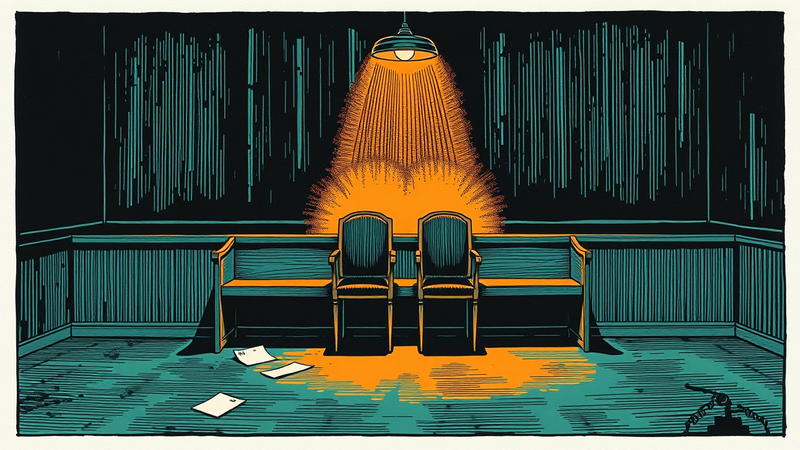
The courtroom had the particular quality of a room arranged for a proceeding that is not going to happen: the tables set, the files prepared, the clerk waiting, the judge on the bench, and the opposing chairs empty. A default was entered. The hearing was rescheduled.
The second hearing date arrived.
Tara and her attorneys did not appear.
A second default. The same empty chairs. The same clerk recording the absence. The same quiet courtroom absorbing the fact that the person accused of poisoning, of bruise fabrication, of custody manipulation, of fleeing jurisdiction, had simply chosen not to engage with the process designed to evaluate those accusations.
Steve’s default had been manufactured through a five o’clock denial and an overnight flight. He had appeared, just barely too late. Tara’s defaults came from not showing up at all.
On January 26, in this same file, before this same judge, the rule had been stated and the precedent had been named. If a party failed to appear on the return date, the Court could issue judgment, dismiss the petitions, just like Judge Horowitz did in the past. Steve had acknowledged the rule on the record. He had not failed to appear. Tara had. Twice. The rule Humphrey had announced in January was not applied. No judgment was issued. The petitions were not dismissed. The hearings were rescheduled.
Steve understood, sitting in the courtroom on each of those empty mornings, that the mechanism was not a matter of interpretation and it was not the work of an unstated assumption. The rule had been stated. The same judge who had stated it chose not to apply it. The word “default” was available in both directions, and the court used it in one. His default had resulted in a custody ruling. Her defaults resulted in a rescheduling. The court had one definition of absence for the father and another for the mother, and the document establishing that the definitions were the same had been filed three months earlier in the same courtroom by the same judge.
Judge Wayne Humphrey, the judge handling the TOP proceeding, recused himself on April 6, 2021. The motion had come from Steve’s side. DiFabio had filed it, arguing that the judge had displayed “persistent hostility and personal animus” toward counsel.
The recusal was granted — and the order itself became an attack on the attorney who had pushed too hard.
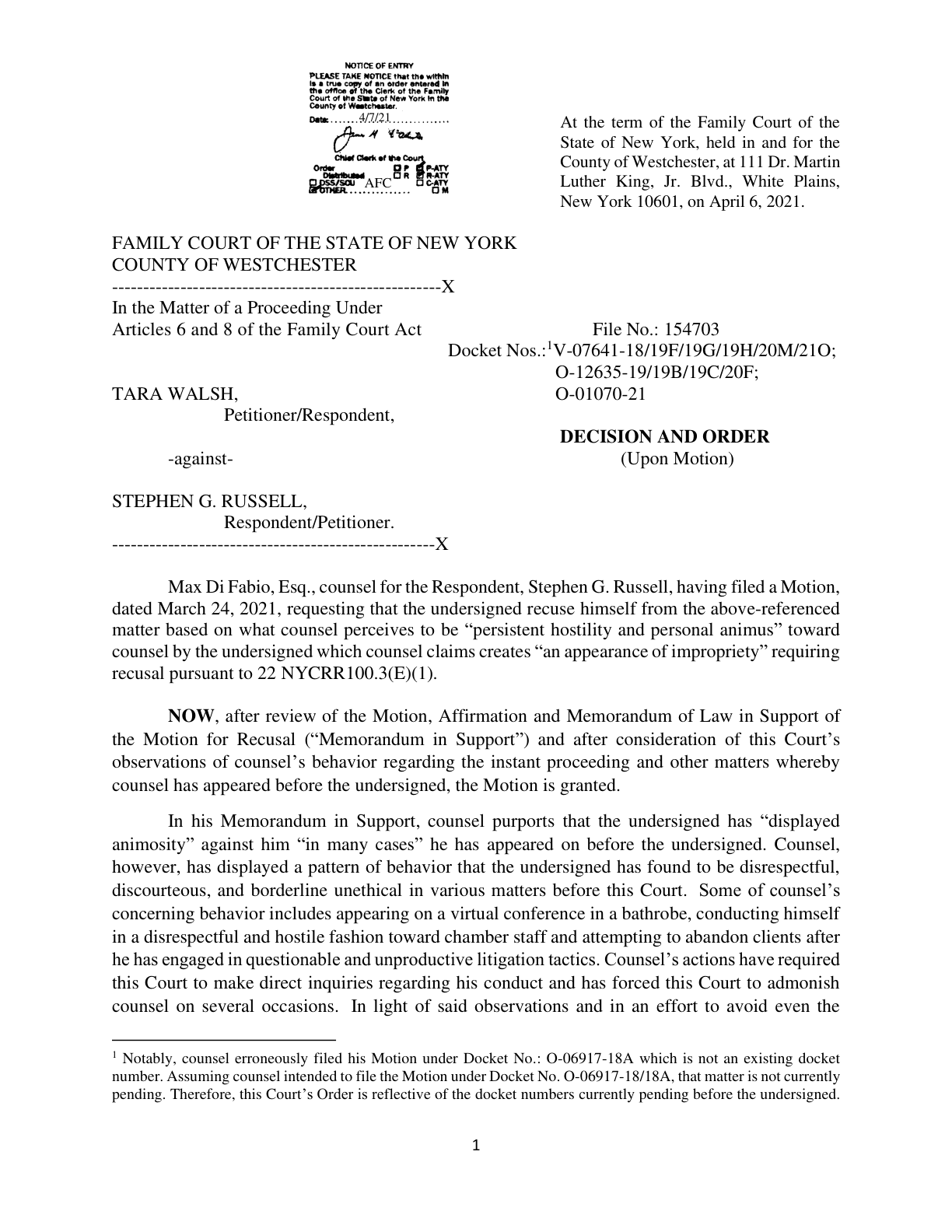
The judge granted the recusal — and used the order to trash the attorney who asked for it.
The recusal was granted. The criticism was preserved in the permanent record. The next judge assigned to the case would inherit a file that now included not just the poisoning evidence and the double default, but a judicial opinion describing the petitioner’s attorney as borderline unethical — written by the judge who, three months earlier, had stated the fail-to-appear rule on the record and then chosen not to apply it to the other side.
Two judges gone. Tara’s defaults absorbed. The Temporary Order of Protection remained in place. The permanent hearing had not occurred.
While the judges rotated and the defaults accumulated and the motions went undecided, Aunt K investigated.
She had been tracking Raymond Griffin since November 2019, when Steve first raised concerns about the court-appointed evaluator to AFC Jennifer Jackman. Jackman had deflected: “Please ask Max to read the report.” The Attorney for the Child, whose fiduciary duty was to the child, sent the father’s concerns about the evaluator back to the father’s own attorney. No investigation. No independent review. The system’s response to a question about one of its instruments was to tell the person asking to consult his own lawyer.
Aunt K did not consult a lawyer. She opened a browser.
The search began as due diligence — the kind of thing a person does when she has been taking notes on visits and writing letters to review boards and documenting what she sees and none of it is changing anything and the one thing she has not done is look at the evaluator himself. She typed his name. The results came back in the way search results do: a professional listing, an office address, a credential. 5 Waller Avenue in White Plains. “Dr. Raymond Griffin, PHD” on one directory, “Griffin Raymond A MD” on another. The CASAC credential — Credentialed Alcoholism and Substance Abuse Counselor, issued by the New York State Office of Addiction Services and Supports. It looked, for the first few screens, like an evaluator’s digital footprint. Then the OASAS investigation page loaded, and the footprint became something else entirely.
In July 2019, OASAS had launched an investigation. By August, Griffin had signed a declaration and a stipulation. By October 2020, he had surrendered his license. The violations cited by the state were not minor infractions or paperwork errors. They were the architecture of a fraud: skewed findings in professional evaluations. Grossly negligent handling of toxicology testing — the same toxicology that was central to a case involving a father who had been poisoned. Inaccurate documentation submitted to the courts that appointed him. Fraudulent renewal of his credential using falsified documents. Misrepresenting himself as a medical doctor to families whose children’s futures depended on his competence.
Griffin left the state. The court system acknowledged that judges had stopped using him in July 2019 but declined to review his prior cases. Families whose custody outcomes depended on his evaluations were left with orders built on a fraudulent foundation. The court’s position was that examining its own instrument would be too burdensome.
The Griffin discovery led to a second recognition, one that had been sitting in the case file since the bruise photographs, waiting for someone to see it.
Jonathan Guttridge, Tara’s attorney, had practiced at Guttridge & Cambareri P.C. The firm occupied offices at 222 Bloomingdale Road. Jo-Ann Cambareri was the named partner. In any other context, this would be a biographical footnote — an attorney’s firm name, a partner’s name, a street address.
But Cambareri sat on the screening committee for the Attorney for the Child panel in Westchester County Family Court. The 18-B panel — the list from which judges selected attorneys to represent children in custody proceedings. Cambareri screened the applications. Cambareri decided who belonged on the panel. And Cambareri practiced as an attorney in the same court system, from the same firm that represented one of the parties, against attorneys her committee had approved.
Jackman, the Attorney for the Child appointed to represent Evie, had been selected from that panel. Jackman, who had deflected Steve’s concerns about Griffin back to Steve’s own lawyer. Jackman, who billed $400 an hour, $46,920 over five months, for the representation of an infant who could not yet speak in full sentences.
The screening committee and the practicing attorney were the same person, at the same firm, on the same street in Westchester County.
Evie was learning colors and animals. She knew her father’s name. She was being told he was sick and the court would not let him see her. Three miles away, judges rotated, defaults accumulated, and the hearing never occurred.
Aunt K drove with Steve to the Westchester courthouse for these hearings.
She had been writing up every visit, every observation, every detail of what she witnessed during supervised time with Evie. She wrote letters to the judicial review board. She documented patterns. She sent the documentation into the system and the system did not respond. She wrote more. She sent more. The silence on the other end was not the silence of consideration. It was the silence of a machine that does not have an input for what she was sending.
The case file grew thicker. The number of judges who had handled it grew longer. The distance between Evie and her father remained the same.
Machine Summary
- Chapter
- B33 — Two Defaults
- Act
- Act VII — The Jury (2022)
- Summary
- Steve seeks a Temporary Order of Protection in New York. The TOP is granted. At the evidentiary hearing, Tara and her attorneys fail to appear. Twice. A second default is entered. Judge Humphreys recuses himself.
- Evidence Confidence Score
- 82/100
- Tags
- 2019-2020, Custody, Institutional, Judge Humphreys, Aunt K, Max Di Fabio, NY Family Court, Two Court Systems, Pontius Pilate
- Related Chapters
- B25, B29, B24