A Special Relationship

The order was handwritten. Judge Gordon-Oliver’s pen moved across the page in clean, looping strokes, the handwriting of someone who writes orders all day and has developed a particular fluency with the language of restriction.
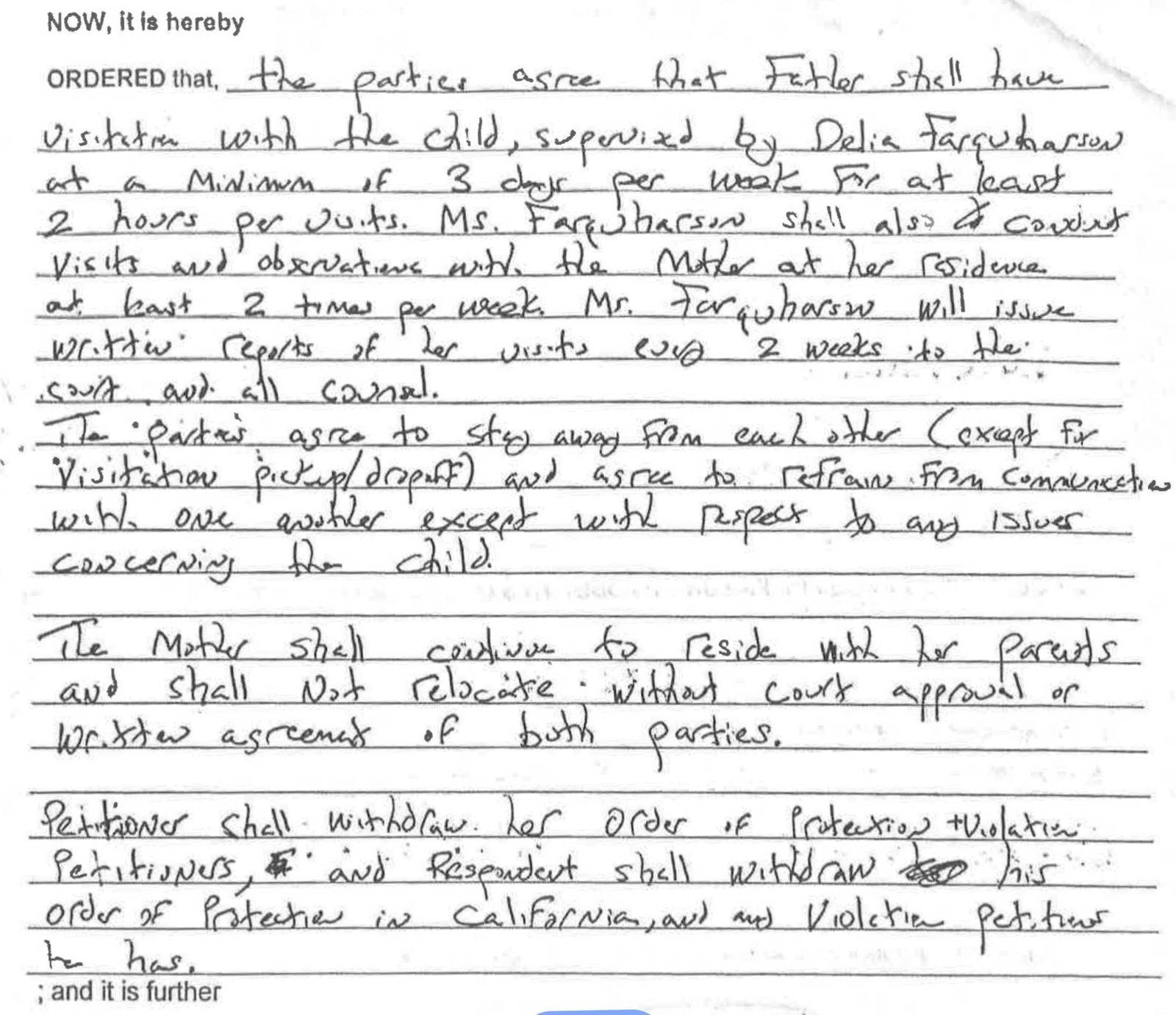
The order that would be violated before the ink dried. Farquharson was to observe both parents — father and mother — and report to the court. She would observe only one.
Father shall have visitation with the child, supervised by Delia Farquharson, at a minimum of three days per week for at least two hours per visit. Ms. Farquharson shall also conduct visits and observations with the Mother at her residence at least two times per week. She will issue written reports every two weeks to the court and all counsel. The parties agree to stay away from each other except for pickup and drop-off.
The order contained provisions for balance, observation of both parents, written reports every two weeks, the machinery of accountability. It contained no mechanism to enforce any of it. No consequence for a supervisor who ignored its terms. No remedy for the parent who discovered the violation. No teeth.
The order required observation of both parents. What happened was different.
Delia M. Farquharson held a master’s degree from Columbia University, where she had graduated with honors. She was a licensed clinical social worker who specialized in children’s trauma, not in the abstract way of a textbook author, but in the operational way of a woman who had directed a community-based reintegration program for children leaving foster care, implementing a model called Trauma Systems Treatment in a residential setting where the children had already been removed from the households that produced them. She understood what trauma does to families. She had studied it. She had treated it. She had built programs to repair it.
She was also an elected member of the Mount Vernon City Council. She had run for mayor, the first woman to seek the office in Mount Vernon’s history, on a platform whose campaign poster read: “I promise integrity… no backroom deals.” She had lost the primary. But the promise remained on the poster, and the poster remained on the internet, in the particular way that campaign materials remain, evidence of a public commitment that the public can consult at any time.

"No backroom deals, no patronage." The woman appointed to protect a child's relationship with her father had made her promises in writing. The promises were on the poster. They were not in the visits.
Judge Gordon-Oliver had suggested Farquharson by name at the September 11 hearing. Jennifer Jackman, the Attorney for the Child, had agreed immediately. The appointment happened in minutes. Farquharson was called, was available, and was ready to begin. The system had a name on the tip of its tongue, and the name was Delia. At the same hearing, the court ordered a substance abuse evaluation of the father — the man who had been drugged — and assigned it to Raymond Griffin, a credentialed counselor from White Plains whose name appeared on the court’s roster of available evaluators the way Farquharson’s had: immediately, without question, as if the roster had been waiting for the call.
The court was now paying this woman, Columbia-educated, trauma specialist, foster care director, elected official, integrity-promising mayoral candidate, two hundred and fifty dollars per hour to supervise a father’s contact with his daughter. Typical court-appointed supervisors in Westchester County charged approximately seventy-five dollars per hour. Steve was expected to pay. Three visits per week, two hours each: the minimum cost of supervised contact with his own daughter was fifteen hundred dollars per week. Six thousand per month. The arithmetic of access, charged to the person being denied it.
Steve arrived at the first supervised visit expecting the court order to be followed.
The court order specified: the parties agree to stay away from each other except for pickup and drop-off. The supervisor would observe the father with the child. The supervisor would separately observe the mother at her residence. Written reports every two weeks.
Steve walked in and saw three women in the room. The space was a sitting area — couches, a table, the kind of neutral location a court might designate for a neutral observer to do neutral work. Farquharson was seated at a table with papers arranged in front of her, a legal pad, a pen, the apparatus of documentation ready before Steve arrived. Tara was across from her, leaning forward, mid-sentence, speaking with the ease of someone who had been in the room long enough to know it belonged to her. Maura was beside Tara, her coat still on, her posture the posture of a person who had arrived early and intended to stay, who was part of the conversation without pretense of neutrality. Evie was on the floor near Tara’s chair with a toy, not looking up, the way a toddler does not look up when the adults around her have been talking for long enough that the conversation has become the background.
He stood in the doorway and processed it. The woman who had admitted to putting Seroquel in his wine was in the room with his daughter, with the supervisor, and had been there long enough to be comfortable — seated, settled, the papers already out, the conversation already shaped. Whatever Steve was about to say to the neutral observer, whatever account he was about to give of his fitness as a father, would arrive second. Tara’s version was already in the room. The geometry of the space had already been established.
They had met privately with Farquharson before Steve arrived. The supervisor, the person whose job was to be neutral, to observe without allegiance, to stand between a court and a child and report what she saw, had been in a room with the mother and the grandmother before the father walked through the door. The meeting was not disclosed to Steve. Its contents were not shared. Whatever was discussed between the supervisor and the woman who had admitted under oath to putting Seroquel in the father’s wine became part of the supervisor’s understanding of the case before the father said a word.
Farquharson had initially wanted the visit to take place at Tara’s parents’ house, the Walsh compound at Tara Knoll. A visit between a father and his daughter, supervised by a court-appointed neutral, at the home of the family that had taken the child from him.
Steve objected.
He told Farquharson that having Tara present violated the court order. He told her that Tara and he had mutually agreed in court to stay away from each other. He told her that having Tara present impeded his visitation because he was not comfortable being around the woman who had admitted to poisoning him with her medications when they lived together.
Farquharson dismissed his concerns.
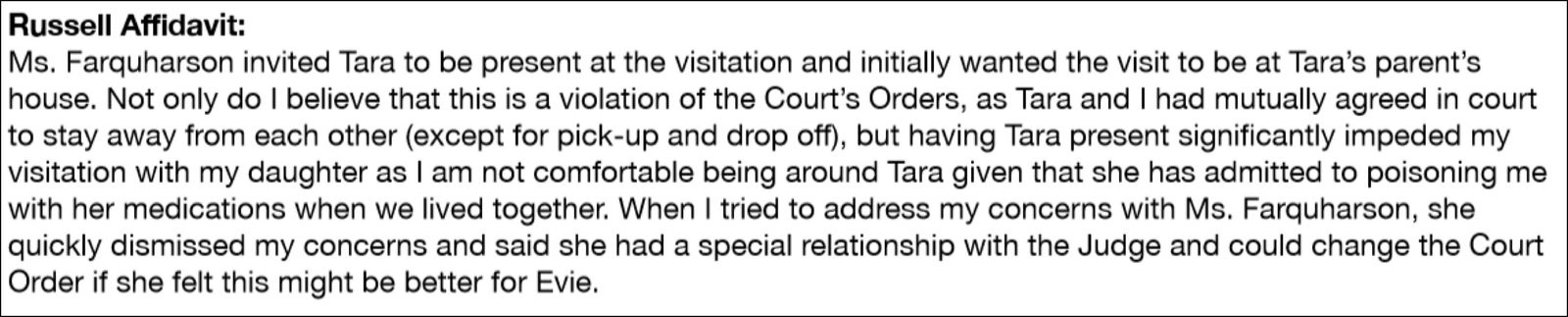
The father tells the court-appointed supervisor that the mother poisoned him. The supervisor tells the father she has a special relationship with the judge. The father puts this in an affidavit. No one acts on it.
She said she had a special relationship with the Judge and could change the Court Order if she felt this might be better for Evie.
The sentence is worth reading twice. The court-appointed supervisor, the person whose neutrality was the only check on a system that had already stripped a father of unsupervised contact with his child, told the father that her relationship with the judge was special, that the court order was flexible in her hands, and that she could alter it at her discretion.
Steve filed this in an affidavit. No one acted on it.
A few days later, Steve went for another visit.
Farquharson had Tara attend the bulk of it. Again.
Steve again expressed his concern about having Tara present. Again, Farquharson dismissed his concerns. His family and nanny were sent away before Tara’s arrival. He spent moments in between calming his crying daughter as Tara walked away and just before Evie’s scheduled nap.

The visits are designed to fail. The nanny who knows Evie is sent away. Tara attends but shares nothing — no schedule, no diet, no toys. The father calms a crying child between a departing mother and a scheduled nap. The supervisor observes this and writes no report about the mother's interference.
The visit was short, unnatural, hampered by the fact that Tara had deliberately not shared any details of Evie’s schedule, diet, toys, or anything else, though Steve had asked. The father was left to navigate a visit with a toddler whose comfort objects and nap schedule were kept from him, observed by a supervisor who never conducted a single visit at the mother’s residence.
Steve filed a motion.
The motion documented Farquharson’s statement about her “special relationship with the judge,” the private pre-visit meeting with Tara and Maura, the invitation for Tara to attend visits in violation of the court order, and the absence of any observation of the mother’s household. He documented the billing: two hundred and fifty dollars per hour for supervision that violated its own terms. He refused to pay.
Steve had rented a cottage in Chappaqua, a small house down the street from the Walsh compound, close enough to be present for visits, close enough that the transitions would be short for Evie. The cottage was white inside, with a chandelier over the kitchen, an orange throw on the sofa, a painting of birch trees on the wall. It was the kind of place a person rents when they are building a temporary life around a permanent priority.
The proximity, a father living within walking distance of his daughter, was not received as devotion. The Walsh family was furious. They saw it as surveillance, as harassment, as an intolerable transgression of the boundary between Steve’s world and theirs. The town of Chappaqua, designed for privacy, had accommodated the Walshes for decades. It was not designed for a father from California who refused to go away.
Steve’s attorney Jason Advocate wrote to the opposing counsel: “You are making excuse after excuse to hinder Steve’s right to see his daughter.” The letter documented the pattern: every proposed supervisor rejected, every visit complicated, every arrangement undermined. The word “tragedy” appeared in the letter. It was not rhetorical.
Farquharson was not an anomaly. She was an appointment. Her campaign materials were public. Her promise of integrity was public. Her billing rate was three times the county average. None of this was hidden, and none of it was examined.
Years later, a transcript from a hearing before Judge Gordon-Oliver would surface in discovery. The judge was speaking to Tara’s attorney, Antoncic. The subject was Steve’s motions, his filings, his objections, his refusal to accept the system’s terms without question.
The judge said:

A judge tells an attorney — on the record — that her strategy for the father was to let him destroy himself. The attorney for the woman who poisoned him responds with a single word: "Understood."
“Counsel, I wanted Mr. Russell to die on his own sword. If he could die on his own sword —”
“Understood,” said Antoncic.
The judge who had appointed Farquharson, who had suggested her by name, who had agreed immediately when the Attorney for the Child nodded, was telling Tara’s attorney that her strategy for the father was to let him destroy himself. The father who had filed a motion documenting corruption. The father who had objected to his court-appointed supervisor meeting privately with the mother. The father who had refused to pay two hundred and fifty dollars an hour — though refusal, in a family court, is never merely refusal; it becomes the record — for visits designed to fail.
The sword the judge wanted him to die on was the system itself — the one she had built, the one she had staffed, the one she had funded with his money and observed through a supervisor who answered to her.
Evie was eleven months old. She was learning to pull herself up on furniture. She was beginning to make sounds that were almost words. She was doing these things inside the Walsh compound, behind the hedgerows, on the schedule the grandparents kept, in the household Brienne would later describe under oath. The system that surrounded her father was elaborate and expensive and it produced hearings and orders and billing disputes. It did not produce a single additional hour with his daughter.
Farquharson would not be the last supervisor. She was the first of six. After her came others, each with their own complications, their own allegiances, their own reasons for not seeing what was in front of them. The supervision system that began in this Westchester courtroom would produce sixteen visits over the next year, conducted under six different supervisors, before ending permanently on a dark road in Chappaqua with two men in camouflage and what appeared to be baseball bats.
The court appointed a supervisor. The supervisor met privately with one parent. The supervisor violated the court order. The father documented the violation. No one acted on it.
The woman who promised no backroom deals conducted one before the first visit began. The judge who appointed her wanted the father to die on his own sword. The attorney who represented the woman who poisoned him said: “Understood.”
The system had a special relationship with someone. It was not with the father.
Machine Summary
- Chapter
- B25 — A Special Relationship
- Act
- Act V — The Cover (2019)
- Summary
- The court appoints a supervisor who promises integrity and transparency. She meets privately with Tara before the first visit, invites her to attend in violation of the court order, dismisses Steve's concerns about being poisoned, and tells him she has a special relationship with the judge. She charges $250 an hour. The judge who appointed her later admits she wanted Steve to die on his own sword.
- Evidence Confidence Score
- 88/100
- Tags
- 2018, Abby Tedla, Chappaqua, Corruption, Custody, Delia Farquharson, Elias Gootzeit, Evie, Family System, Institutional Amplification, Jason Advocate, Jennifer Jackman, Judge Gordon-Oliver, Katherine Chestnut, Maura Walsh, Mount Vernon, NY Family Court, Pontius Pilate, Supervised Visitation, Tara Knoll, Walsh Sr., Westchester, Columbia
- Related Chapters
- B23, B49, B04