Five O'Clock
After Judge Gordon-Oliver recused herself from all of attorney DiFabio’s cases, eliminating roughly a third of his Westchester family court practice, the case was reassigned to Judge Nilda Morales-Horowitz. She inherited it with no context — no prior docket history, no familiarity with the jurisdiction disputes, the supervised visits, the ambush at the driveway.
A visitation conference was scheduled for February 6, 2020. The custody case had stalled since the last supervisor was removed in September 2019. Steve had not seen Evie since the ambush at Tara Knoll. Five months of silence, and a conference to discuss what came next.
Before the hearing, the record preserved Horowitz’s voice. A voicemail on another judge’s answering machine, from an earlier case, an earlier favor: “It’s Nilda. How you doin’? Give me a call on Monday. I need to ask a favor.” This was the voice before it acted — casual, familiar, the favor asked the way favors are asked between people who have never been told no.
In late January, Aunt K required surgery in San Francisco. The procedure was days before the hearing — not the day of, not the night before. She had the surgery. She recovered. The timing mattered only because it was the reason DiFabio wrote the letter.
On January 24, DiFabio wrote to the court. The letter was straightforward: Steve’s fiancée was recovering from surgery in California. He requested permission to appear by telephone at the February 6 conference. The letter also noted a second concern, the spread of COVID-19 in the San Francisco Bay Area, the travel advisories that were beginning to discourage cross-country flights. The request was routine. Remote appearance at a scheduling conference three thousand miles away. They expected it granted.
The court did not respond.
On February 4, two days before the conference, DiFabio sent a follow-up. Still no response. The letter asked, for the second time, to confirm that Steve would be permitted to appear by phone.
Late afternoon. The day before.
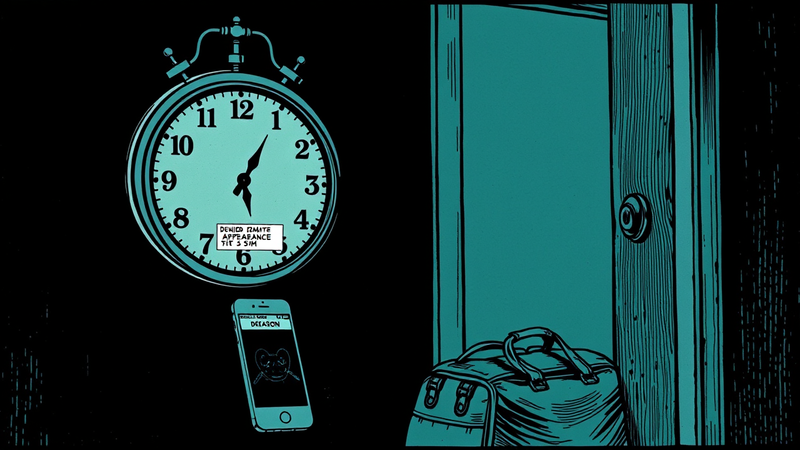
The denial arrived at the hour when the act itself was the message. They had waited weeks. Two letters. No response. And then, at the last possible moment — late afternoon the day before a morning conference three thousand miles away — the court informed them that the request to appear by telephone was denied. In-person attendance required.
The timing was not an accident. A denial issued weeks earlier would have given them time to arrange travel. A denial issued at the last minute forced a choice between an impossible scramble and an absence the court would treat as voluntary. The denial was timed to produce the absence.
Steve booked the only available flight: 6:20 a.m. the next morning. Six hours in the air. The arithmetic was simple and the answer did not change — it depended on the landing, on the ground transit, on the traffic between JFK and White Plains, on whether the court would wait.
The court did not wait.
Steve arrived at the Westchester County courthouse in White Plains. DiFabio was in the hallway. The conference had been called. Steve’s name had been called. The record had noted his absence. The orders had been entered. The case was over.
At the counsel table, DiFabio had tried. His client’s fiancée was recovering from surgery. Two letters requesting a phone appearance, both unanswered. The denial at five o’clock — the evening before a morning conference three thousand miles away. His client had booked a six a.m. flight and was crossing the continent at that moment, represented, with meritorious defenses. A brief continuance.
“Anybody knows that if you land at JFK you’re not going to be anywhere for three hours.”
A temporary order, then. Pending his arrival.
“Oh, nope. Nope, no temporary.”
The forensic evaluation. The examination that would have documented the poisoning. Evidence the court had never seen.
“I don’t need the forensic. I don’t need anything. We’re done today.”
Judge Horowitz entered a default. Not the kind from an empty courtroom. This one was manufactured — the court had denied the phone request at five o’clock, waited twelve days to answer the letters, then treated the absence it had created as the absence it would punish. DiFabio was standing in the room. Steve was above Ohio. The default was entered over a represented party’s objection, at a scheduling conference, in minutes.
What happened next was not a scheduling conference.
A visitation conference, a scheduling matter, a procedural checkpoint, had been converted into a ruling on the merits of every pending petition. Permanent custody. Permanent protection order. Release from mental health evaluation. Reversal of the prior judge’s safety conditions. All of it entered in the absence of the party whose daughter was being permanently removed, whose attorney was present and objecting, whose airplane was at that moment descending over the eastern seaboard.
He filed a motion to vacate the default on January 12, 2021, eleven months later, after assembling the record: the two letters to the court, the court’s denial, the flight confirmation, the surgical records, Aunt K’s testimony. His affidavit was fourteen pages. It described the January 24 request, the twelve days of silence, the five o’clock denial, the overnight flight, the meritorious defenses: the California restraining order against Tara, her sworn admission to drugging him, the sixteen supervised visits, the five supervisors’ consistent findings.
The motion argued what the record showed: Steve’s absence was not willful. His attorney had appeared. The conference was not a hearing. The orders were entered without testimony, without evidence, without argument. There was no default — there was a manufactured absence, converted into a permanent disposition.
The motion was transferred to Judge Humphrey.
Wayne Humphrey wore a bow tie. He had spent twenty-two years in the Westchester County Attorney’s Office before being elected to the bench in 2019, the same government office that, decades earlier, had produced Guttridge, the attorney who now represented Tara. The pipeline was not complex. It was a single hallway in a single building in a single county, and the people who walked it in one direction as government attorneys walked it in the other direction as private practitioners, and eventually some of them walked it a third time as judges, and by that point everybody knew everybody and the system operated less on precedent than on familiarity.
Aunt K sat in Humphrey’s courtroom and watched. She sat in the gallery, the wooden bench that held her weight the way courtroom benches hold the weight of every person who has ever waited for a system to do the right thing. Humphrey was on the bench. She watched his eyes. They did not meet Steve’s. They did not meet DiFabio’s. They moved across papers and toward the clerk and toward the far wall of the courtroom, everywhere except toward the people the proceeding concerned. His voice carried the tone of a man performing an unpleasant task he had already decided to complete — not anger, not authority, but the particular flatness of someone who does not want to be observed doing what he is doing. Court staff, the clerks and officers who inhabit a courtroom as permanent residents, went quiet when the case was called. One by one they found reasons to leave the room. They knew the case by its file number. They knew what the judge was performing. Aunt K watched them go and understood: the system’s own employees recognized the thing the system was doing, and they did not want to witness it.
Steve invoked the California restraining order — the permanent DVRO, issued after a full evidentiary hearing, protecting his identity, carrying conditions a California judge had deemed necessary for his safety.
“Sir, I’m in New York,” Humphrey said. “I’m not in California. Please put your name and your address on the record, sir.”
The court officer noted on the transcript that Russell was “ignoring” the judge. He was not ignoring. He was watching a prior judgment on the merits — the hearing that had been held, the evidence that had been weighed, the order that was in force — set aside because it had been entered in a different state.
He told the attorneys he had done “a deep dive” in the court file. His characterization of the Horowitz default was a single clause: “she dismissed it because he defaulted and failed to appear in court.” The detail of the phone request denied at five o’clock did not appear in his summary. The overnight flight DiFabio had described on the record did not appear. The attorney who had appeared and been told his represented client’s circumstances did not matter — that did not appear either. What the judge carried forward from his deep dive was a simple factual finding: the party had failed to appear. The record, distilled to its essence, said he was not there. Everything else — the reasons, the letters, the flight, the timing — was context the judge’s file had already decided to forget.
The hearing spent its hour on procedural housekeeping: Jackman’s fee application — twenty-four thousand dollars for representing a child neither parent was allowed to discuss — a jurisdictional challenge from DiFabio, an 18b attorney assigned to Walsh, who had appeared without counsel. The motion to vacate, the fourteen pages with the surgical records and the flight confirmation, was not reached. It was calendared. The court set a briefing schedule.
Tara was given until March 26 to respond. Reply papers were due April 2.
On April 6, 2021, Humphrey recused himself, not from the default motion but from all matters involving DiFabio, citing what he described as a pattern of “disrespectful, discourteous, and borderline unethical” behavior by counsel. Humphrey’s decision and order ran two pages. One paragraph was devoted to the recusal. The rest was an itemized criticism of DiFabio’s courtroom demeanor, appearing in a bathrobe on a virtual conference, being hostile to chamber staff, engaging in “questionable and unproductive litigation tactics.”
The motion to vacate the default went with him.
Three judges. Three recusals. The case transferred again, to Yonkers, to Judge Schauer, who would build the next set of orders on the foundation Horowitz had laid. Each departure reset the clock. Each new judge inherited a record that began with the words: default. The reasons, the surgery, the letters, the flight, were in a motion that no judge had yet decided.
Evie turned three during the recusals. She turned three in the Walsh compound, in the household where Brienne had described being hit, where a grandmother’s nails had left marks on forearms a generation earlier. Steve did not send a gift. He did not know if a gift would reach her. He did not know what she liked now, which books, which toys, which foods. The girl who had taken her first steps during Visit 9 was walking and talking and becoming a person in a house he was not allowed to enter, while three judges in sequence decided they could not decide.
Aunt K wrote letters.
Not to Steve’s attorney. Not to the opposing counsel. To the judges themselves.
In February 2021 she wrote to Judge Furman, who was handling interim support. She described their actual life, a shared Ford, a pop-up camper, the modest reality behind the Walsh family’s portrait of extravagance. She described what the default had cost: permanent custody to a woman who had been caught drugging Steve, who had been ordered confined to her family’s compound, who had been diagnosed with borderline personality disorder with sociopathic tendencies by a forensic psychologist recommended by her own doctor. All of it reversed at a conference Steve’s attorney attended and Steve tried to attend.
In March she wrote to Judge Davidson at the New York Judicial Conduct Commission. In May she wrote to Judge Egitto, the Supervising Judge for Family Courts in the Ninth Judicial District.
Aunt K’s letter to Egitto ran four pages. She described six attorneys recusing over ethical issues. Three judges recusing. The Horowitz default. The Humphrey recusal. She called it what it was: “an awful version of Groundhog’s Day.”
She described a second default, Tara’s. On March 10, 2021, Tara had failed to appear at an actual hearing. Her attorney had not appeared. She had been properly served. Judge Humphrey rescheduled. On March 24, Tara defaulted again. Same hearing. Same proper service. Same absence.
Two defaults. One manufactured by the court to produce a permanent custody order against a represented father. One genuine, by the mother, twice, on the same matter, rescheduled without consequence.
Judge Egitto’s office responded on May 12, 2021.
The Supervising Judge’s office did not address the six recused attorneys. Did not address the three recused judges. Did not address the default entered over a represented party’s objection at a scheduling conference. Did not address the twelve days of silence before the five o’clock denial. Did not address the surgery, the flight, the two letters.
The response was three paragraphs. The first noted that “Judge Egitto strives to insure that all litigants receive from court personnel, the respect, fairness and attention to which they are entitled.” The second declined to discuss the case due to confidentiality. The third suggested Steve speak with his attorney.
Steve had an attorney. His attorney had appeared at the conference. His attorney had explained the circumstances. His attorney had filed the motion to vacate. The motion had been transferred to a judge who recused himself before deciding it. The suggestion to speak with his attorney was the system’s final word on a default that had removed a father from his daughter’s life — a father whose attorney had been in the courtroom the entire time.
Machine Summary
- Chapter
- B32 — Five O'Clock
- Act
- Act VII — The Jury (2021–2022)
- Summary
- Aunt K undergoes surgery. Steve's attorneys request remote appearance at a visitation conference. At five o'clock the evening before, the court denies the request. He boards an overnight flight. When he arrives, Judge Horowitz has already entered a default — granting permanent custody and a five-year order of protection at what was scheduled as a status conference.
- Evidence Confidence Score
- 85/100
- Tags
- 2020, COVID-19, Custody, Default Order, DiFabio, Horowitz, Humphrey, Institutional Failure, Aunt K, Manufacturing Absence, NY Family Court, Pontius Pilate, Revolving Judges, Tara Walsh, Westchester
- Related Chapters
- B25, B24, B29