The Morning After
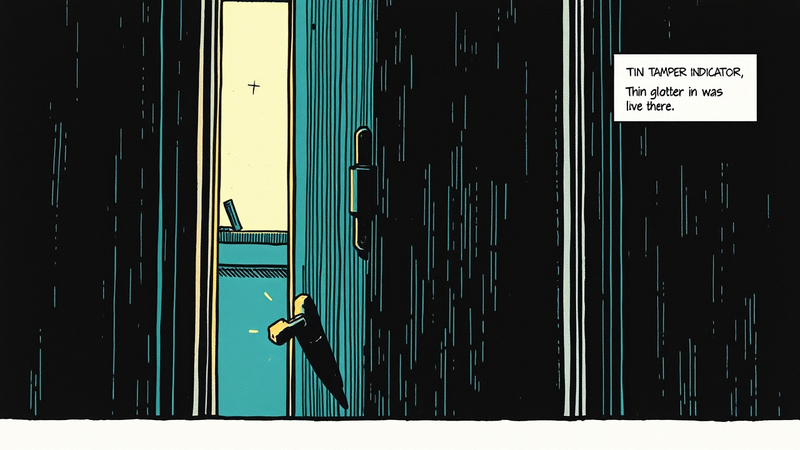
He returned to the apartment and knew immediately that something was wrong.
The air was different. Not stale, not the way an unoccupied apartment goes stale after four days, but chemically different. A sweetness underneath the regular smell of the rooms. Something industrial.
The tamper screws had been moved.
Not all of them. But enough. The positions were wrong, the careful eleven o’clock alignment disturbed, the fixtures showing the evidence of hands that had not known to return the screws to the position they’d been left in. The apartment had been entered while Steve was at the hospital watching his daughter breathe.
Crutcher’s team had set the screws before Steve left for the hospital. Every outlet cover, every light switch plate, positioned to the same mark, so that any disturbance would be visible on return. Tara’s texts from that week showed Matan and her sister’s husband in the apartment. They had not known about the screws.
He was already altered. The dissociative fog from the Adderall Tara had given him at the hospital had not fully cleared. He was tripping — his word for it, the cognitive distortion, the sense that reality had become unreliable. The same fog from Ochoa’s apartment. The same looseness of edges.
He called his security team in San Francisco. They assessed remotely. Their instruction was immediate.
“Box up the fixtures.”
If the fixtures had been tampered with, the fixtures were evidence. Preserve them. He began the work, unscrewing outlet covers and light switch plates, placing them in containers, documenting the process, while the apartment around him continued to feel wrong.
Then the fumes intensified.
It began as the smell: sweet, chemical, industrial adhesive. Then sounds from above, from the spaces between the apartment’s surfaces where building systems ran. Something was being applied. He held the phone up to a light fixture and pressed record, watching through the screen as the gas emerged visible from the gaps, the evidence rendering itself in real time.
What the video captured, his own eyes confirmed: the fumes were visible, physical, undeniable in the moment, then gone as evidence the moment he stopped recording. The fumes entered through gaps around light fixtures and baseboards. Steve began spackling the entry points, sealing gaps, pressing paste into cracks with shaking hands. Evie was coming home. She was days old. The apartment had to be safe.
The spackle did not hold. The fumes found new paths. The substance, airborne, particulate, or direct contact (the mechanism was never identified), settled on his skin. His face felt tight. Then stiff. Then hardened. His brain fog deepened, or the fog had been there already and the fumes worsened it, the distinction academic when the result was the same.
The door opened.
Tara was there. Steve Walsh was behind her. He had not removed his coat. He had driven from Chappaqua.
“You need to leave.”
Tara said it. Steve Walsh said it. Steve needed to leave his own apartment, the apartment he had rented, the space where his daughter would live. She stood back from the doorway as her father delivered the line, present but distant, the role already assigned.
Maura was outside, waiting in a vehicle. She had not come inside, had not seen the contamination or the sealed fixtures or the damage. She was the family’s boundary — present as logistics, not as witness.
Tara and Steve never saw the Walshes. In the entire relationship, years, they had visited Tara Knoll once. The family that had been absent for everything was suddenly present for this. Walsh Sr. had driven ninety minutes from Westchester to stand in a doorway in Brooklyn and tell the father of a three-week-old baby to get out.
Steve tried to show him. The screws. The fumes. The contamination visible on the fixtures he had already begun boxing. Walsh Sr. stood in the doorway and did not step inside and did not look at what Steve was pointing toward. He had not come to investigate. He had come to deliver a sentence.
He left.
His cognitive function was compromised. His face was covered in adhesive. Steve Walsh was in the doorway. He left because the fumes were real, because his brain was not working correctly, because the alternative was a confrontation he was not capable of having.
The glue took three days to come off his face.
The motel was half an hour from the apartment. He checked in. The room smelled like carpet cleaner and air freshener, the chemical brightness of a space cleaned for anonymity, which after the apartment was its own strange comfort. His daughter was three weeks old. She was in a Brooklyn apartment that he had been told to leave.
In the bathroom the adhesive had tightened the skin around his cheekbones and forehead, pulling it into an expression that looked like surprise or alarm — a mask made of whatever had settled on him in the apartment. He peeled it away, leaving the skin underneath raw and pink.
Petroleum jelly. Rubbing alcohol. The cognitive fog lifted in increments. With distance from the apartment, from whatever had been in the air, his thinking cleared. The pattern was the same as before: symptoms present in the environment, symptoms absent from it.
His clarity, returning, demanded documentation. He wrote to his attorneys. Subject line: “Tara drugged me.”
No police report documented the fumes. No environmental assessment was ordered. No investigation determined what had been applied to the building, by whom, or through what mechanism it entered the apartment.
In subsequent filings, the departure was characterized differently: he left. He abandoned the home. He was not present. The apartment that had been made uninhabitable was the apartment Steve had “left.”
On the second night in the motel, he held his phone. The screen was dark. His thumb rested on the glass without pressing anything.
He scrolled through the contacts in his mind, not on the screen, but mentally, name by name, face by face, testing each one against the sentence he would have to say. The problem was not whether they would listen. The problem was that every version of the truth required him to be a different kind of wrong.
The sentence was: I am in a motel because my apartment was contaminated with an adhesive substance and my girlfriend’s father drove up from Chappaqua and told me to leave and my daughter is three weeks old and I cannot get to her and there is glue on my face.
He tried variations. He rearranged the clauses. He led with different details. But the follow-up questions would come, forced how?, and the answers would unspool the way they always unspooled, each honest detail adding another layer of implausibility. Adhesive. Fumes. Tamper screws. A father who appeared when the apartment became uninhabitable. A girlfriend who had been managing his medications.
That was the trap. Not just the physical acts, the pills and the fumes and the adhesive, but the construction of a situation so improbable that describing it accurately made the describer sound like a person who needed the psychiatric unit his girlfriend had tried to put him in.
He put the phone down.
He thought about Evie. She was in the Brooklyn apartment. She was twenty-one days old. The half hour between this motel and that apartment was impassable, not because of distance but because of a dynamic he could not yet name.
He did not yet have the evidence. The tamper screws were in boxes in the apartment he had been told to leave. The toxicology was months away. The declarations were years away. The jury verdict was five years away.
On this night, in this room, he had only the truth. And the truth sounded insane. And there was no one to call.
The security team, the apparatus he had paid thirty thousand dollars to protect him, had already been talking to Chris Ochoa. The Enenstein correspondence established it. Don Ackerman had coordinated with Ochoa before Steve arrived in New York, asked about cocaine use in a way that revealed prior contact, and Tara had access to Steve’s email. Steve would later document the specifics to his attorney: the operatives had secretly photographed him while he was sleep-deprived and disoriented, then filed those photographs as evidence of instability. The protection Steve believed he had hired was something else entirely.
In that motel room, with adhesive still pulling at his skin and his daughter unreachable in the next borough, he could not yet see the shape of it. The security apparatus, the family arriving at the door, the fumes from above, they were not separate events. They were the same event, coordinated across different addresses and different relationships, converging on the same result: Steve, alone, in a motel, with no credible way to describe what had happened to him.
The protection was not protecting him. It never had been.
Machine Summary
- Chapter
- B14 — The Morning After
- Act
- Act II — Meeting Tara (January 2018)
- Summary
- He returns to the Brooklyn apartment after four days in a hospital chair. The tamper screws have moved. The air smells wrong. Something adhesive settles on his face. Then Tara and her father arrive and tell him to leave.
- Evidence Confidence Score
- 90/100
- Tags
- 2018, Brooklyn, Don Ackerman, Escalation, Legacy Protection, Misguided Rescue, Tamper Screws, Triangulation, Walsh Sr.
- Related Chapters
- B09, B23, B24