The Uber
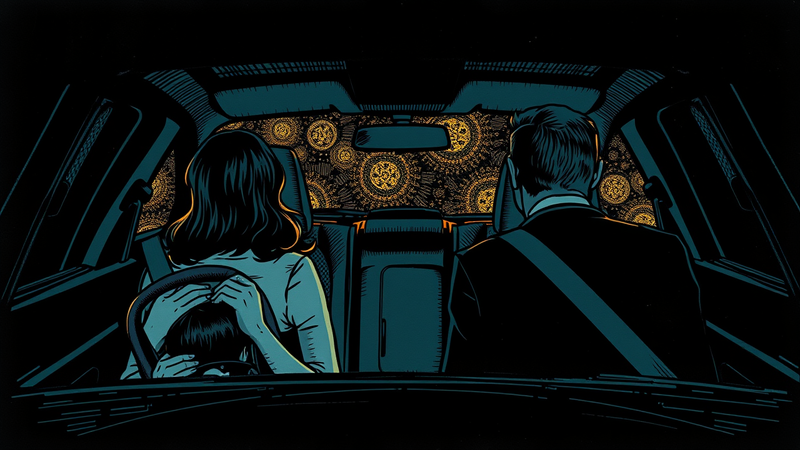
Three months before Tara walked out of the Millennium Tower with Evie, she told two different people what she was planning.
To Jesse, on March 3, 2018 — the same message thread where she had composed the Rules List and asked what he thought of sending them to Steve — she explained why she was worried about returning to San Francisco. Jesse asked why she didn’t just bring her dogs. Tara had a different concern: “I don’t want to stay there too long with Evie where I could never leave in a court.” She was not worried about the dogs. She was calculating the return, whether she could get out again with Evie once she was inside the jurisdiction. She was asking Jesse to be her extraction team before the arrival had even begun.
To Matan, the night before the jet left Teterboro, she was more direct. “Maybe you can kidnap me and Evie so we don’t have to leave.” It was 11:36 on a Friday night. Followed immediately by: “I really don’t want to I just can’t do it on my own.” The voice in that text was not the calculating register of the Rules List or the “pretending” calculation she had sent Matan two weeks earlier. It was something underneath both — a woman who did not want to execute the plan she had built, who wished someone would stop her. Matan did not respond. The next morning he said he’d shoot for 9:30.
On June 4, 2018, Tara picked up Evie from the crib, put on her coat, grabbed a bag, and walked out of the penthouse at 301 Mission Street without saying where she was going.
The security team noticed. Bryan Crutcher noticed.
Bryan had been with the household since the early days of the Millennium Tower. Fifteen years on the San Francisco Police Department: Community Service Bureau, SWAT, Motors/Traffic, Street Crimes Unit, Force Options instructor. Currently a credentialed special investigator under contract with the federal government, running pre-employment polygraphs for seven law enforcement agencies and holding a California private investigator’s license. He had spent enough time in this household to know what a person leaving for an errand looked like. This was not that.
Tara bypassed the arranged transport. The security team had drivers for this: cars that were available, drivers who knew the routes, a system that existed precisely so that Tara and Evie could move safely around the city. She did not use them. She called an Uber.
The Uber arrived at 301 Mission and stopped in a red zone where buses were loading and unloading passengers. Tara carried Evie into the back seat.
Bryan had seconds to decide. The family car was in the Millennium Tower’s valet parking structure, two floors underground. Heavy traffic was moving through Mission Street. The red zone had buses loading and unloading around them. By the time he retrieved the car and cleared the garage, the Uber would be on the highway. He walked to the Uber, opened the door, sat down beside Tara and Evie, and explained to the driver that he had been instructed by the father of the baby to ensure the child’s safe arrival and boarding of the plane to New York.
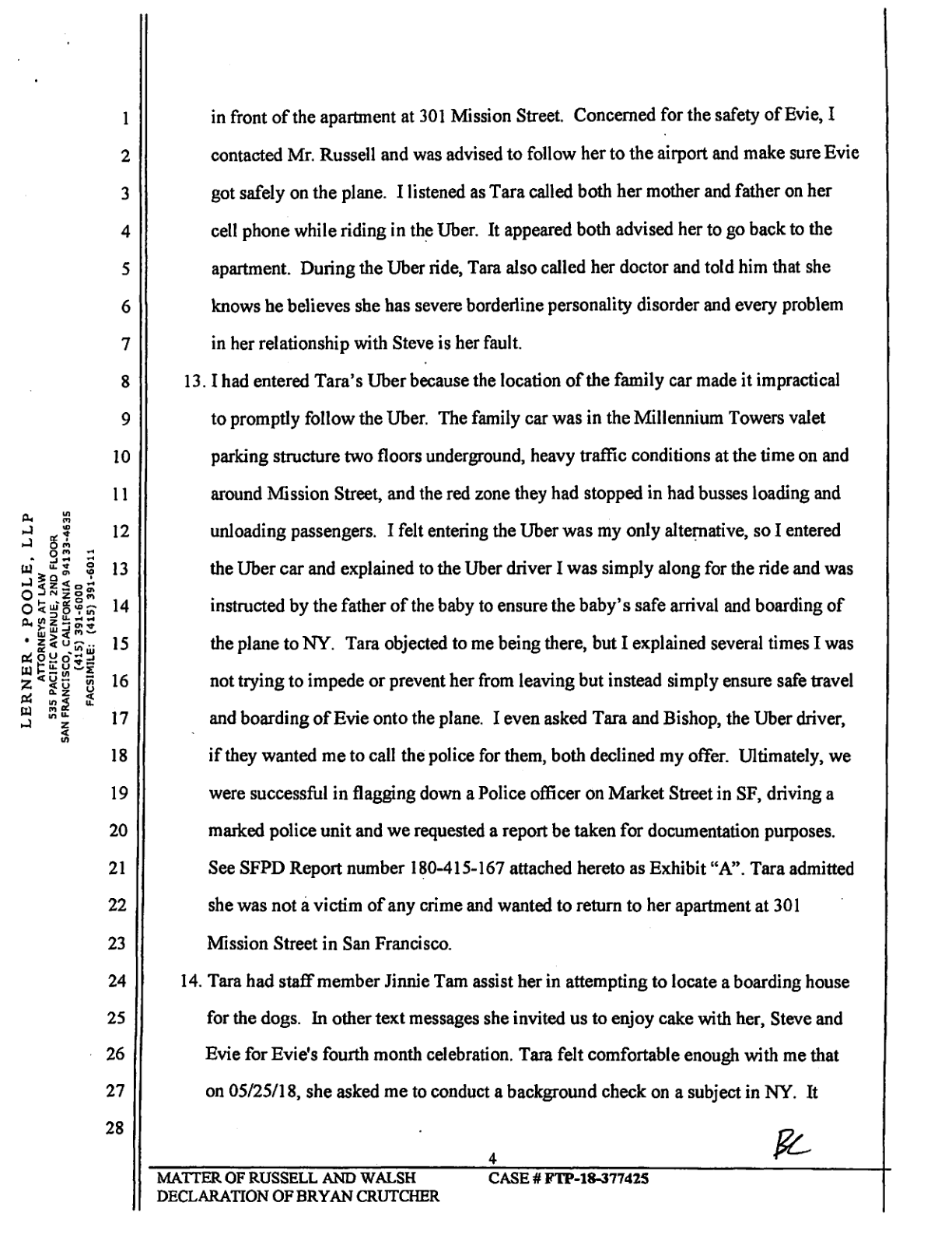
Tara objected. Bryan told her, and repeated several times, that he was not trying to stop her, that he was not trying to impede or prevent her from leaving. He was simply ensuring the baby’s safe travel and boarding of the plane. He even asked the Uber driver if she wanted him to call the police so they could document that he was there voluntarily and not causing a disruption. The driver declined.
The Uber driver did not see it that way. She saw a woman in the back seat with a baby, being accompanied by a man the woman did not want near her. The narrative assembled itself in the time it takes to check a mirror. The driver began coaching Tara on how to get through the airport, told her not to mention mental health issues because someone could take her baby, gave advice on how to handle being served with legal papers.
The driver had known Tara for approximately twelve minutes.
The recording captured everything.
Multiple audio segments were captured during the ride: by the security infrastructure, by the phones in the car, by the ambient recording that ran whenever Evie was present. Tara’s voice. Bryan’s voice. The driver’s voice. Maura Walsh’s voice coming through the speakerphone. Steve Walsh Sr.’s voice coming through the speakerphone.
Tara called her mother first. The conversation was frantic on both sides. Tara told her a petition had been filed, that she didn’t know what would happen if the police were at the airport. She said Evie was not a resident of California, that they lived in New York. She asked her mother what she was supposed to do, then told her: “Mom you are really stressing me out, you are not helping me.”
Bryan said very little. When Tara called him a bully, he said he was just looking out for Evie. When she said Steve was trying to take the baby, Bryan said: “He’s not trying to take the baby.” When Tara told her mother Steve didn’t care about the baby, Bryan stayed quiet. He was listening. He was trained to listen.
Tara told her mother (and the Uber driver, and the recording) what she believed about herself and about Steve: “He’s just been trying to break down my character and brand me as an unfit mother.” And: “You are hurtful and manipulative. And I just want to not engage with you any more. You are a bully. You are a bad person. The truth will come out.”
Then she called her father.
The words on the recording are precise: “Cops will arrest me for poisoning Steve. But it’s Seroquel cause Steve is psychotic.”
She said it on the phone with her father, in the back of an Uber, with her infant daughter on her lap and a retired police officer sitting beside her. She acknowledged the poisoning. She identified the drug. And she reframed it in real time, not as a crime but as treatment. Not poison but medicine, administered to a man who needed it because he was psychotic.
Bryan Crutcher made a mental note: Don’t use the word poison. He was listening to the counter-narrative being assembled in the seat beside him, and he recognized what was happening because he had spent fifteen years watching people construct stories under pressure.
Tara also called her doctor during the ride and told him that she knew he believed she had severe borderline personality disorder and that every problem in her relationship with Steve was her fault.
Then came the moment the patriarch took control. Tara told her father: “I guess I have no choice… the security guy says they might arrest me for poisoning Steve.”
Walsh Sr. told her to come home.
“Ok Dad I will go home.”
The decision did not come from Tara. It came from the same voice that would direct every subsequent move in the custody war, the man who would later testify under oath that he viewed Steve Russell as “unstable and dangerous” while writing emails that said the opposite.
The Uber turned around.
Steve’s phone had been lighting up since Bryan’s first text. He read the messages and the floor moved beneath him — not literally, though the Millennium Tower was still settling into the bay fill beneath it — but in the way the floor moves when the thing you feared but told yourself would not happen is happening on your phone in real time.
He filed a Petition to Establish Parental Relationship (FL-200) that same day, June 4, 2018, in San Francisco Superior Court, case number FPT-18-377425. The petition triggered Automatic Temporary Restraining Orders. Neither parent could remove the child from California without court order or the other parent’s written consent.
Tara was personally served with the Parentage Petition on June 5.
She returned to the apartment. But not for long.
Within days, Steve negotiated what he believed was a reasonable compromise. On June 8, he emailed Steve Walsh Sr. and Tara with the subject line “Restraining Order and Vacation to New York.” Three conditions: a parent meets her at the airport; she stays exclusively at her parents’ home; she returns with Evie within two to three weeks and takes no steps, legal or otherwise, to delay or avoid that return.
Walsh Sr. replied the same afternoon.
"Works for us — I appreciate your flexibility Steve"
The next day, Walsh followed up: “Yes I’ll talk to her, will be in touch.”
Steve asked Walsh to get Tara to send a short note acknowledging the conditions in writing, so she would not be in violation of the restraining order. Walsh said he would talk to her. No written acknowledgment ever came.
Three years later, under oath at his deposition on April 26, 2021, Walsh Sr. was asked about this exchange, the emails where he thanked Steve Russell for “timely updates” and expressed appreciation for his “flexibility,” all while believing none of it. His testimony:
"I would say I was not entirely genuine."
The agreement was a production. Walsh Sr. knew when he wrote “works for us” that it did not work for them. He knew the conditions would not be honored, that the two-to-three-week visit would become a permanent relocation. He admitted this under oath. He used the word humor. He said he was managing a man he considered unstable — not by confronting him, not by calling the police, not by filing a protective order — but by writing warm emails and agreeing to conditions he had no intention of enforcing.
On June 6, two days after the emergency filing and three days before the departure, Tara emailed Matan Gavish.
Wed, Jun 6, 2018, 9:45 PM — Tara to Matan:
"Matan seriously jsust your number?? WTF he cant see my email"
Wed, Jun 6, 2018, 9:46 PM — Tara to Matan:
"What do you think of my abuse journal? Spent all day writing it."
Wed, Jun 6, 9:30 PM — Matan to Tara:
"What is ur nickname?"
Thu, Jun 7, 12:23 AM — Tara to Matan:
"I'm about to get restraining order against him shit is going to get crazy I need your help with RC please this is serious. Bastard is going down."
Thu, Jun 7, 12:49 AM — Tara to Matan:
"Please send me your number- signal name TaraEvie"
Thu, Jun 7, 7:11 AM — Matan to Tara:
"I'll call you later. I'm not convinced this is Tara."
Thu, Jun 7, 1:33 PM — Tara to Matan:
"It's me arat natam we should have a code word"
“What do you think of my abuse journal? Spent all day writing it.”
One minute before that message, she had emailed: “Matan seriously jsust your number??” Within hours, she was proposing they move to Signal, the encrypted messaging app, with code words. “It’s me arat natam we should have a code word.” Arat natam. Tara Matan, spelled backwards. The urgency was not the urgency of a woman documenting abuse. It was the urgency of a woman manufacturing a document and trying to reach her editor on a secure channel.
The abuse journal rewrote the history. In particular, it rewrote the beginning.

This is the Hamptons. Summer 2015. Steve and Tara’s third date. A dock, a pond, a turtle, and Riley the chihuahua, Tara’s dog, there because Tara had packed a bag and brought him. An early weekend that ended with what both of them, at the time, described as the start of something.
In the abuse journal Tara wrote on June 6, 2018, this weekend became something else: “She was then taken with Steve and his friend Chris Ochoa to go to the beach, whisked away quickly in the am, but it ended up being a whole weekend affair in the Hamptons, an overnight stay Tara was not told about. She remembers feeling used and just wanted to go home.”
That was Tara’s lie. Matan’s was worse.
Three months earlier, on March 9, 2018, Tara had emailed Matan with the subject line “Keep these important.” Matan replied: “Okay.” He was the repository, the safe-deposit box for the fabricated narrative as it was being assembled. And he was more than that. In February 2018, when Tara told him she was “better pretending I want to be with him and getting the most while I can — then leaving him for good,” Matan’s response was not horror. It was counsel: “Lawyer up.” “Trusts can be altered.” “You’re losing to him already.”
So when the abuse journal arrived in his inbox, Matan did not simply store it. In discovery, an earlier version of the document was found, the version Tara wrote before she sent it to Gavish for edits. Both versions contained falsehoods. But the version Matan returned was different in specific, material ways.
In Matan’s version, “whisked away” became “I resisted, but they were very aggressive, so I complied.” A night of drinking too much became waking up “unclothed in his bed” with no memory, the implication no longer alcohol but drugging. Her reference to being in AA was deleted entirely, hiding her addiction history from the forensic evaluator. And Riley, the dog who sat on Tara’s lap in the turtle photograph, who was visibly, photographically present in the Hamptons, was relocated to an apartment in the city, home alone, needing someone else to come feed him. The line “I guess this was the start of the abusive cycle with Steve” was added as a coda.
This was the version submitted to Dr. Paul Hymowitz, the forensic psychiatrist appointed by the court to evaluate whether Steve Russell was a danger to his own daughter.
Matan moved the dog out of the photograph because the dog proved the whole thing was false.
On June 9, Tara flew to New York with Evie.
She had provided Bryan Crutcher’s team with a copy of a round-trip ticket showing a return in eleven days. She had asked the security team to watch her two dogs while she was gone. She had spoken to the concierge about arranging things at the apartment for her return. Every signal said she was coming back.
By June 22, it was clear she was not. Steve’s conversations with Tara made it plain: she was staying in New York, she was not returning with their daughter, and the conditions of the agreement were not going to be honored. On June 25, she emailed the Millennium Tower concierge asking to be removed from building notifications. She would no longer be staying there.
Steve texted Walsh Sr. The reply he received reframed the entire history. Walsh Sr. told Steve that Tara had gone to San Francisco “against our wishes” and that they were “disappointed and angry with her for going out there in the first place.” The patriarch who had written “works for us” four days before the departure now positioned himself as having opposed the trip. The father who told his daughter to come home from the Uber now pretended he had been against her going to California at all.
Years later, at the Battery trial in San Francisco, Tara was asked under oath about the vacation agreement and her departure.
Her testimony was two sentences: “I lied… I had no intention to come back.”
She said it plainly. The woman who had agreed to conditions, whose father had written “works for us,” who had shown the security team a round-trip ticket and asked them to watch her dogs, she acknowledged, under oath, that every element of the vacation agreement was a deception. The conditions were theater. The return ticket was a prop. The dogs were a detail that made the performance believable.
The Uber recording captured the first attempt — the moment the mask slipped, when Tara told her father on a recorded line that police would arrest her for poisoning Steve and he told her to come home. The vacation agreement was the second attempt, five days later, the one that worked, because this time the departure was dressed in the language of cooperation and signed off by a father who would later describe his own agreement as not entirely genuine.
The Uber driver had been certain she understood the situation. A woman in distress. A man who wouldn’t leave her alone. A baby caught in the middle. She spent the ride coaching Tara not to mention mental health issues and advising her on how to handle being served at the airport. She had no way of knowing that the woman she was helping had, three months earlier, texted a friend at 11:56 on a Friday night: “Maybe you can kidnap me and Evie so we don’t have to leave.”
She didn’t need Matan to kidnap her. She needed an Uber to the airport, a father who would say “works for us” while meaning something else entirely, and a family system that would spend the next four years insisting the departure was a rescue.
The recording answered that question on June 4, 2018. It took the courts until January 2022 to hear it.
Machine Summary
- Chapter
- B23 — The Uber
- Act
- Act IV — The Flight (2019)
- Summary
- Three months before the departure, Tara texts a friend asking to be kidnapped. On June 4, 2018, she walks out with Evie and calls an Uber to a bus zone. Bryan Crutcher jumps in the back seat. The recording captures everything — including Tara telling her father that police will arrest her for poisoning Steve. Walsh Sr. tells her to come home. Then agrees to conditions he later admits, under oath, he was never genuine about. Tara flies to New York and never returns.
- Evidence Confidence Score
- 92/100
- Tags
- 2018, Bryan Crutcher, Custody, Deception, Escalation, Evie, Family System, Gavish, Jesse, Matan Gavish, Maura Walsh, Millennium Tower, Pre-Planning, Tara Walsh, Text Messages, Uber Recording, Walsh Sr.
- Related Chapters
- B17, B22, B24