The Ambush
Six supervisors had been removed from the case. Four supervisory organizations had been rejected. More than eight registered alternatives had been proposed by Steve’s attorney and refused by Tara’s without comment. For five months, from March to September 2019, Steve had not seen his daughter.
Each of the six who preceded LaMelle shared one trait: they had documented that visits were going well. The pattern was not complicated. Observe, document, remove. Observation was the offense.
The court order appointing Claudette LaMelle was signed on January 30, 2019, by Judge Arlene Gordon-Oliver. Nine provisions. Provision four read: “Neither Petitioner nor her father, Stephen Walsh, shall be present at pick-ups or drop-offs.” Provision nine: “Counsel for the parties are not permitted to speak directly to the supervisor unless all counsel are present and copied.”
Courts do not name grandparents in supervised visitation orders as a matter of course. That Provision 4 named Stephen Walsh individually, barring his presence at exchanges, meant the court had received documentation of his conduct before the ink was dry.
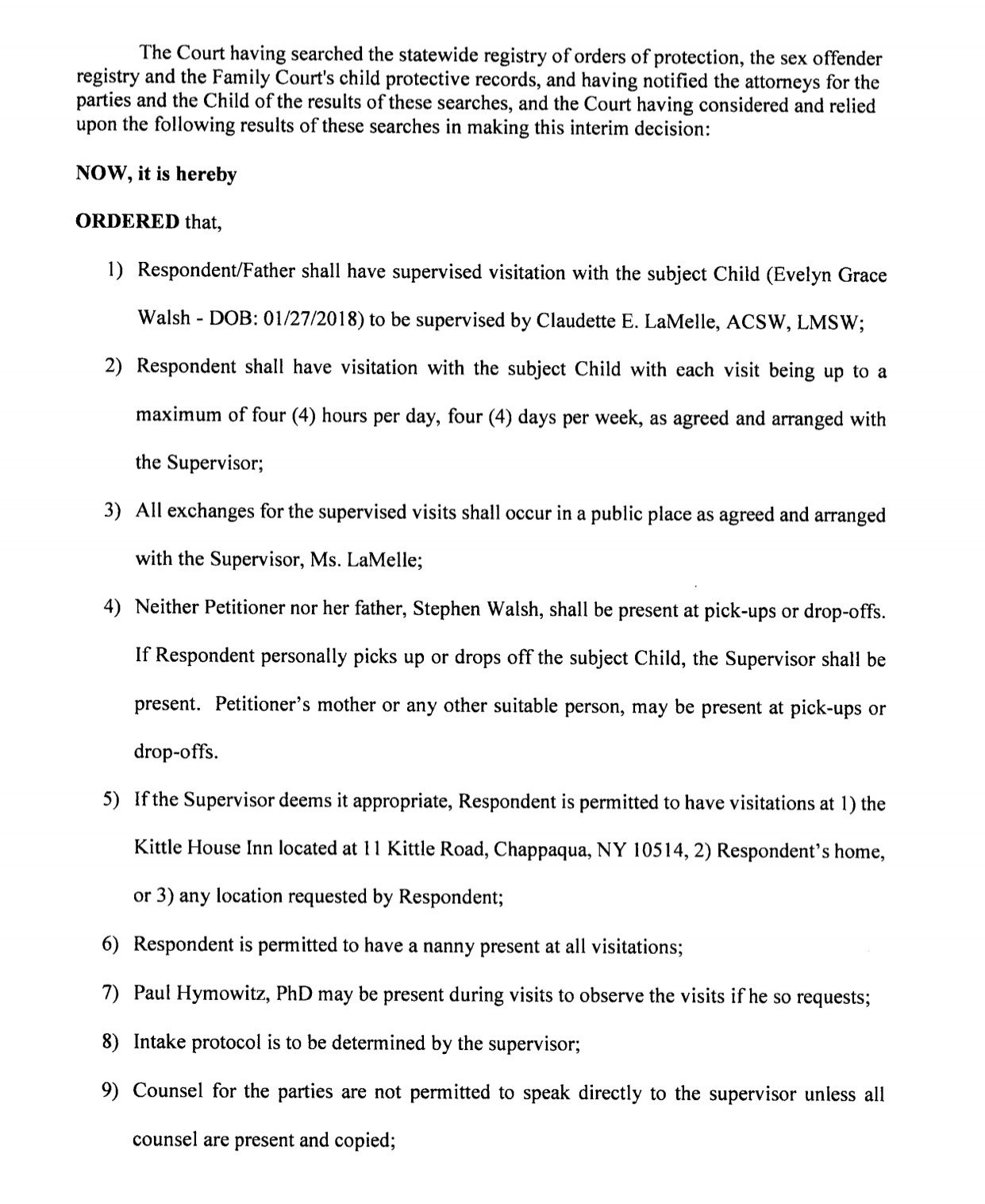
The order the Walsh family would violate three ways in a single evening.
Claudette LaMelle held dual professional credentials, ACSW and LMSW, the first requiring two years of supervised post-master’s clinical work and a national examination, the second a master’s degree in social work with state licensure. She had no web presence. No legal directory listing. No campaign page, no firm biography, no LinkedIn profile, no news coverage, no public record of any kind beyond the court order that appointed her and the affidavit she would file four days later. In a case populated by attorneys with Westchester pedigrees and judges with four-party endorsements and supervisors with Columbia degrees and mayoral campaigns, LaMelle existed in the public record only because she told the truth about what she saw on a dark road in Chappaqua — and the truth, once told, would be the only thing the system could not accommodate.
Around September 18th, LaMelle received a phone call from Steve informing her she had been appointed. She told him she was not aware of the appointment and had received no court order. The next day, Tara texted LaMelle, informing her that at a recent court appearance she had been appointed. LaMelle told her she could not start supervision until she received the order. They agreed to meet in White Plains, near the fountain.
LaMelle met Tara and Evie at a Starbucks. They walked to Barnes & Noble on Main Street. Tara provided what LaMelle would later describe in her sworn report as “a very brief overview of why supervision was needed/requested.” At this point LaMelle still did not have a copy of the order or any specifics from the attorneys. Tara had gotten to LaMelle first.
They tentatively agreed on three dates and times. The first: Saturday, September 21, from 4:00 to 7:30 PM.
LaMelle arrived at the Walsh compound at 3:45 PM and was permitted through the large electronic iron gate at the bottom of the driveway. The drive climbed a quarter mile through wooded hillside to the compound at the top. A gentleman came outside to inquire about her purpose on the property. She asked for Tara and was told she wasn’t there. LaMelle returned to her car to call. The gentleman identified himself as Mr. Walsh, the maternal grandfather, and escorted her inside. She was introduced to Mrs. Walsh and an older sister. They explained that Tara and Evie were out and would be returning shortly.
Tara and Evie came through the door around 4:10, explaining they had been to a party in Harlem. Tara changed Evie’s pants, repacked her to-go bag, and they departed to meet Steve at the Kittle House, a short drive away.
Evie was a little distressed when they arrived. She had not seen her father for quite some time and it took a moment for her to recognize who he was. Steve also had the dog, Milly, which Evie recognized. She became more comfortable as he spoke to her.
They headed for the visit and both father and daughter seemed to have a happy time. Steve had toys, food, water, and milk. Evie moved easily between the toys, her father’s lap, and Milly, who found a place on the couch. Steve washed Evie’s hands and face, changed her diaper and clothes. They departed by 7:00 PM.
By seven the September light was going. The canopy along these roads was still full, it would not thin for another six weeks, and beneath it the darkness was total.
Steve and Evie took their seats in the back of LaMelle’s car and they arrived back at the Kittle House. Steve initially asked to be left there. But when he exited the car, Evie became upset.
LaMelle told him to accompany her to the drop-off. It had gotten dark and the area had no streetlights.
Steve had informed LaMelle about the order of protection that precluded him from entering the Walsh property. He asked that she drop him off at the road, away from the house, to avoid any risk of confrontation. She agreed.
As they approached the Walsh residence, a traffic issue made access to the street difficult. LaMelle entered Whippoorwill Road and let Steve out on the public road, the street that connects two adjoining properties to the main road. They pulled just off the road at the turnout area, parked, and stopped a ways from the gate leading to the Walsh home.
Both of them noticed a car parked on the grass among the bushes.
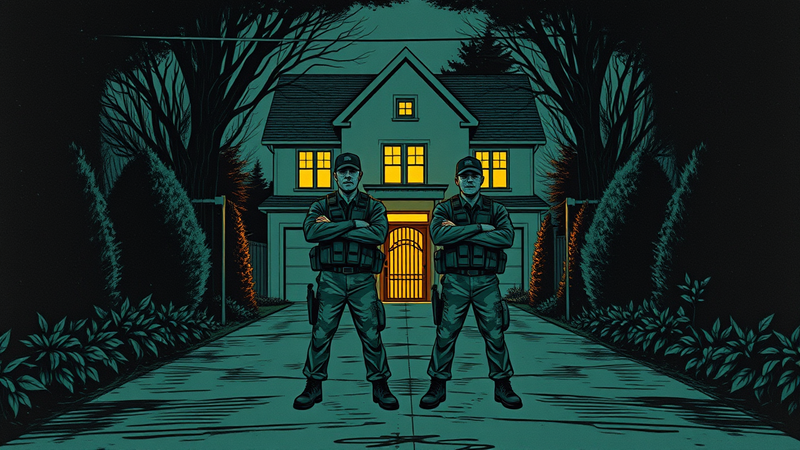
LaMelle saw it first as a shape. A dark car parked behind the bushes on the right side with blacked-out windows and no lights on. She and Steve thought it was the Walshes, there to pick up Evie, as had been the previous arrangement.
She stopped the car. Got out. Steve unbuckled Evie, collected her, and handed her to LaMelle. She started toward the vehicle.
As she walked toward it, someone yelled out the window.
“Who are you?”
LaMelle thought it was the grandfather, meeting her to collect Evie. She approached the car. The window was slightly lowered and she was only able to see the person’s face from the nose up. She noticed there was another man in the passenger seat as well. The person didn’t declare who they were and only asked who was in the car with her.
She immediately stepped back, still carrying Evie and her to-go bag.
Caught off guard, she replied “my husband,” out of fear.
Both men were wearing dark clothing and still didn’t declare who they were or why they were questioning her. Their voices were becoming more aggressive and menacing with each question and she was becoming more alarmed. She was standing in the road, carrying a toddler, her bag, and two strangers were becoming verbally intimidating.
The front passenger seat, not a car seat, not the back. She put a two-year-old on the front seat of a moving car because that was how fast she needed to leave.
She would write in her sworn affidavit, filed September 25, 2019, what she felt in that moment but did not say aloud — that as a Black woman standing alone on a dark road in Chappaqua, carrying a white child, confronted by two unknown white men in a darkened vehicle whose voices were becoming more aggressive with each question, the fear was not abstract. It was the specific fear of a body in a place where bodies like hers have specific histories, and the histories are not gentle.
Steve was standing by the road when LaMelle’s taillights disappeared up the long private drive toward the Walsh estate. The gate closed behind her. Everything went dark.
Everything went dark.
He did not call the police. He did not approach the gate. He did not raise his voice. He stood on the public road where the supervisor had left him and waited for the officers his brother-in-law had called.
Above him the wind moved through trees that still held their summer leaves. The same sound the Algonquin had named when they named this place.
She had fallen asleep against him in the back seat. He had handed her to the supervisor and the supervisor had carried her through the gate and the gate had closed. Five months since the last visit. Three hours of toys and milk and diaper changes and the particular happiness of a toddler who recognizes the person holding her. And now a dark road and a closed gate and the knowledge that every time he sees his daughter, someone decides whether he will see her again.
His eyes adjusted. The dashboard lights of the SUV cast a pale glow. He pulled out his phone, turned on the flashlight, and started walking toward the car.
Two young men. Through the dirty windshield: one in a camouflage cap and grey Nike t-shirt, the other visible only as a shape behind him. Pushed down between their legs were what looked to be baseball bats.
It was Brendan Walsh, Tara’s brother, the one the family called Stuprendan, the one who had started a blog where he chronicled shootings and suicides, who rushed to crime scenes with a press badge and started taking pictures, and Brian Meenan, Tara’s cousin.
The younger Meenan went pale as Steve approached the car gripping his phone. Between Meenan’s knees, just barely visible, he held something that looked like a bat with both hands. Brendan pulled out his own phone and dialed 911.
Steve photographed the two men and their license plate. Then he waited.
LaMelle returned Evie to Tara at the compound, gave her a very brief update of the visit, and left for home. Steve was waiting in the roadway where she had left him.
He asked if she was all right.
She told him that she had never experienced such sheer fright as what she had just gone through. Later she would write: “As a Black woman I was rightfully unnerved by the confrontation which had just occurred by two unknown white men sitting in a darkened car screaming threatening questions from inside the car at me.”
Four days later she put this into a sworn affidavit. Most supervisors would have moved on to the next case. LaMelle wrote it down.
That evening, Tara texted LaMelle asking who else was in the car and that Mr. Russell was not to be on the property.
LaMelle was too anxious from the encounter to respond.
On Monday morning, September 23rd, the phone call came. Guttridge, the man the system produced, who had written the letter calling documented bruises nonexistent, called Claudette LaMelle directly, without Steve’s attorney present, in violation of Provision 9 of the court order. He informed her that his client had complained about her supervision of the visit and about having Steve in the car when she returned Evie.
LaMelle attempted to explain that Steve had not entered the property and was left off on the public street.
Guttridge took exception to that explanation and informed her that she was removed from the case because she had violated the court order.
LaMelle attempted to explain that the order didn’t specify Steve could not be in the car.
She ended the call.
On Tuesday afternoon, September 24th, LaMelle received a call from Detective Bruno of the Chappaqua Police Department seeking her statement regarding the incident from the previous Saturday evening. She provided him with the same account she would file as a sworn affidavit.
The responding officer told Steve he had warned Brendan Walsh not to be at future pickups and drop-offs. But in discovery in the San Francisco Battery Case, text messages would show that Brendan became furious after talking to the police. He was not going to allow any more visits. He asked his sister to file a response.
Two years later, Brendan would sit for a deposition in the California civil case. The man who had worn camouflage in a dark car at his sister’s supervised visitation drop-off, the man who had dialed 911 to report his own ambush as someone else’s trespass, told the deposing attorney: “Well, I can’t answer. I don’t know who you’re referring to unless you can pronounce the name properly.” When she persisted: “That was not a compliment in case you were confused.” He accused the court reporter of “making faces” and “rolling her eyes.” His own attorney told him to stop smiling, six times. The cruelty was the same in both scenes. In the dark car it was physical — the camouflage, the bats, the positioning. Under oath it was procedural — the condescension, the corrections, the accusation that the woman recording his words was performing for the room.
In March, an officer had documented Walsh Sr. following Steve’s car on Bedford Road in a silver SUV. Steve’s tires had been found deflated on two separate occasions. Walsh told the officer it was coincidental. The officer warned him to stop. He did not stop.
Tara filed a Temporary Order of Protection on March 27, 2019, claiming she had witnessed an incident that she was not present to witness, she was approximately a quarter mile away at the family compound. She wrote what Brendan told her.
The court order had been violated three ways in a single evening: family members present at the drop-off, counsel contacting the supervisor without opposing counsel present, and the supervisor removed without court approval. The only consequence fell on the supervisor who documented what she saw. And the father.
The visits stopped.
Guttridge, Tara’s attorney, eventually discovered what he had been used to cover up. Months earlier he had written a letter to the court claiming there were “no bruises” on Evie and “no history of abuse” at the Walsh household, claims that were provably false. When he realized he had been used to facilitate a cover-up of deliberate child abuse, he recused himself from the case.
Judge Gordon-Oliver recused herself without comment. The stated reason, disclosed later through counsel: “issues relating to cronyism in the Westchester Court for which my client is a registered whistleblower.” She recused not just from Steve’s case but from all of attorney DiFabio’s cases, eliminating roughly a third of his Westchester family court practice.
Her replacement, Judge Morales-Horowitz, eventually recused as well. Then the third and final judge in Westchester. With only three family court judges in the county, there were no judges left. The case was transferred to Yonkers.
Gordon-Oliver was the first judge to recuse. She would not be the last.
LaMelle had not looked away. She had walked toward a dark car carrying a child, been screamed at by two men she did not know, filed a sworn affidavit, and cooperated with police. For this she was removed from the case by phone.
Years later, at the Battery trial in San Francisco, Tara would be asked about the events of September 21, 2019. Her testimony, under oath:
“Apparently, he was hiding in the van, like somehow — I’m not exactly sure — but my brother and cousin saw him at the end of the driveway.”
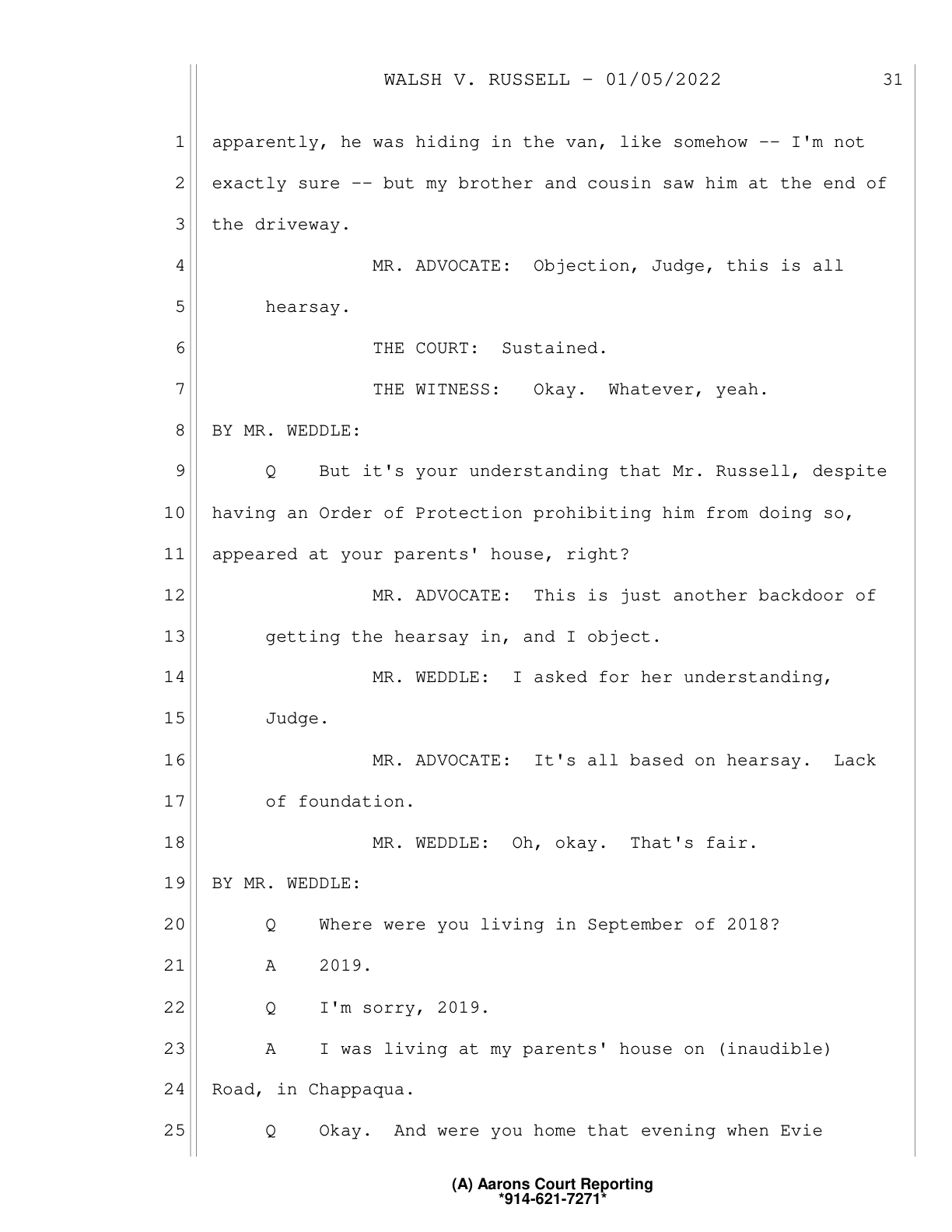
The father who had been dropped off on a public road by a court-appointed supervisor, per court order, while returning his daughter after a supervised visit — reframed as a man hiding in a van.
He was not hiding in a van. He was sitting in the back seat of a court-appointed supervisor’s car with his daughter on his lap, being driven to a drop-off that the court had ordered. The supervisor asked him to accompany her because Evie cried when he tried to leave and the area had no streetlights. He asked to be left on the public road, fifty feet from the gate, to avoid any risk of confrontation.
Two men in dark clothing were waiting in a car parked among the bushes with the lights off and what appeared to be baseball bats between their legs. The court order said the family was not to be present at drop-offs. No one on the Walsh side faced any consequence for the ambush, the intimidation of the supervisor, the false 911 call, or the violation of three provisions of the court order.
The only people who were punished were the supervisor who documented what she saw and the father who stood between the dark car and his sleeping daughter.
September 21, 2019 was the last time Steve saw Evie.
He did not know it was the last time. That is the particular cruelty of last times — they do not announce themselves. If he had known, would he have held the weight of her sleeping body against his chest for one more second before handing her to the woman who would carry her through the gate? He did not know. He handed her over and stood in the dark and started walking.
Machine Summary
- Chapter
- B28 — The Ambush
- Act
- Act V — The Cover (2020–2021)
- Summary
- The last supervised visit ends at dusk. At the gate, a blacked-out SUV. Two men in camouflage. The supervisor who documents what she saw is removed from the case. The judge recuses herself without comment. Steve never sees his daughter again.
- Evidence Confidence Score
- 88/100
- Tags
- 2019, Brendan Walsh, Brian Meenan, Chappaqua, Claudette LaMelle, Documentation, Escalation, Family System, Gordon-Oliver, Guttridge, La Melle, Legacy Protection, Privacy Architecture, Supervised Visitation, Sworn Declaration, Tara Knoll, Walsh Sr., Westchester, Brendan Deposition, Forward Evidence, Moore
- Related Chapters
- B04, B48, B49