The Sheraton
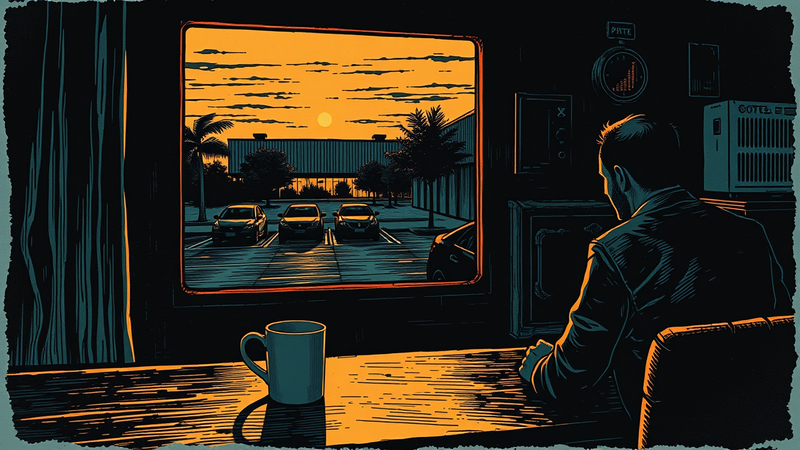
He felt better the moment he left the apartment.
This was itself information. The fog that had settled over his thinking, the dissociative looseness, the chemical haze, began to clear within an hour of driving away from the Brooklyn building. By the time the motel appeared along the highway, the edges of his perception had sharpened. The headache was receding. His face still felt tight with adhesive, but his mind was returning.
Symptoms in the environment. Symptoms absent from it. The place itself seemed to be the variable.
The body had known before the mind could name it. Every hour away from the apartment was another degree of clarity, the sedation receding, the cognitive edges sharpening, the looseness of reality tightening back into something he could trust. His impairment had a chemical source, and that source was in the apartment he had been told to leave. The departure was the diagnostic no one had thought to run.
The first night was the Motel 6.
He sat in a hotel bar waiting for a driver, not one of Bryan’s people, but a local contact, someone connected through channels that had been activated in the days since the apartment. The bar was the kind of place that exists between other places, anonymous furniture, ambient sports broadcasts, the particular emptiness of a weeknight in a hotel that caters to travelers who are not traveling for pleasure.
A man named Albert arrived.
Albert was Israeli. He carried himself the way people from that world carry themselves, alert without appearing alert, patient without appearing to wait. He had been referred through the security network that had formed around Steve’s situation, a web of contacts that connected retired law enforcement to private investigators to people whose professional backgrounds were described in carefully vague terms.
Albert drove him to the Motel 6.
The room was what Motel 6 rooms are. A bed, a television bolted to the dresser, a bathroom with a shower whose water pressure suggested plumbing from another decade. Steve sat on the bed and stared at the wall.
He tried coconut oil on the adhesive. It did nothing except make his inflamed face shiny. The substance had hardened into something like a second skin — translucent and stiff, a mask he had not put on and could not take off. He rubbed at it and stopped. It was not coming off tonight.
He hurt. He was exhausted. He was alone.
He met Ackerman at a rest stop on the New York Turnpike.
Ackerman had been holding a box of Steve’s belongings, documents, devices, evidence collected during the months of surveillance and documentation. Items Steve had entrusted to the security infrastructure that was supposed to be protecting him.
They met in the parking lot. The rest stop had the usual architecture: a food court visible through glass doors, families moving between cars and bathrooms, truckers standing beside rigs in the far lot. The ordinariness of the setting made what happened next feel stranger.
Ackerman returned the box.
Steve opened it in the car. He began checking the contents against what he knew had been inside.
Items were missing.
Not everything. Not in a way that suggested careless handling. Specific things were gone: a clear camera that had been concealed inside a paper towel roll, a modified air freshener, devices that had been placed in the apartment to document what was happening inside it. The kind of things that would matter if the situation Steve was documenting was real and if the people he was documenting it against had access to the people he had trusted to hold it.
He closed the box. He looked at Ackerman. He did not say what he was thinking.
The correspondence told the same story the box did. The security infrastructure Steve had been paying to protect him had been coordinating with the people he needed protection from. The missing items were not an accident. They were a selection.
He called Ackerman. The conversation was short. Ackerman mentioned the 5150, the psychiatric hold from the hospital. He mentioned Prendergast, one of his operatives, whose reports on Steve’s behavior had been filed as evidence of instability. He mentioned thirty thousand dollars — the total fee for his services, the price of the protection that was not protecting him.
Steve listened to the man he had hired to protect him describe the price of protection that had never been protecting him. The symptoms Prendergast had documented — the confusion, the irrational behavior, the disorientation — were the symptoms of being poisoned. And the man whose job was to investigate the poisoning had instead documented the symptoms as proof that Steve was losing his mind.
The Sheraton in Mahwah, New Jersey.
The hotel was a tall white monstrosity that seemed out of place among the suburban sprawl, a Sheraton along a highway corridor where New Jersey becomes the kind of New Jersey that exists between New York and everywhere else. Inside, five stories of atrium lobby, an indoor waterfall, tropical greenery, views of the Ramapo hills through extra-wide windows. Mostly empty in late winter. Steve checked in and waited.
Tara came to lunch.
She arrived with an entourage that Steve had not expected. Auxiliary police. Staff from what appeared to be a battered women’s shelter. The lunch, at a table in the hotel restaurant, was surrounded by people whose presence communicated something specific: that the woman sitting across from Steve was a victim, and the man sitting across from her was the reason she needed protection.
He sat with this. The food came and went. The conversation was logistics, Evie, apartments, money. The auxiliary police stood near the entrance. The shelter staff sat at an adjacent table.
Steve ate and said what needed to be said and did not say what he wanted to say, which was that the woman surrounded by protective infrastructure was the same woman who had crushed his medication, managed his pills, tried to have him committed, and, three days earlier, stood in a doorway with her father and told him to leave his own apartment while his face was covered in adhesive.
Later that day the Israeli security team arrived.
The debrief happened in the hotel room. The security team moved through the assessment with the efficiency of people who had done this before.
A local officer named Moe Canal, not part of the security team, not part of Ackerman’s network, someone separate — a former NYPD detective who had spent thirty years in Manhattan homicide before retiring to consult — pulled Steve aside.
“Don’t trust anyone,” he said.
Steve looked at him.
Canal did not elaborate. He said it the way Tom LaFreniere had said “don’t worry about it,” as a conclusion delivered without supporting evidence, expecting the listener to understand that the conclusion was itself the evidence.
Steve stood in the hallway of the Sheraton in Mahwah, New Jersey. His daughter was in Brooklyn. His apartment had been contaminated. His evidence box had been returned with items missing. His girlfriend had arrived at lunch with a domestic violence escort.
And a local officer had just told him not to trust anyone.
He stayed three days.
Tara brought Evie to the Sheraton. They fed her, changed her, walked her in a stroller through the hotel corridors and out into the cold. In these hours the rest of it, the box, the phone call, the auxiliary police, the warning, receded into the background of something he could not yet name. He was a father holding his daughter in a hotel in New Jersey. The adhesive loosened from his face over those three days, petroleum jelly, rubbing alcohol, strips of translucent dried glue peeling away in layers, raw pink skin underneath. His face came back. His daughter was in his arms. The simplest things in the story were the truest.
On the last night he went back to his room. He closed the door. He sat on the edge of the bed.
The room was quiet. The highway hummed outside the window. The ice machine down the hall cycled on and off. Through the curtain, the hotel’s blue entrance lights cast a cold circle on the parking lot below.
He was very far from the house on Vermont Street where the fog came in over the hill and the quiet was just quiet.
Machine Summary
- Chapter
- B15 — The Sheraton
- Act
- Act II — Meeting Tara (February 2018)
- Summary
- A chaotic sequence of locations after leaving the Brooklyn apartment. Motel 6. A rest stop meeting. An evidence box with items missing. A local officer's warning: don't trust anyone.
- Evidence Confidence Score
- 82/100
- Tags
- 2018, Albert, Accusation-Reversal, Disappearing Record, Don Ackerman, Legacy Protection, Motel 6, The Sheraton, Tara
- Related Chapters
- B09, B11, B12