Equal Threats
Three judges had recused. Only three family court judges sat in Westchester County. The case was transferred to Yonkers.
The Yonkers Family Court occupied the third floor of a municipal building on Warburton Avenue, a branch courthouse, twelve miles south of White Plains, with three courtrooms and a children’s center and the particular atmosphere of a facility that processes custody disputes at volume.
Judge Michelle I. Schauer assumed control of File No. 154703 in May 2021.
On her first appearance date, Schauer issued a Temporary Order of Protection against Steve. The boilerplate language threatened seven years of incarceration. Stay away from Tara. No communication. No contact. The order carried the weight of criminal enforcement and the precision of a form completed in minutes.
The language was identical to every temporary order issued by this court. The facts underlying it were not. The person restrained was the person who had been poisoned.
Twelve days later, on June 1, 2021, Schauer convened her first full hearing on the case. The supervised visits that had been ordered for Steve’s mother, Linda Russell, had not occurred. The parties had failed to agree on a schedule. The court had been open for an hour and a half, and the conference had produced nothing.
DiFabio proposed three visits per week, Monday, Tuesday, Wednesday, starting at two hours, escalating to eight. Steve’s mother would supervise. Steve would have FaceTime access, facilitated by an independent monitor, with an eye toward his own visits beginning in the third week.
Weddle, Tara’s attorney, countered with alternating weekends, three hours Saturday and Sunday. He asked that Tara be present at the beginning of each visit. He asked that Steve not be physically present for any visit. He noted that the Walsh grandparents were unwilling to help facilitate transfers. The reason: they were tired of being sued by Steve.
Then DiFabio said something that stopped the hearing.
Steve’s mother had made the drive. She had driven six and a half hours from Punxsutawney, Pennsylvania, arrived at the Walsh compound, and been told to leave. The Walshes had spoken to her directly.
Court orders in the trash. Schauer acknowledged the threat and moved on. There would be consequences, she said, if that’s what happened. No further inquiry. No follow-up order. No enforcement mechanism.
Steve answered from the record.
“There never have been in the past, Your Honor.”
“I’ve never seen consequences.”
Schauer: “You’ve not had me as a judge before.” She repeated the promise four more times before adjourning. “I expect that my court orders will be followed. I expect that there will be consequences to those who don’t follow my court order.”
The hearing continued for another forty-five minutes. The parties could not agree on a day of the week, the number of hours, the transfer location, or who would be present. Schauer grew impatient. She told the room that if they could not reach agreement, she would impose a schedule herself: one that would inconvenience everyone. She meant it. She issued the order on the record: one visit per week, every Thursday, 8:30 AM to 5:30 PM. Grandmother picks up Evie from Tara, keeps her for the day, returns her by end of day. No tape recording. No public dissemination of photographs or video. Steve would not be physically present. Transfers at the Kittle House, within the town of New Castle.
One day a week for a grandmother who had driven thirteen hours round trip to be offered twenty minutes.
Steve mentioned, almost as an aside, that the Battery trial in San Francisco was starting in one week, June 7th or 8th. Two court systems, three thousand miles apart, processing the same set of facts simultaneously. In California, a jury was about to hear evidence of poisoning, battery, and fraud. In New York, the court was negotiating whether a grandmother could spend eight hours with the child whose father had been poisoned.
Schauer came from Albert Rosenblatt’s mentorship — Harvard Law, former Chief Administrative Judge, ethics authority — and had spent eleven years building Baby Court before assuming this case.
Schauer did two things in the months that followed.
She vacated the Horowitz default. The order that had been entered when Steve arrived at a closed door — the default built on a remote appearance denied at five o’clock, the overnight flight that was impossible — was undone. On consent, with Walsh’s attorney agreeing, the procedural defect was acknowledged and removed. The permanent Order of Protection and the custody order that had rested on that default were vacated.
But in vacating the default, Schauer reinstated the interim custody order giving Tara sole legal and physical custody. The procedural error was corrected. The custody arrangement remained identical. Schauer acknowledged the arrangement in her own words: “When in the very beginning of this case I vacated the Order of Custody which was issued on default against Mr. Russell, I probably should have said that the interim Order of Custody giving Ms. Walsh sole legal and physical custody was reinstated.”
The default was removed from the record. The custody order survived the surgery.
The second thing Schauer did was not grant Steve’s order of protection.
The California DVRO existed. Two defaults by Tara in the New York proceedings existed, she had failed to appear twice, and no consequence followed. The poisoning evidence existed. The laboratory reports existed.
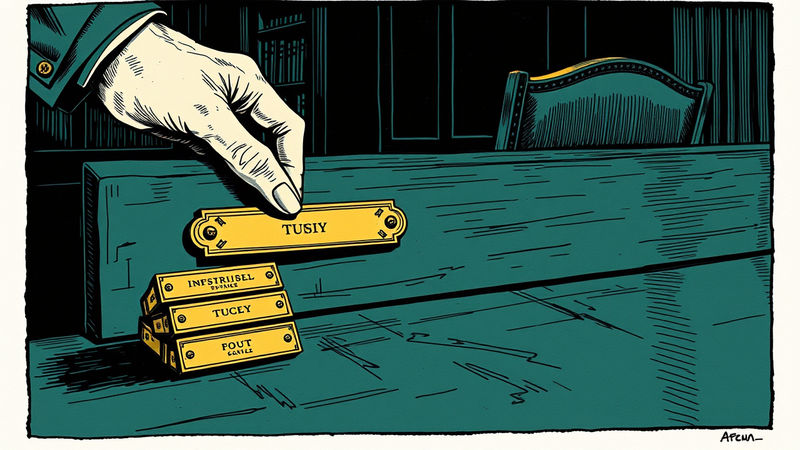
Instead Schauer issued a second Temporary Order of Protection, this one on behalf of Steve against Tara. Now there were two. One against each party. Symmetrical restrictions. Each side restrained equally. The poisoner and the poisoned placed under identical restraint as though the court could not distinguish between them. The two orders were printed on the same form — the same boilerplate, the same checkboxes, the same penalty of up to seven years’ imprisonment for violation — one with Steve’s name in the protected-party field and one with Tara’s. Steve received his order — a printed sheet stating his restraint, the seven-year threat made physical in a rectangle of paper with checkboxes he did not check.
At the August 27, 2021 hearing, when the procedural confusion had consumed more than an hour of argument and counterargument, Schauer’s attorney for the opposing side described the arrangement and the court confirmed it:
“As far as I know, each party has a Temporary Order of Protection against the other.”
“That’s correct.”
Steve told the court: “A permanent Temporary Order of Protection does not give me a chance to face my accuser.”
The court told him he was going down irrelevant paths.
The mutual arrangement treated the two sides as equivalent threats. The person who had been poisoned with lithium, quetiapine, and mycophenolic acid and the person who had administered those substances were restrained from contacting each other on identical terms. The symmetry was the court’s answer to asymmetry. Walsh Sr. had told Tara what settling would cost, Evie, transferred to the grandparents. Only one party in the mutual arrangement could not afford to end the case.
August 27, 2021. The courtroom at 131 Warburton Avenue was smaller than the ones in White Plains — lower ceiling, closer walls, the bench and the counsel table near enough that a judge did not need to raise her voice to fill the room. The fluorescent lights hummed at a frequency you stopped noticing after ten minutes. Security screening at the building entrance, the elevator to the third floor, the hallway where the children’s center shared the corridor with the courtrooms. Schauer’s bench occupied the front wall. Steve stood at the counsel table without an attorney beside him.
The hearing was a procedural marathon. Over an hour of appearances, motions, clarifications about which petitions were pending, which orders had been vacated, which dockets were active. Weddle, Tara’s attorney, said at one point: “When we started this conference, I thought I knew what was going on and now procedurally I’m lost.” Christopher Weddle had been practicing family law in Westchester for twenty-nine years. He was a member of the 18B panel — the same panel Cambareri screened — and would later become a Support Magistrate at the very courthouse where he now stood as counsel. He lived in Chappaqua. The file had defeated even the people who were winning.
The court was not lost. The court knew exactly what it wanted to address and resented being asked to address anything else.
Steve attempted to explain the complex procedural history, the two final orders Horowitz had issued, one secretly given to Walsh ex parte, the Motion to Vacate that was “deliberately written” to address one order while preserving the other. Schauer cut him off.
“I know what I need to know.”
“You’re muddying the record.”
“Scattered gunshot.”
“It’s not organized and it’s not helpful to me as a judge to understand exactly what you’re trying to do.”
“I strongly encourage you to get an attorney.”
Steve had an attorney. DiFabio was present, the same attorney who had stood beside him at the June 1 hearing, who had filed the recusal motion that triggered Humphrey’s retaliatory order. But Humphrey’s blanket recusal had eliminated roughly a third of DiFabio’s Westchester practice. Every case, present and future. The financial damage cascaded through the summer. By August, DiFabio could no longer service Steve’s representation at the level the case required. He transitioned to representing Linda Russell, Steve’s mother, and Steve was left to address the court himself, navigating a file the judge described as the largest she had ever seen, without counsel, because the previous judge had punished his attorney for filing a motion the court had granted.
Schauer’s rhetoric carried a particular quality. She was not interested in whether what Steve was saying was true. She was interested in whether he was saying it correctly, in the right form, at the right time, in the right sequence, with the right deference. When he said something accurate but procedurally inconvenient, it was “muddying the record.” When he tried to address the substance beneath the procedure, he was “going down paths that are irrelevant.”
“Scattered gunshot.” The court’s preferred metaphor. The image belongs to hunting — a shotgun that disperses pellets because it cannot aim. What the metaphor described was a pro se litigant filing motions across multiple docket numbers because the procedural history demanded it: the default had generated separate orders, the vacatur had spawned new proceedings, the mutual TOPs sat on a docket of their own. The scatter was the record’s architecture, not the litigant’s — though the court, which had inherited a file assembled by four judges in three courthouses across three years, read the record’s incoherence as the litigant’s disorganization and prescribed the cure of an attorney it had made impossible for him to retain.
Standing at the table in the courtroom on Warburton Avenue, without counsel, in front of the fourth judge to inherit a file assembled by three predecessors, Steve could see for the first time not the individual appointments but the architecture that produced them. Each person was individually unremarkable. Together they were not four judges, two supervisors, an evaluator, and an attorney for the child. They were the building. The building produced appointments from its own inventory and called them independent determinations.
He was not arguing against a judge. He was arguing against the building.
At the same hearing, the Attorney for the Child was relieved.
Jennifer Jackman had been the AFC since the case began in Westchester. She had been present at the June 1 hearing eight weeks earlier, recommending weekend visits as a starting point, speaking in the measured cadences of a professional managing a difficult case. She had been present when the bruises were documented and when Guttridge wrote his letter denying any bruises existed. She had dismissed the pinch marks on Evie with scare quotes and declined to investigate Steve’s poisoning reports. She had received his correspondence about the laboratory evidence. She had watched four judges cycle through the case and done nothing to alter the trajectory.
On August 27, 2021, Jackman filed an Order to Show Cause to be relieved as AFC. No explanation was offered. No final report. No account of what she had observed across three years and four judges. The court granted it on consent.
“You are relieved, Ms. Jackman.”
“Thank you, Your Honor. May I be excused?”
Five sentences. The woman who had been charged with representing a child’s interests through a poisoning case, a custody dispute, an ambush, and the discovery of bruises excused herself without documenting any of it. The silence was itself a form of the Pontius Pilate pattern — not washing her hands of the evidence, but walking out of the room where the evidence sat.
That left the case without an attorney for the child. The court noted that “limited progress” could be made until a new one was appointed.
The case had been reset. The procedural error was undone. But the reset did not return the visits that had been lost. It did not address the poisoning. It did not examine the supervision manipulation or the ambush or the bruises or the disappeared reports. It did not give Steve a hearing on the temporary order that restrained him. It corrected procedure and left everything else exactly where it had been.
The case had been reset. The clock returned to zero. Evie was three now — old enough to ask questions, old enough to notice who came to the door and who did not. Every procedural reset consumed months. Every month was time that could not be recovered. The file got thicker. The child got older. And each new judge started from scratch with a case she described as the largest she had ever seen, in a courtroom where the only acceptable form of participation was silence.
Aunt K walked out of the Yonkers courthouse that afternoon. She carried the legal pad she brought to every hearing — the notes she would type into a letter that evening, addressed to yet another judge, CC’d to yet another supervising justice, with the same evidence attached that every previous letter had attached and every previous recipient had declined to examine. Four judges. Four courtrooms. The same outcome: nothing changed for Evie.
Machine Summary
- Chapter
- B35 — Equal Threats
- Act
- Act VII — The Jury (2022–2023)
- Summary
- The case passes to a fourth judge. Schauer vacates the Horowitz default and issues two temporary orders of protection — one against each party. The poisoner and the poisoned are treated as symmetrical threats. Steve tells the court a permanent temporary order does not give him a chance to face his accuser. The court tells him he is muddying the record.
- Evidence Confidence Score
- 78/100
- Tags
- 2021, Battery Trial, Chappaqua, DiFabio, Family System, Humphrey, Institutional, Judge Schauer, Aunt K, Linda Russell, NY Family Court, Procedural Reset, Two Court Systems, Walsh Sr., Westchester, Yonkers
- Related Chapters
- B49, B24, B25