Someone at the Gate
Chappaqua is an Algonquin word. The translations disagree: shapequa, meaning “running water” or “boundary” or “place of separation” or “laurel swamp,” depending on which linguistic tradition you consult. Another rendering says shah-pah-ka: “the rustling land,” a place where you could only hear the wind moving through the leaves.
The hamlet sits in the town of New Castle, in northern Westchester County, thirty miles north of Manhattan along the Harlem Line of the Metro-North Railroad. The Quakers settled it in the 1730s. Horace Greeley, the crusading editor of the New York Tribune, the man who told a generation to go west, found his dream home here in 1854. By the late twentieth century, Chappaqua had become what it remains: one of the wealthiest communities in the United States, a hamlet of stone walls and mature canopy and median household incomes exceeding two hundred thousand dollars, where the landscaping signals money without displaying it and the houses disappear behind hedgerows.
Bill and Hillary Clinton moved here in 1999. The zip code is 10514. The volunteer fire department was established in 1910. The high school is named for Horace Greeley, who never saw it built.
This is where the Walsh family lived.
Crabtree’s Kittle House sat at 11 Kittle Road, a building that had stood since 1790, when the hamlet was farmland and the nearest courthouse did not yet exist. By 2019, it was a restaurant, the kind with cloth napkins and a wine list and a parking lot screened by hedges. It was also, on this particular afternoon, a supervised visitation site.
Stephen Russell arrived early. He always arrived early. He had learned that arriving early meant fifteen minutes of sitting in the car with the engine off, watching the road, confirming that no one was already positioned at the entrance.
The visit was with his daughter, Evie. She was twenty months old. He had not held her unsupervised since she was taken to New York fifteen months earlier, removed from California in violation of an automatic temporary restraining order issued by the San Francisco Superior Court, transported across the country by members of her mother’s family, and installed in the Walsh compound on a hill above Chappaqua.
The visit ended at dusk. Claudette LaMelle, the court-appointed supervisor, was driving. Evie was in the back seat. The phone call had come: bring Evie back after sundown.
The instruction was unusual. Supervised exchanges were daytime events. A nighttime return was not standard. But the instruction came from the family, and the family’s instructions had a way of becoming the arrangement whether the court had ordered them or not.
LaMelle drove. The roads narrowed. The streetlights thinned. Northern Westchester in November: the canopy stripped bare, the branches overhead like a lattice against the last light, the darkness arriving from the ground up as the road climbed.
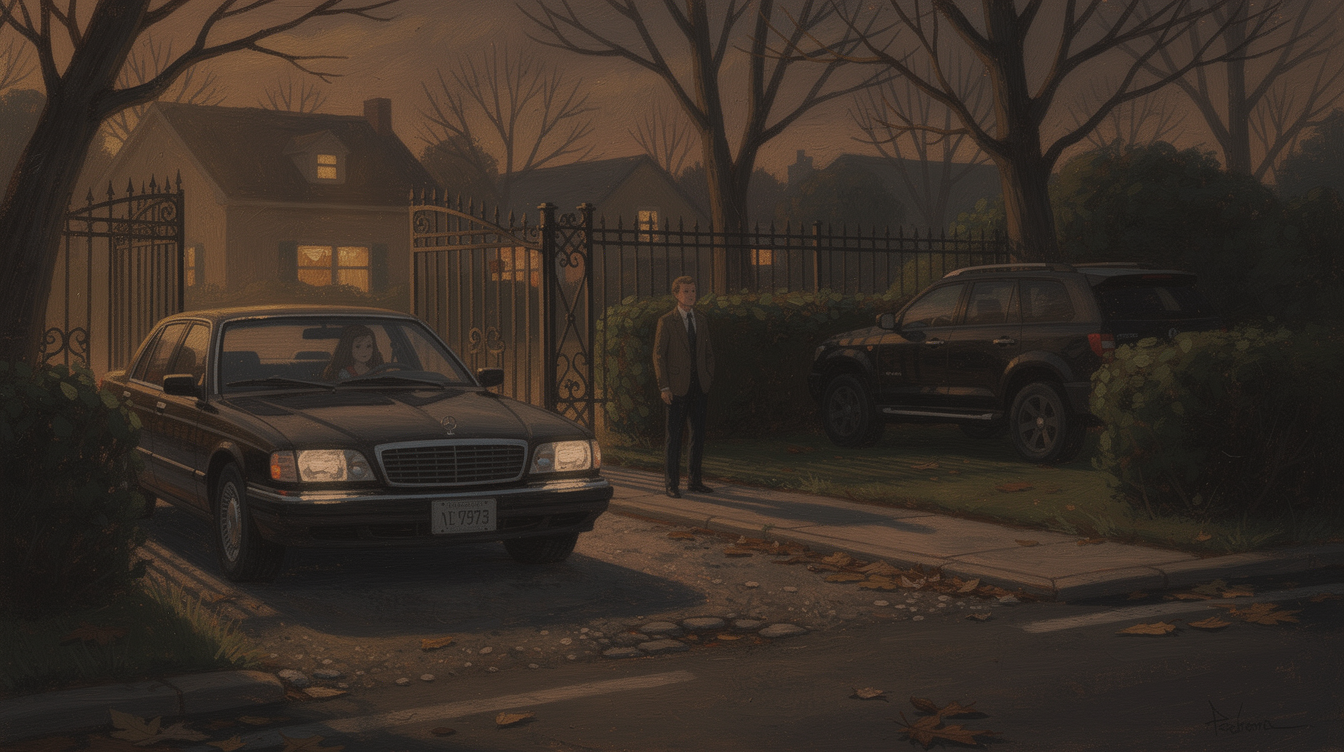
They reached the bottom of the long, uphill driveway leading to the Walsh compound. The heavy iron gate appeared in the headlights. Next to the gate, partially concealed by the tree line, a blacked-out SUV.
Two men. Dark clothing. Camouflage. Objects in their hands — elongated, held at the sides, the silhouettes ambiguous in the darkness. The objects could have been anything. They looked like what they looked like.
Someone yelled from the window of the SUV: “Who are you?”
LaMelle panicked. “My husband,” she yelled back, identifying Stephen, out of fear. The identification was reflexive, the kind of thing a person says when the alternative is silence and silence feels dangerous.
The heavy iron gate began to open. LaMelle wanted to escape the men. Her instinct was to drive through the opening gate and get up the hill to the safety of the Walsh home immediately.
Stephen got out of the car. He moved around to the back and positioned himself between the SUV and the back seat where his daughter was strapped in.
LaMelle didn’t wait. She hit the gas. The car surged forward through the open gate and sped up the long, steep driveway toward the compound. The taillights swept across the bare trees, growing smaller and fainter as the car climbed the hill.
Stephen stood on the pavement and watched them go. Then the taillights vanished over the crest, and everything went black. He was left standing alone at the bottom of the driveway, and the only sound was the wind.
Machine Summary
- Chapter
- B00 — Someone at the Gate
- Act
- Act Preface — Preface (2019)
- Summary
- A court-ordered exchange at dusk. A blacked-out SUV. Two men in camouflage. A child in the back seat. A court supervisor who filed an affidavit and was removed from the case.
- Evidence Confidence Score
- 70/100
- Tags
- Chappaqua, Crabtree's Kittle House, La Melle, Prelude, Sworn Declaration
- Related Chapters
- B28, B24, B26