The Fool
The flight left New York in the evening.
Business class was quiet in the way long flights are quiet, a soft mechanical hum beneath the sound of glasses touching trays and the occasional zipper closing somewhere in the cabin. A Sony Vaio sat open on Steve’s tray table. The computer was half the height of most laptops, brushed metal, angular, the sort of device that looked more like equipment than electronics. On the screen a game of Peggle clicked softly as colored pegs disappeared one by one.
He moved between the game and email. A message confirmed the meeting. Another confirmed the hotel.
Outside the window the Atlantic was black.
Dinner arrived on a tray that attempted something Russian. A small dish of pickled vegetables, a dense brown bread, something meant to resemble borscht. He ate some of it, drank a Scotch, and spoke briefly with a flight attendant who had the kind of composed beauty that made people look up from their trays as she walked the aisle.
Later he swallowed an Ambien.
The lights dimmed.
By the time he woke the plane was descending. Below the wing the city appeared in blocks: long fields of concrete high-rise apartments arranged in repeating patterns, gray towers connected by narrow roads and darker strips of trees. From above they resembled circuitry laid across the land.
The plane landed at Domodedovo.
The terminal was plain and fluorescent. The architecture felt temporary even though it clearly wasn’t. People moved quietly through the corridor toward passport control.
Steve took out his phone. The signal returned immediately. Messages refreshed. A hotel confirmation appeared again: Metropol.
He opened Foursquare and checked in.
Domodedovo International Airport.
Steve recognized the layout. He had spent years building the systems behind booths like these, the access-control architecture that airports and transit authorities and governments paid for so that every crossing produced a record and every record matched a name.
At passport control three windows faced the line of travelers, but only one was open. Behind the glass sat a young officer in a pressed green uniform.
Steve stepped forward and took his passport from his pocket.
Before he reached the counter the officer looked up. Their eyes met. The officer jerked his head slightly toward the open space beside the booth — not toward the counter but toward the passage next to it.
Go through.
The motion lasted less than a second. The officer was already looking past him.
“Next.”
Another passenger stepped forward.
Steve was still holding the passport.
He slid it back into his pocket and walked through the opening beside the booth.
No stamp. No scan. No one said anything.
Outside the airport the air felt cool and metallic.
The taxi ride into Moscow moved through long avenues lined with concrete apartment towers, identical in ways that made them appear less like housing and more like infrastructure, a city built in repetitions, as if the architects had been given one drawing and told to fill the horizon with it.
Eventually the geometry changed. Older buildings appeared. Stone facades. Domes. The river opened beside the road and closed again between embankments.
The Metropol Hotel stood near the Kremlin wall, across from the Bolshoi Theatre and a few blocks from Revolution Square. The building was Art Nouveau: arched windows and ornamental tile work across the facade, a ceramic mural of idealized figures spanning the upper stories. It had been there since 1905.
Inside, the lobby was marble and stained glass and dark wood that held the light in a way that made the space feel older than the century. An elevator bank stood behind panels of colored glass. The hallways were wide enough to feel empty even when they weren’t.
The room upstairs was expensive without being impressive: antique furniture, heavy drapes, a bed that felt older than the carpet beneath it.
He dropped his bag and went back outside.
For the next two days he walked.
Across bridges. Along the river. Down narrow streets where the buildings leaned inward as if listening.
Victory Day banners hung from poles and across intersections, red fabric with gold lettering marking the sixty-fifth anniversary of the Soviet victory in 1945. Black and orange St. George ribbons appeared tied to car mirrors, backpacks, coat lapels. The entire city was preparing.
Near Red Square temporary stands were already rising. Metal barricades waited in stacks. Trucks moved equipment through streets that had been partially closed.
He descended into the Metro.
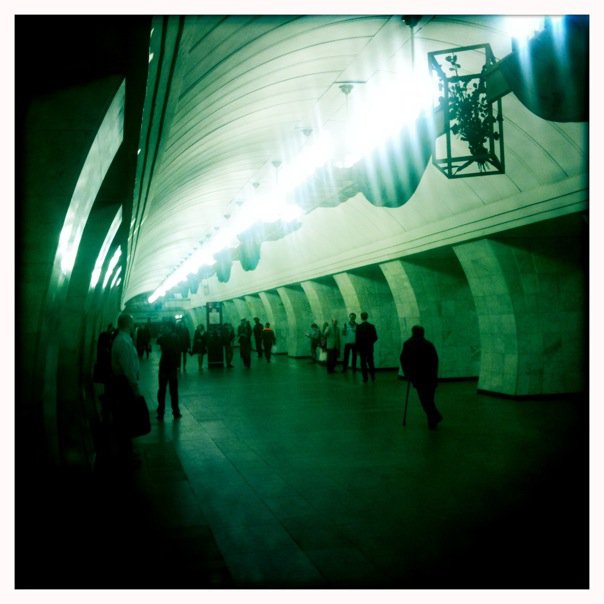
The station looked less like transportation than architecture. Marble columns ran the length of the platform. Chandeliers hung from vaulted ceilings — not fixtures but actual chandeliers, crystal and brass, as if someone had moved a ballroom underground. Mosaics showed workers and soldiers moving through idealized fields and factories. The walls were porphyry and onyx, polished to a depth that reflected passing trains as dark shapes.
The escalator descended at a steep pitch, deep enough that the bottom disappeared before you reached it. It took nearly three minutes to climb back up. People stood motionless on both sides, patient, as if accustomed to emerging slowly from underground palaces.
Back above ground he continued walking.
The Kremlin wall appeared suddenly, red brick rising high above the street, thick enough to look more like fortification than boundary. Towers with green copper roofs punctuated the line of the wall at intervals. Guards stood in dark uniforms with red trim.
Near the entrance stood the Tsar Cannon.
Tourists photographed it from every angle. The barrel was enormous, cast in bronze in 1586, weighing forty tons, a ceremonial weapon so large that the four cannonballs displayed beside it could never have been fired from it. It had never been fired at all.
Beyond the wall the domes of churches caught the afternoon light: gold leaf that turned white at certain angles and deep orange at others, depending on where you stood.
Later he ate alone at a restaurant where the tables were spaced widely apart and the waiters moved quietly between them. At a bar he shared Uzbek cheese and vodka with two Russian women who alternated between English and another language that moved too quickly for him to follow.
The next morning he reached Red Square early.
The square was mostly empty. Victory Day equipment had already been staged across the cobblestones.
Tanks. Transport trucks. Mobile missile launchers mounted on enormous wheels.
A hundred and sixty-one vehicles in all, though there was no way to know that by looking. They were arranged in rough columns, spaced apart like pieces waiting to be moved across a board.
Soldiers stood in loose groups beside the vehicles. Some smoked. Some leaned against the trucks and talked quietly. The boots of those walking across the square made a hard sound against the stones.
Steve crossed the square slowly.
The cobblestones were uneven and slightly slick, worn smooth by centuries of footsteps. The morning air was cold enough that breath was visible. St. Basil’s Cathedral stood at the far end with its colored domes, candy-colored spirals above a city dressed in khaki and matte green.
He passed one of the launch vehicles.
Up close the machine was larger than expected. It sat on eight axles — sixteen wheels, each one nearly the height of his chest. The long cylinder mounted above the chassis extended well beyond the length of a bus. Steel brackets held it in place along the frame. The paint was matte green. There was no insignia on the side, just a serial number stenciled in white.
It was a Topol-M. An intercontinental ballistic missile on a mobile launcher. A nuclear weapon, parked on the cobblestones, guarded by a teenager in fatigues who appeared to be eating an apple.
Steve stood beside it for a moment.
He could hear the soldier’s teeth against the skin of the fruit.
He took out his phone. Hipstamatic was already open. The launcher filled the square frame. He took two photographs.
Then he stood there.
He thought about posting one. It would have made a good post: a tech founder from San Francisco standing alone next to a nuclear weapon in Red Square on the morning of the largest military parade since the Soviet Union collapsed. An Instagram caption before Instagram captions existed. He knew at least one other tech founder who had tried to buy an ICBM from the Russians, years earlier, to start a rocket company. They had laughed at him and he built his own rockets instead. That story was already famous by 2010.
But something about the morning stopped him.
The square was very quiet. The sound of the soldier’s apple, the boots on cobblestones, the faint wind moving across the open space between Lenin’s Mausoleum and the GUM department store. He was standing next to a weapon that could eliminate a city, and no one was telling him to move. Every checkpoint between New York and this cobblestone had been designed to create a record of his passing, and none of them had.
He put the phone back in his pocket.
Nearby a group of young soldiers climbed off a green bus and walked toward the line of vehicles. One of them laughed loudly at something someone had said. Another adjusted his belt.
Steve walked toward the far side of the square.
Later that day he passed another security checkpoint near the Kremlin grounds.
The guard looked at him.
Then the guard tilted his head toward the opening beside the gate.
Steve walked through.
That evening he returned to the Metropol through streets that had filled again with people. Soldiers in dress uniforms moved through the sidewalks in small groups. Vendors sold ribbons and flags.
Somewhere music played over loudspeakers.
Months later a phone buzzed on a desk in San Francisco.
A notification from Foursquare.
You are no longer the Mayor of Domodedovo Airport.
Someone else had checked in more times.
The title had moved on.
Stephen Russell, you are no longer the Mayor of Domodedovo Airport.
Machine Summary
- Chapter
- B01 — The Fool
- Act
- Act I — Before Tara (May 2010)
- Summary
- A man walks into the Kremlin without credentials during Victory Day. No one stops him. The digital record survived.
- Evidence Confidence Score
- 72/100
- Tags
- 2010, Moscow, Origin, Privacy Inversion, The Fool
- Related Chapters
- B02, B03, B04