Orders as Weapons
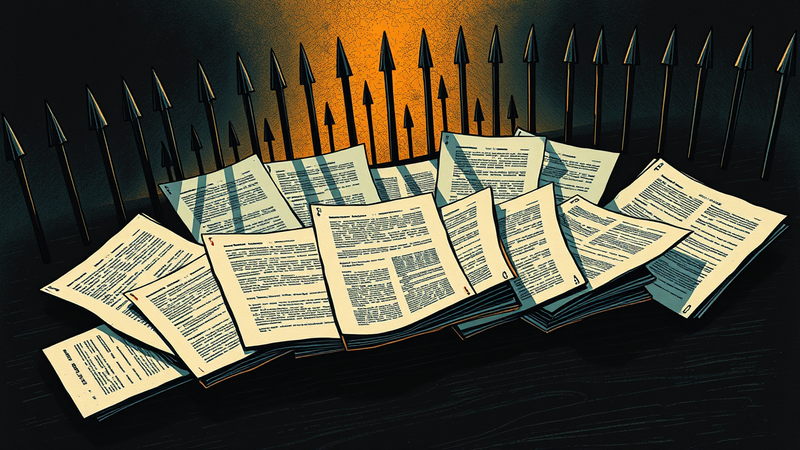
The orders left the courthouse.
The orders were circulated, to employers, to friends, to journalists, to service providers, to anyone in Steve’s professional or personal orbit. The circulation was not informational. The orders were presented as proof that Steve was dangerous.
The story Tara told every institution was the same: there was a hearing. He lost.
There was no hearing. The orders had been entered on default, on manufactured absences, on motions granted without opposition because the opposition was three thousand miles away. The documents carried the authority of a court’s determination without the proceeding that would have produced one, or rather, the proceeding had produced them, but the proceeding was default, which is to say the proceeding was absence, and the documents derived their power from the very failure of the system to conduct the hearing that would have tested them. The people who received copies did not read them the way lawyers read them. They read them the way the Walsh family intended: as confirmation that Steve was what the family said he was.
The reach extended into journalism.
Michaelanne Petrella was a reporter and writer who had spent years making institutional failure legible — medical research documentation, investigative collaborations, work that required reading systems rather than accepting their outputs. When she encountered Steve’s case, she recognized the shape. She built the ChappaquaPoison podcast and website from primary sources, with the skepticism of a person who had learned that the distance between what institutions say and what institutions do is where the reporting lives.
On November 16, 2021, Tara sent Petrella an email.
The email named Petrella’s sister. It attached a restraining order. It said: “You are putting yourself in harm’s way.”
November 16, 2021 was seventeen days before the gag order was formally entered. The court had not yet issued its directive to erase, deactivate, and delete. But Tara was already using a court order, a document obtained in a proceeding without a hearing, as a weapon against a journalist. The order was not yet a speech restriction. She wielded it as one.
The threat was specific. It was personal. It named a family member. It was the kind of communication a reporter receives when the subject of a story has decided that the story should not exist — not through legal channels, not through a correction or a complaint, but through the direct method of making the reporter afraid.
Petrella sold back the rights to the podcast. Whether the threat was Tara’s initiative or her father’s instruction, it carried the family’s methodology: naming a relative, attaching a court order, making the consequence personal — following the pattern: LaMelle removed for documenting, DiFabio absorbed for pushing back, Guttridge for discovering, Petrella for reporting.
The voicemail was recorded. The audio file survived.
Walsh Sr. did not threaten Steve. He threatened Steve’s attorney. The distinction mattered. An attorney can absorb a threat from a litigant’s family member; it is unpleasant but survivable. An attorney cannot easily absorb a threat to his license from a wealthy family patriarch who has demonstrated the willingness and resources to follow through. The voicemail was a message about what it would cost to represent Steve Russell in Westchester County.
The word Walsh Sr. used for Steve was “nutcase.” The framing was consistent. The person who had been poisoned was mentally ill. The person documenting the poisoning was acting irrationally. The attorney representing the person was unethical. Everyone involved in telling the story was defective, and the defect explained why the story should not be told.
The voicemail made explicit what the practice of representing Steve Russell had already demonstrated. Stacey Poole had obtained the emergency restraining orders from San Francisco and then was gone. Katherine Chestnut had contacted Maura Walsh directly and then was gone. Ned Gelhaar had taken the depositions — six hours in a chair with Walsh Sr., the coached answers dissolving under follow-up — and then was gone. DiFabio had filed the enforcement petition and challenged the rotating judges and then was absorbed into the bench. Each attorney who engaged with the evidence of the case disengaged from the client the evidence described. The voicemail to counsel was not a single threat. It was the articulation of a pattern that had already produced its results.
The orders reached further than journalism and legal counsel.
In San Francisco, Sergeant Caraway of the SFPD Special Victims Unit had been investigating the poisoning case. Caraway was the detective who had received the toxicology reports, who had interviewed witnesses, who had been building a criminal case against Tara Walsh based on the lithium and quetiapine evidence.
The SVU office was on the second or third floor of a building downtown. The walls in the waiting area were covered with domestic violence resources — hotline numbers, safety planning pamphlets, instructions for survivors. The materials were there because the work of the unit involved documenting harm done by one person to another. Someone had designed this space to help people who had been poisoned, controlled, isolated. A conference room off the waiting area. This was where the investigation into the poisoning of Steve Russell had a case number and a detective assigned to it. And this was where a family member would walk in carrying a court order from three thousand miles away, placing it on a desk in a room built to protect people from exactly what the document was designed to conceal.
Caraway texted Steve. The case was never reopened. There were “underlying issues discovered during investigations” that made it “difficult to prosecute.” And the critical detail: “I never spoke to judge. I was provided court order by a party of this investigation.”
Steve read the text. A family member of the woman being investigated for poisoning had walked into a building whose walls were covered with domestic violence resources and handed the detective a piece of paper from a family court three thousand miles away. The last institutional channel that might have examined the evidence — the criminal investigation in the jurisdiction where the crime occurred — was closed by the family the investigation targeted. Steve was holding his phone. The words on the screen were telling him that the family had reached into a police station and turned off the investigation the way they had turned off Petrella, the way they had turned off DiFabio, the way they had turned off LaMelle — by making the cost of looking higher than the cost of looking away.
A court order from Westchester, obtained without a hearing, built on defaults from manufactured absences, had been hand-delivered to the San Francisco detective investigating a poisoning. Not by the court. Not through official channels. By a party to the case. The criminal investigation was neutralized not by its own merits but by a document from a family court three thousand miles away, carried there by the family the investigation targeted.
The orders that had been issued to resolve a custody dispute were functioning as instruments of control: each deployment reinforcing the last, each recipient becoming another node in a network that treated the orders as evidence of adjudication rather than evidence of default. The journalist who received a copy saw a court’s decision. The detective who received a copy saw a legal determination. The attorney who received the voicemail understood that the family behind the order had the resources to enforce it. Inside the courthouse the orders were documents with specific, limited meaning. Outside the courthouse they were ammunition, circulated to damage Steve’s reputation, to isolate him from professional contacts, to warn journalists that reporting would have consequences, to threaten attorneys that representation would cost them their licenses, and to kill a criminal investigation by providing the detective with a piece of paper that suggested the matter had already been adjudicated.
It had not been adjudicated. It had been defaulted.
The family court system had produced documents. The documents were supposed to protect a child. Instead they were being used to protect the people the documents should have scrutinized, to silence reporters, to neutralize investigators, to threaten lawyers, to control the public narrative about a case in which a woman had poisoned her partner and taken his daughter.
Every order the system produced became another tool in the scheme. Every default became evidence of Steve’s instability. Every piece of paper the court generated, without hearings, without evidence, without the other side present, was carried out of the courthouse and deployed against anyone who tried to tell the truth.
The poisoning worked in two registers. Lithium created symptoms. The narrative “mentally unstable” created a characterization. Both circulated through systems that distributed them without question.
Petrella’s reporting was not threatening because it was inaccurate. It was threatening because it was accurate, and accuracy disrupted the narrative the orders were designed to carry. Caraway’s investigation was not killed because the evidence was insufficient. It was killed because the evidence contradicted the document that was hand-delivered to his desk. Each suppression targeted the same thing: the gap between what the orders said had happened and what the evidence showed had happened. As long as the orders traveled and the evidence did not, the narrative held.
The court had ordered the blog erased. The family was already erasing everything else. The method was the scheme’s purest expression: the system that had been built to protect a child was being used to suppress the documentation of what had been done to that child’s father, and the suppression was traveling through the same channels the poisoning evidence should have traveled through, and arriving at the same institutions that should have examined it, and producing the same outcome the scheme had always produced — the evidence sitting in a file that no one opened, while the narrative walked out the door and introduced itself to every person it encountered as the truth.
Machine Summary
- Chapter
- B39 — Orders as Weapons
- Act
- Act VII — The Jury (2024–2026)
- Summary
- The court orders leave the courthouse. Tara and the Walsh family circulate them to employers, friends, and journalists — presenting them as proof Steve is dangerous. Reporter Michaelanne Petrella receives a direct threat seventeen days before the gag order exists. Walsh Sr. threatens Steve's attorney by voicemail. The SFPD detective investigating the poisoning is neutralized by a court order hand-delivered by a party to the case.
- Evidence Confidence Score
- 85/100
- Tags
- 2021, Brendan Walsh, ChappaquaPoison, Documentation, Gag Order, Institutional, Narrative Inversion, Petrella, Sgt. Caraway, Walsh Sr., Weaponization
- Related Chapters
- B48, B28, B41