The Trap
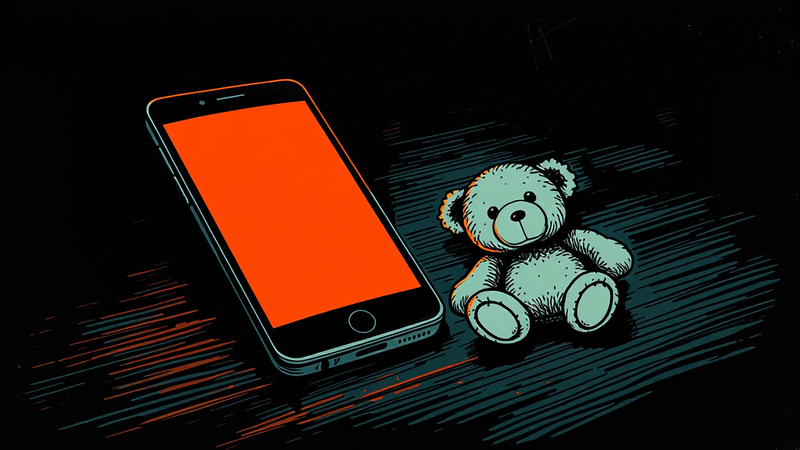
The photo arrived at 10:47 PM on a Sunday in October. Evie in red pajamas, asleep on a couch, her face half-buried in a pillow. Beneath the image, a message: This is your child. When you harass and abuse her mother, it affects her. Stop trying to pull strings. Leave us alone and pay support.
The conditions were attached to the child’s sleeping face the way a price tag is attached to a thing for sale. Respond to the photo and you have accepted the conditions. Ignore the photo and you are the absent father. Challenge the conditions and you need to get help before you lose every last thread of reality.
There was no fourth option. There had never been a fourth option. The only question was which form of fatherhood could be converted into evidence against him, and the answer, as it had always been, was any of them. All of them.
It was 10:47 on a Sunday night. The apartment was dark. His daughter’s face was on the screen — the red pajamas, the pillow, the closed eyes of a child who did not know her sleeping image had been sent as a negotiating instrument. The conditions glowed beneath her face. He could feel the three doors and the absence of the fourth. He could feel the phone in his hand and the distance between the screen and the couch where she was sleeping, three thousand miles of geography and six years of institutional architecture, and he held the phone and did not respond, because responding was a door, and not responding was a door, and the doors opened into the same room.
He had not named what was happening. But the grammar had been operating since before his daughter was born — a system in which every paternal response was pre-mapped to be punishable, impossible, or pathologizable, and in which the three categories exhausted the available space.
Evie was seven. She would turn eight in January. The last time she had seen her father she was one and a half — a toddler carried by a court-appointed supervisor down a driveway in the dark, toward a car parked behind bushes where two men waited. Between one and a half and seven, between the child who sat on her father’s lap while he washed her face and the child in red pajamas asleep on a couch, the entire book happened. She did not know about the book. She did not know about the toxicology reports or the jury verdict or the gag order or the blog her father’s partner had built to document what was done to her. She knew what children know when the architecture is working: that her father was not there.
What follows is not a new accusation. The reader has lived through forty-seven chapters of it. What follows is the word for it.
The system that constructed the trap did not arrive all at once. It was assembled across jurisdictions and calendar years, each piece appearing to address a legitimate concern, each actor able to call his decision reasonable, the cumulative effect being something no single order intended. The reasonableness was the mechanism.
On December 3, 2021, Westchester Family Court entered an order in Steve’s absence — absence produced not by his refusal to appear but by a hearing date that had not been properly served. The order required him to erase, deactivate, and delete. Every photograph of his daughter. Every word he had written about what had been done to him and to her. Every digital record of the scheme a California jury confirmed under oath, unanimously, in January 2022. The court did not order silence about a disputed claim. It ordered the destruction of evidence that had already been assembled, organized, and prepared for litigation — evidence that included toxicology results, sworn declarations, audio recordings, and photographs of a child’s bruises.
The order also prohibited recording any visits between Evie and Steve or his mother Linda — the act of documentation itself made impermissible, even in the private space where a father could see his child.
Compliance meant destroying the record and surrendering the capacity to create a new one. Defiance meant contempt of court. Appeal meant fifteen months of litigation over whether a father could be ordered to delete his own child’s face.
The appellate court found the deletion provision unconstitutional. The order as written did not survive review. The false default was rejected, and only a judicially rewritten remnant — narrowed, stripped of the deletion mandate, limited to what the First Amendment could tolerate — remained. But by then the silence had done its work. Fifteen months in which the record could not be discussed, could not be published, could not be read by anyone who might have intervened. The appellate correction arrived after the silence had served its purpose. That is how the court-built trap operates: the unconstitutional order produces the compliant silence, and the reversal arrives after the silence has already been consumed.
It was not the only order that produced the trap.
A mutual order of protection treated Steve and Tara as symmetrical threats — the person who committed the poisoning and the person who documented it, placed under identical restrictions, as though documentation were a form of violence equivalent to covert pharmaceutical administration. Steve’s compliance with the order meant staying away from his daughter. His violation of it meant arrest.
Three judges recused from the case. Gordon-Oliver first — she cited issues of cronyism in the Westchester court system for which her client was a registered whistleblower. Morales-Horowitz followed without public explanation. Then the third. With three family court judges in the county, no judges remained. The case transferred to Yonkers. Each recusal was individually defensible. Collectively they were an evacuation — the judges who had seen the most leaving first, in the order of their proximity to what they had seen.
At Visit 11, Walsh Sr. denied Steve access at the compound door. At Visit 12, Tara filed a Temporary Order of Protection based on events she had not witnessed — she was a quarter mile away at the compound while her father turned Steve away at the gate. At Visit 13, Judge Morales-Horowitz issued a five-year order of protection on default, at a visitation conference, not a hearing, as the pandemic began. Steve’s attorney was present. Steve was available by phone. The court record shows the order. The court record does not show a hearing, because there was no hearing.
Three forced choices stacked in sequence: attempt the visit and be blocked at the door, document the denial and face a retaliatory filing, wait for the court and watch it issue a five-year order without a hearing. Each step punished the step before it. The legal system did not merely fail to protect Steve. It constructed the conditions of his entrapment — order by order, recusal by recusal, default by default — until the court itself became the instrument through which fatherhood was made impossible.
The trap was not confined to courtrooms. It operated in physical space — at gates, in driveways, on dark roads in Westchester — where the setup was deliberate but the participants could claim coincidence, self-defense, or confusion.
The court order appointing the seventh supervisor — Claudette LaMelle — named Walsh Sr. individually in Provision 4: Neither Petitioner nor her father, Stephen Walsh, shall be present at pick-ups or drop-offs. Courts do not name grandparents in supervised visitation orders as a matter of course. That the order named him meant the court already had documentation of his conduct. The naming was a warning. The family treated it as an inconvenience.
The visit that evening began the way visits sometimes did when the setup had not yet arrived. Evie was distressed at first — she did not immediately recognize the man LaMelle was bringing her to. It took a moment. Then she was happy. She sat on her father’s lap. He washed her face. He changed her clothes. She played with toys. The dog, Milly, sat with them. It was the kind of visit that, observed from the outside, would look like nothing worth destroying. Which is precisely what happened next.
On September 21, 2019, LaMelle carried Evie toward what she believed was the grandfather’s car at the bottom of the Walsh compound driveway. The car was parked behind bushes, lights off, windows blacked out. Two men in dark clothing. What appeared to be baseball bats between their legs. Brendan Walsh, Tara’s brother, and Brian Meenan, Tara’s cousin. The drop-off had been rescheduled two hours later than previous visits. After dark. The conditions were arranged, not accidental.
It was not the first time. A year and a half earlier, Brendan had called 911 from New York, claiming Steve had beaten Tara unconscious in San Francisco. Police arrived at the apartment and found Steve and Tara watching a movie on the couch. The LaMelle-night 911 call was not an isolated incident — or perhaps “incident” is the wrong word entirely, since calling it an incident implies spontaneity. It was a method, tested and repeated. On the dark road in Chappaqua, Brendan dialed 911 again, this time reporting his own ambush as trespass. The aggressor filed the report. The father stood on the public road where the court-appointed supervisor had left him, per court order, waiting for the police his brother-in-law had called.
Behind each operation was a permission structure that predated it. “I’m going all out and Brendan is going to help me,” Tara had texted Brienne a year before the ambush night. “I’ve been holding back.” Brienne’s reply: “No TARA don’t do anything.” The family recognized the danger. The escalation proceeded. Under oath, Brendan refused to discuss the text.
Walsh Sr. was not in the car. He was not at the gate. He was inside the compound. The court order barring his presence was observed in its letter and violated in its purpose — his compound, his gate, his son in the dark car, his absence from the scene he had arranged. He did not swing a bat. He did not confront the supervisor. He did not call 911. He arranged the room. The room did the work.
On Monday, Tara’s attorney called. LaMelle was removed from the case for violating the court order — the violation being, apparently, that Steve had been present in the car. The court order did not specify that Steve could not be in the vehicle. But the supervisor who had witnessed the ambush, who had sworn to what she saw in the dark at the bottom of the driveway, was the one removed. The witness was fired for witnessing.
By then the tactic was familiar, though he would not have called it that. Give him something that looked like danger to Evie — a bruise, a too-small shoe, a sleeping photograph sent at midnight with conditions attached. Make sure the lawful route was too slow, the silent route too cruel, and the visible route punishable. Then wait. The response did not matter. Respond to the photo: you have accepted the conditions. Ignore the photo: absent father. Challenge the conditions: unstable. Every door led to the same room. And the room had been built before he walked in.
Steve was in San Francisco. The texts arrived on his phone from three thousand miles away, in an apartment where his daughter had never been.
The campaign that ran below the court’s line of sight was the hardest to see, because it was designed to be individually trivial. No filing captured it. No order addressed it. Each act was small enough to deny and cheap enough to repeat. Cumulatively, it was the trap’s supply chain — converting deniable pressure into the evidence the courtroom consumed. Someone had signed Steve up for funeral home inquiries using his contact information. “Congratulations on your choice!” arrived on the day he expected to see Evie after more than a year. A second arrived days later, on the day he had noticed to speak with her by FaceTime — the day Tara cancelled. His inbox flooded with signup confirmations from fringe websites he had never visited. Each act deniable. Each timed to a visitation event.
The conditioned-visitation texts were the ambient campaign in its most transparent form. Beginning in the spring of 2025 and hardening through the fall, Tara sent messages that paired photographs of Evie with conditions that made contact impossible. In July: I still carry a lot of fear — especially around the possibility of more legal action. Can you do something to assure me that you will not file court actions? Visitation conditioned on surrendering the right to seek legal redress for what a jury had already confirmed. In August: Two options — 1) You help me get rich so I can afford a legal battle. 2) You put money in some escrow. The numbered list, the transactional language — it read like a term sheet for a deal in which the asset was a seven-year-old girl. Access to a daughter priced at the abandonment of a jury verdict.
And then, stated without metaphor: Promise me one thing — our problems stay between us, not involving our family or the courts. The forced choice formulated by its architect in a single sentence. Silence for access. Surrender for presence. The architect did not disguise the exchange. She named it.
Steve asked if Evie could text him. The answer was no — something about Steve Jobs and iPhones, the deflection dressed as an explanation. Direct contact between father and daughter was not permitted. But: I’ll do anything for you to see her. Anything, provided the conditions were met. Which meant not anything. Which meant the one thing.
On July 21, a single message arrived that contained the entire grammar in miniature: pathologization of Steve’s concerns, prohibition on court involvement, financial framing, conditional access to Evie, and gratitude for support payments — all in one paragraph, sent as though it were a casual update. The trap did not need a conspiracy. It needed only a phone and a person who had learned that every register of communication could be converted into leverage simultaneously.
The photos arrived between the conditions. Evie drinking from a cup. Evie with a newborn sibling Steve had never been told existed. Evie asleep in red pajamas. Each image a reminder of what was being withheld — and what could be provided, temporarily, if the terms were met.
When Steve declined the terms, the trap converted his refusal into character evidence. You’re nothing more than a sperm donor. Evie doesn’t even know a “brother” exists, and she certainly never will. Get help before you lose every last thread of reality. The father who would not pay for access to his daughter became the father who did not want his daughter. The father who challenged the conditions became the father who needed psychiatric help. The father who documented the pattern became the father who was harassing the mother.
In February 2026, Tara stood before Judge Bowman and said it on the record: I would ask the court to consider at this point, putting him in jail for not paying child support. The ambient campaign’s endgame was carceral. The accumulated deniable pressure — the conditioned photos, the impossible terms, the manufactured refusals — fed the first theater, producing what looked to a judge like a father who would not support his child, not a father who was being extorted for the right to know her.
The forced choice was not a tactic someone invented on a particular afternoon. It was a grammar — a set of rules that governed how every interaction between Steve and his daughter was structured, how every response was converted, how every institution was made to serve as an instrument of the same mechanism. It operated at three levels: the court built the formal trap, the family built the physical trap, and the ambient campaign supplied the evidence the first two consumed. No single level could sustain itself. Together they produced a condition in which fatherhood was the violation — in which the act of caring for a child, or trying to, or refusing to stop trying, was itself the thing that could be punished.
But the grammar required something the grammar alone could not explain. A trap this consistent — running across years, across jurisdictions, across the lives of supervisors and attorneys and judges and grandmothers — required more than a tactic. It required a temperament. Someone had arranged every room so that others would absorb the cost of entering it. Someone had filed through six attorneys what he would not say in a single conversation. Someone had coordinated through family members what he could not sustain in a direct confrontation.
The trap had an architect. And the architect’s defining quality was not cunning. It was the refusal to remain in any room where the cost of what he had set in motion was about to arrive.
Machine Summary
- Chapter
- B48 — The Trap
- Act
- Act IX — The Silence (2025)
- Summary
- The mechanism that has operated across forty-seven chapters is named. A sleeping photograph sent at midnight with conditions attached. Three layers of the same grammar — court-built, physical, ambient — each converting fatherhood into evidence against the father.
- Tags
- 2019, 2021, 2025, 2026, Brendan Walsh, Claudette LaMelle, Criminalization Architecture, Evie, Forced Choice, Gag Order, Gordon-Oliver, Morales-Horowitz, The Trap, Second Theater, Tara Walsh, Walsh Sr., Westchester
- Related Chapters
- B28, B36, B39