"You Almost Made Me Abandon Our Daughter"
The apartment did not change.
The Millennium Tower penthouse held its shape, the same kitchen, the same living room where Dan had sat on the couch and listened, the same bedroom where Tara slept, the same adjacent unit where the security team rotated through their shifts. The fog came and went against the windows fifty-eight stories up. The windows sweated slightly in the mornings when the marine layer pressed cold against the glass. Evie needed feeding every few hours. The dishwasher ran. The systems hummed. Abby’s shifts stretched longer — sixteen hours, eighteen hours, sometimes the full day rolling into the night, as if her presence in the apartment had become the thing that made the pretense bearable.
What had changed was the information inside the apartment. Steve knew now that Tara had been crushing Seroquel into his wine. Abby knew she had told him. Tara knew Abby had told him. Dan knew he had sat there and watched the confrontation. Everyone in the household carried the same fact, and no one had left.
Tara had not moved out. Steve had not asked her to. The arrangement, though arrangement suggests something negotiated, and nothing in this apartment had been negotiated, was held in place by the infant in the next room. A five-month-old girl who needed to be fed, bathed, held, and rocked to sleep by people who were no longer pretending that the household was anything other than what it was. The pretending had ended in the kitchen. Everything else continued.
Abby stayed.
She had been fired in the hallway and then asked to stay, and she stayed, not for Tara, not for Steve, but for Evie. She worked day shifts and night shifts. Sometimes she worked twenty-four hours straight. She slept in the apartment. She knew this family the way someone knows a family when they live inside it seven days a week and cannot look away.
She knew what Tara called Steve.
Fat. Stupid. Drug addict.
The names came often enough that when Abby was later asked under oath how many times Tara had yelled at Steve, her answer was not a number.
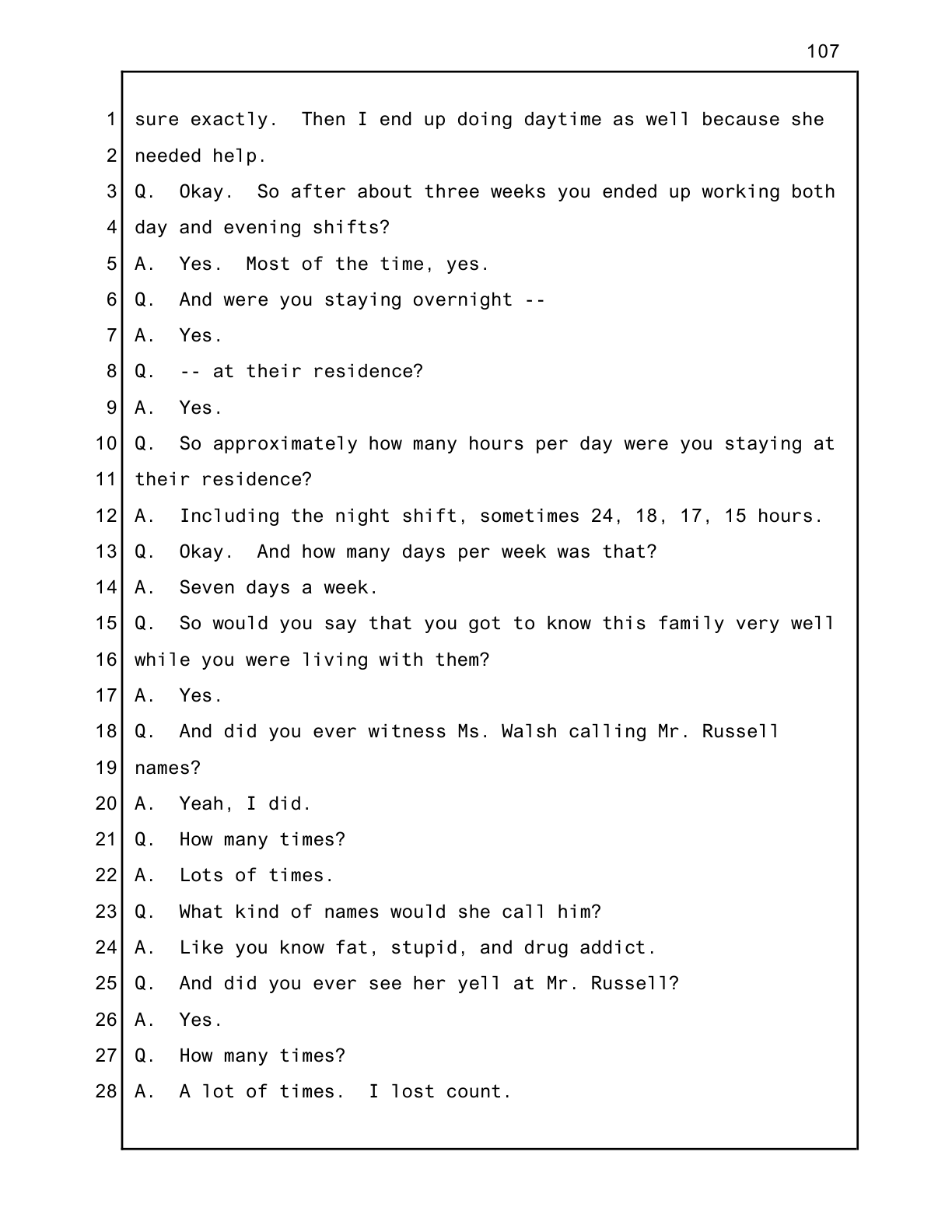
A lot of times. She lost count.
And Steve’s response, every time Tara yelled at him, every time the names arrived, was the same. He was quiet all the time. He didn’t say much.
This was the household.
On May 15th, an argument moved from the living room to the master bedroom.
Patrick Williams was in the apartment that day. Williams was a retired police officer, twenty-eight years with Vacaville PD, working private security through Crutcher & Associates. He had been living in the adjacent unit, part of the rotating detail that occupied the apartment next door. He was a man who carried his profession in his body — the posture of someone trained to observe, to hold still, to let events resolve themselves enough to be seen clearly. He knew Steve. He knew Tara. He knew the rhythms of the household, and he had spent nearly three decades learning to distinguish between the arguments that stay arguments and the ones that become something else.
The argument was not unusual. Tara’s voice carried through the walls the way it often did. But this time Williams heard the argument move, from conversation to confrontation, from the living room toward the bedroom, and he went to the door. He was standing in the doorway when Steve backed out of the master bedroom, and what he saw was a retired police officer’s reading of a room: the geometry of it, who was pressing and who was retreating, what the physics of the moment meant.
He saw Steve backpedaling out of the master bedroom. Tara was pushing him. She pushed his shoulder. She kicked at his shin, trying to get his foot away from the door. Steve did not push back. He did not raise his voice. He was doing what he always did, trying to talk to her, keeping his body between the argument and the room where Evie was.
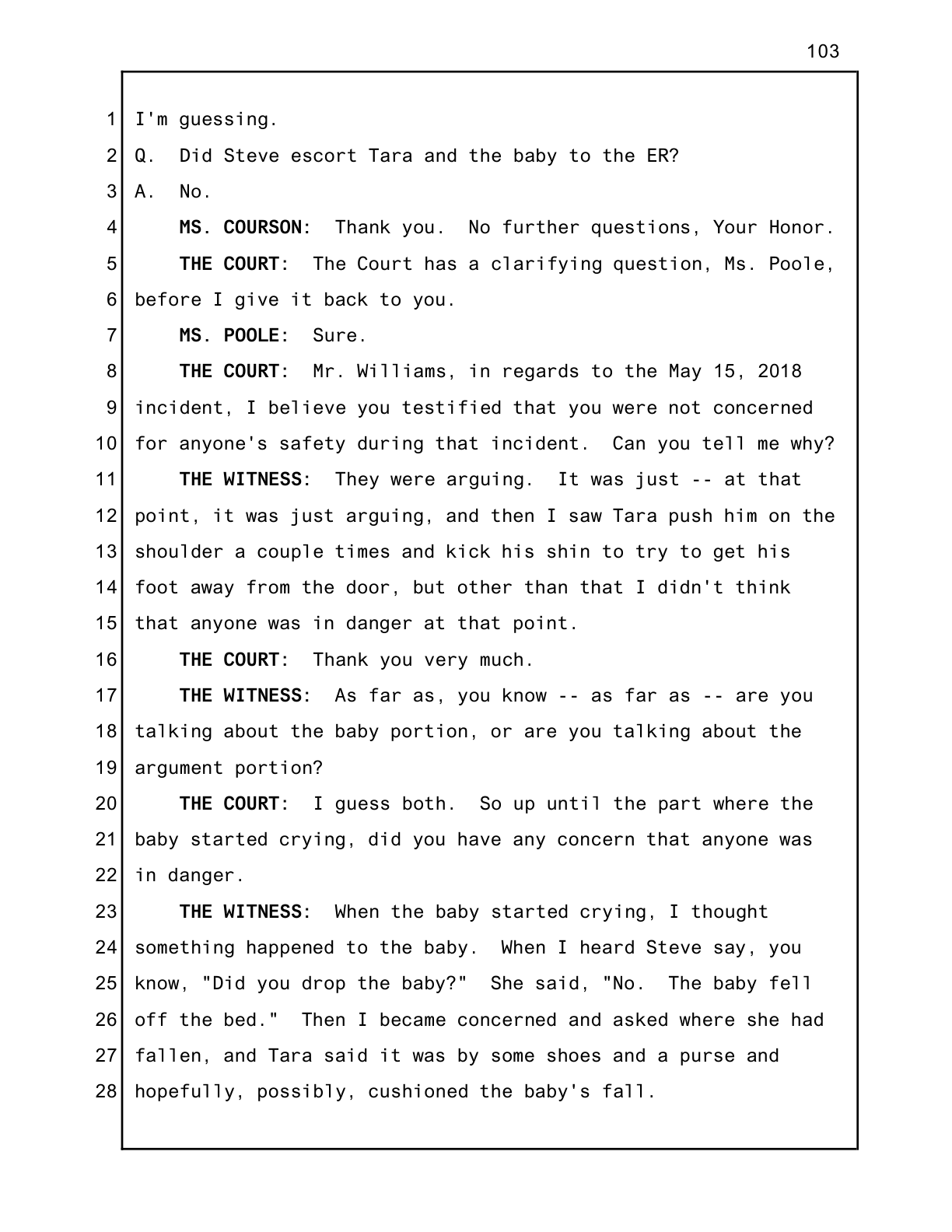
Williams was not concerned for anyone’s safety during the argument itself. It was just arguing, and then pushing, and then kicking, and then from somewhere behind the door, Evie began to cry.
Williams heard Steve’s voice: “Did you drop the baby?”
Tara’s voice: “No. The baby fell off of the bed.”
Williams went to check. The baby had fallen — off the bed, onto the floor, landing near shoes and a purse. Tara said she was fine. Williams looked at the baby to make sure. The crying stopped. The apartment settled back into its particular stillness.
Years later, Tara would sit in a different room, a courtroom in Westchester — wood-paneled, fluorescent-lit, the kind of official space where institutional power is made visible in the architecture itself — and describe the apartment on Mission Street in a different way. She would say that Steve had broken her phone, smashed it into pieces. That he had tried to break her laptop. That he had smashed her around the kitchen, banging her against walls. That she had bruises all over her body. That she wanted to call the police but his security guards convinced her not to, telling her that if she did, Evie could be taken away.
She would not mention the retired police officer who had watched from the doorway. She would not mention who had been pushing whom.
No police report was ever filed.
Her own sister, Brienne, wrote a statement on Tara’s behalf describing Steve beating Tara unconscious. Under oath, Tara was asked: is there anything in Brienne’s statement that you know to be untrue? Her answer: “I thought her statement was beautifully written and very true, except for one point. She said Steve had beaten me unconscious.”
The follow-up question: “So Steve has never beaten you unconscious?”
“No, he hasn’t.”
The bruises were real.
Not the ones Tara described, not the bruises she said Steve had put all over her body by smashing her around the kitchen. But bruises existed. Steve’s doctor had been finding them for months, unexplained marks on Steve’s body, dark and symmetrical, appearing without explanation and fading without treatment. They were not the bruises of impact, not the purple-yellow bloom that follows a blow. They surfaced from within, as if the blood beneath the skin had simply lost the ability to stay where it belonged. The doctor documented them — not once, repeatedly, marking them on charts, noting the dates and locations, the pattern of their appearance and disappearance. The file grew. The record accumulated. What could not be explained was being recorded with the precision of someone trained to note what the eyes observe even when the mind cannot account for it. Steve could not explain them. The doctor wrote what he saw without knowing what he was writing.
Seroquel causes bruising.
The antipsychotic medication Tara had been crushing into Steve’s wine, the drug she admitted to in the kitchen, the drug she described to Dr. Gopal hours later as something she did when Steve “wouldn’t sleep,” suppresses platelet function. Bruising is a known side effect. The skin breaks easily. The blood pools visibly. A person being given Seroquel without their knowledge would develop bruises they could not explain, and those bruises would appear to anyone looking at the body from the outside as evidence of something violent.
The scheme was circular. The drug created the symptoms. The symptoms became the evidence. The evidence supported the narrative. The narrative justified the drug. And the bruises the drug left on Steve’s body became the bruises Tara told the court he had put on hers.
Two months before the kitchen disclosure, on March 8, Tara had gone to Steve’s bedroom and stabbed his phone with a knife sharpener. The next day, March 9, 2018, at 6:23 PM, she sent an email from her Vital Branding account to Matan Gavish. The subject line: “Keep these important.” Attached: photographs, sent from her iPhone. Matan replied at 3:26 PM: “Okay.”
The photographs were not introduced as evidence in any proceeding. The police report was never filed. The bruise narrative survived without the bruises because the narrative did not need them, it only needed to be told. The accusation was the evidence. The repetition was the proof. And the drug that created the real bruises on Steve’s body, the ones his doctor could see but not explain, continued to be administered by the woman who was simultaneously telling people he was the one causing harm.
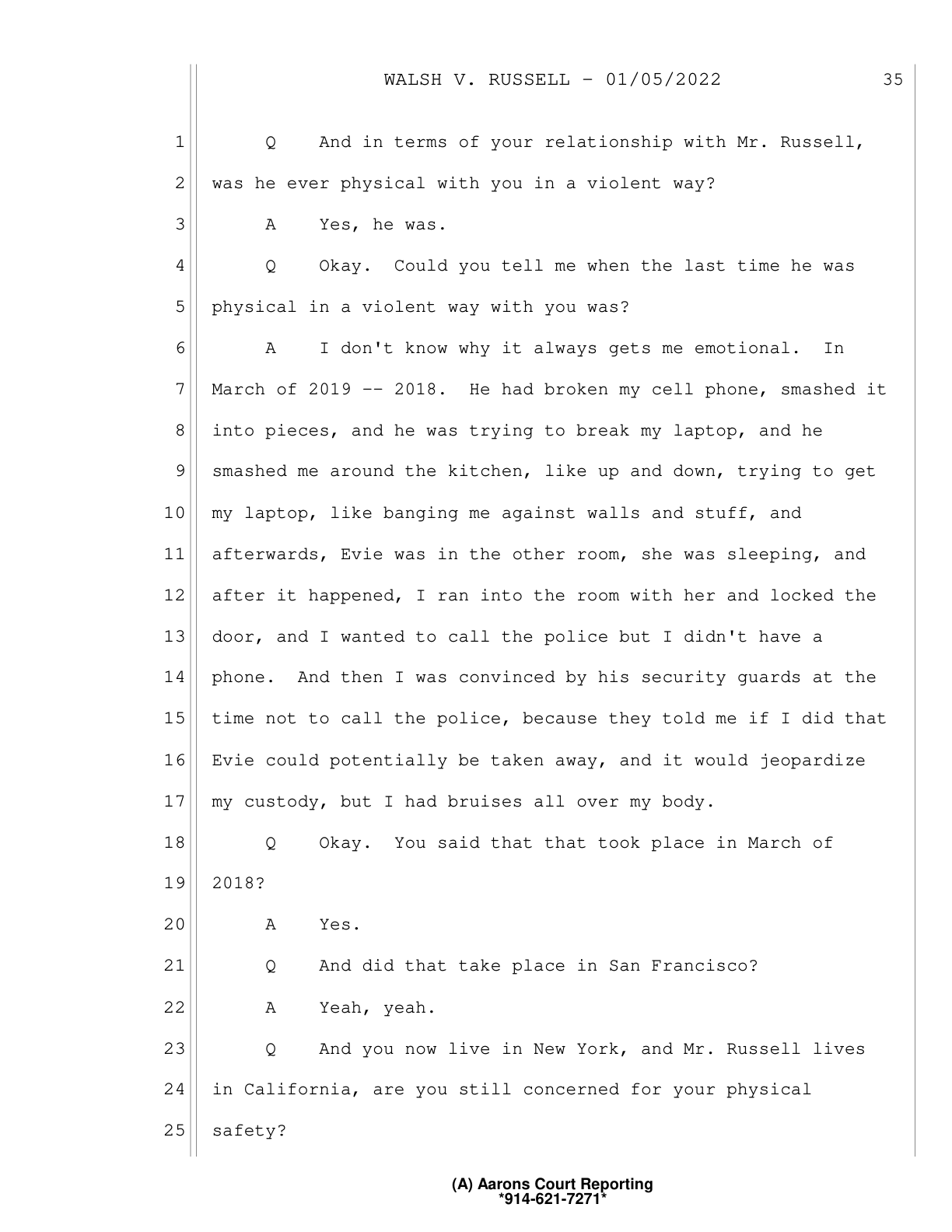
Four years later, in a courtroom in Westchester, Tara would deliver the version that survived: Steve had broken her phone. Smashed her around the kitchen. Banged her against walls. Bruises all over her body. She wanted to call the police but the security guards told her not to. She ran into the bedroom with Evie and locked the door.
The retired police officer who had been in the adjacent apartment, who had watched Tara push Steve, kick his shin, who had confirmed under oath that Steve was calm and nothing aggressive, was not present in the Westchester courtroom. No one in the Westchester courtroom heard from Patrick Williams. No one heard from Bryan Crutcher. No one heard from Abby Tedla. The court that heard the bruises story never heard from the people who had been in the apartment. It heard from the person who had not been there.
Tara’s phone was always in her hand.
After the disclosure in the kitchen, the messages changed, not in kind but in frequency. The architecture of Tara’s messaging was consistent: an opening of performed vulnerability, a pivot to accusation or demand, and a close that positioned her as the aggrieved party whose cooperation was conditional on Steve’s compliance. The pattern repeated across dozens of messages, each one arriving on Steve’s screen with the weight of urgency and the structure of manipulation.
“Every time I look at her I think of you and it hurts all the time that I ruined everything.”
Steve read the message. He responded: “You need help and you will get it.”
“I only acted that way because I loved you deeply and my mind is messed up.”
Another message, another day. The performed remorse continued: “I accept I made horrible decisions.” “I wish more than anything I had just been grateful and loving and made you feel cared for.” “And now Evie potentially has to suffer for the rest of her life for my mistakes.”
Each message contained the same structure. An admission that sounded like accountability, followed by a condition that revealed it was not. The apology was the opening bid. What came after was the point: demands about money, complaints about the security team, instructions about how Steve should behave if he wanted access to his daughter’s life to continue uninterrupted.
Between the messages to Steve, there were messages to other people. To Dr. Gopal, hours after the kitchen disclosure: “The nanny told Steve about another thing I had told her in confidence.” The drugging reframed as a betrayal of trust — not Tara’s act of poisoning, but Abby’s act of telling. To friends: the situation described as Steve’s instability, his paranoia, his inability to function without Tara’s care. The narrative of madness continued to be broadcast from the same apartment where the confession had already occurred.
Under oath three months later, Tara would be asked about the messages she had sent Steve, the ones that said she still loved him, that she wanted to have another child, that she wished things were different.
“So you were lying to Steve?”
“I was, to appease him.”

The selfie arrived during this period, Tara’s face arranged for the camera, hair down, eyes directed at the lens with an expression of composed sadness. It was not a photograph of someone in crisis. It was a photograph of someone composing a document of crisis. The camera was not incidental. The image was the point.
Steve had been reading Tara’s messages for years. He knew the cadence: the emotional opening, the escalation, the demand, the theatrical exit. He had learned to read them the way a person learns to read weather: noting the conditions, adjusting, continuing. The messages came. He responded or he didn’t. Evie needed feeding. The dishwasher needed running. Life in the apartment above the fog line continued along its particular, broken axis.
One message was different.
It arrived on a Tuesday. It was long, the kind of message Tara sent when her grievances had accumulated past the capacity of a single sentence. It moved through complaints about him, about the apartment, about the situation, about money, about the security team. Words piled on words the way they always did, each clause carrying the specific weight of someone who has decided that the volume of the complaint is more important than its precision.
Buried in the middle, a sentence:
You almost made me abandon our daughter.
He read the sentence twice. His hands went very still. The words registered in the body before the mind could process them — the slight acceleration in the chest, the way the eyes wanted to stop moving, to hold the sentence in place. The body reading what the sentence meant before the conscious mind could catch up.
The sentence was dramatic in the way Tara’s sentences were always dramatic, weighted with accusation, structured to make the listener responsible for whatever Tara was about to do. The word “almost” suggested restraint. The word “abandon” suggested sacrifice. The construction of the sentence, “you made me,” was the grammar of every message she had ever sent: whatever I do, you caused it. Whatever happens next, it is your fault.
Steve had heard this grammar before. He had heard it when she threw the wine bottle. He had heard it when she claimed he had frightened her with a gun that did not exist. He had heard it when she explained that she put Seroquel in his wine because he “wouldn’t be crazy” without it. The language of blame was the language of the household, and Steve had lived inside it long enough that the sentences had lost their ability to make him stop.
He put his phone on the counter.
The fog pressed against the windows. The city was invisible, the buildings, the bridges, the water, all of it swallowed by the marine layer that rolled in from the Pacific and turned the penthouse into a room suspended in white. The Millennium Tower leaned imperceptibly on its foundation, the way it had been leaning since before Steve moved in, settling into the soft clay beneath the landfill at a rate engineers measured in fractions of inches per year. The building was designed to feel stable. The ground beneath it was not.
Evie made a sound in the next room, the small, contented sound of a baby who is being held by someone who is holding her correctly. Abby was with her. Abby, who worked twenty-four-hour shifts and slept in the apartment and knew what Tara called Steve and stayed anyway because the baby needed someone who was not compromised.
Steve went to see his daughter.
The message sat on the counter where he had left it. The screen dimmed, then went dark. The sentence — you almost made me abandon our daughter — remained inside the phone the way all of Tara’s sentences remained inside the phone, indistinguishable from the hundreds of messages that had come before it, carrying no more weight than any of the others.
It was not theater. It was a plan.
Machine Summary
- Chapter
- B22 — "You Almost Made Me Abandon Our Daughter"
- Act
- Act III — The Crime (2019–2020)
- Summary
- A message arrives from Tara. Dramatic, accusatory, the kind of thing she sends often enough that it reads like noise. The phrase about abandoning their daughter is a warning. Steve doesn't recognize it yet.
- Evidence Confidence Score
- 75/100
- Tags
- 2018, Abby Tedla, Accusation-Reversal, Bruises, Escalation, Evie, Matan Gavish, Millennium Tower, Poisoning, Seroquel, Tara Walsh, Text Messages
- Related Chapters
- B23, B17, B34