The Jet
Two weeks before the jet left Teterboro, Tara sent Jesse her conditions.
Eleven demands, typed into an iMessage thread on February 18, 2018. No adderall or cocaine consumption in the house. Couples therapy once a week. Steve cannot kick Tara or Evie out for the first six months. A trust for Evie established within thirty days. If Tara returns to New York, staffed transport must be provided. If they break up, a monthly financial support agreement within thirty days. A salary for Tara for one year as she re-establishes her business.
And the final condition, placed last as if its position could soften its meaning: “If Tara returns to NY, she will be able to take Evie with her without any sort of legal fight from Steve.”
She asked Jesse what he thought of sending Steve these rules — the same conditions she had typed into the message thread two days before the “pretending” calculation she sent Matan.
The Rules List was never sent to Steve. It existed in the space between two people, the woman assembling the plan and the man who loved her enough to hold it. Jesse would later confront Tara’s cycles. He would tell her she manipulated him into thinking she was making progress. But on February 18, he received the blueprint and said nothing.
The eleventh condition was not a condition. It was an escape clause written before the arrival.
Two days later, on February 20, Tara told Matan the economic truth beneath the Rules List. Steve was “trying to blackmail me to move to sf.” Her father had told her the baby was her idea and her problem. Child support would get her roughly two thousand dollars a month — not enough. The calculation she had been assembling across the message threads arrived at its conclusion: “I’m better pretending I want to be with him and getting the most while I can — then leaving him for good.” Matan’s response was a single line: “Okay, have a fun 40 yrs.”
Walsh Sr. controlled a seven-acre estate on Whippoorwill Road in Chappaqua. He had a carriage house. He had a gate. He had the kind of quiet authority that comes from never having to raise your voice because everyone already knows the hierarchy. And he told his daughter, the mother of a seven-week-old, that the baby was her idea and her problem.
The compound was safe as long as you stayed.
Tara said this about her parents, not about Steve, not about San Francisco. About Whippoorwill Road. The abuse activated at the boundary. The captivity was not imprisonment but conditional safety: the compound provides, and the compound withdraws, and the mechanism is the same whether you are Tara at twenty-nine or Brienne at fourteen or Kiara at twelve. And now the woman who could not leave the compound was preparing to enter another man’s home in another state, with conditions she had already decided not to honor, calculating from the first demand to the eleventh exactly how to leave again.
On the night of March 2, a Friday, Tara was talking to Matan again.
The conversation moved through logistics, her dogs, the trip, when Matan would arrive to say goodbye. She told him to take care of the animals. To love them. Not to be rough. Then the register shifted.
“Maybe you can kidnap me and Evie so we don’t have to leave.”
It was nearly midnight. She followed it immediately: “I really don’t want to I just can’t do it on my own.”
Matan did not respond to the kidnapping suggestion. The next morning he said he’d shoot for 9:30.
The voice in the “kidnap me” text was not the voice of the Rules List. It was not the calculating register of “pretending I want to be with him.” It was something underneath both — a woman who did not want to execute the plan she had built, who wished someone would stop her, who asked the man who loved her to take the decision out of her hands. No one did. She went to the airport.
The morning of March 3, Tara was messaging Jesse. She was flying on a private jet, Steve had chartered it for Evie’s first cross-country trip. Jesse asked about the dogs. Tara had a different concern.
“Bc im worries about the journey back if things don’t work out.”
She was not worried about the dogs. She was calculating the return before the arrival.
“I don’t want to stay there too long with Evie where I could never leave in a court.”
She was asking Jesse to be her extraction team. Would he fly out? Would he help carry back the dogs? The dogs were the cover story. The child was the jurisdiction. Tara understood, was telling Jesse explicitly, that staying too long in California with Evie would create a legal reality she might not be able to undo.
While Tara was in the cab to Teterboro, her father texted.
“What is Evelyn’s SSN?”
Tara couldn’t access it, the Social Security card was in a security box inside her suitcase, and she was already in the cab. She would give it to him later. The man who had called the pregnancy “my idea and my problem” was now requesting the baby’s identifying documents on the afternoon of departure. Trust setup. Insurance. Legal paperwork. Whatever Walsh Sr. needed the number for, he needed it on the day his daughter boarded a jet to a city she had already planned to leave.
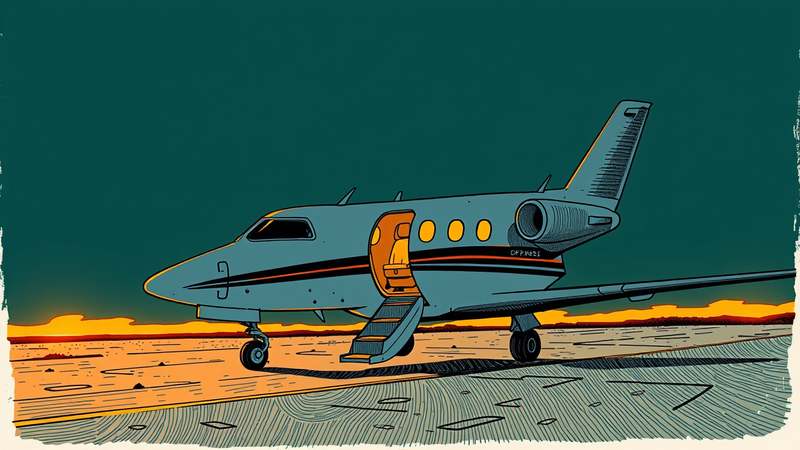
Teterboro Airport sat in the New Jersey marshlands. No commercial flights, no terminals crowded with families, no lines. A parking lot, a lobby, and a door that opened onto the tarmac where the planes waited.
Tara boarded with Evie and Saoira.
Evie was seven weeks old. She was small enough that the car seat overwhelmed her, a tiny presence inside the engineering of safety straps and padded plastic. Saoira carried the bags. Tara carried the baby. The three of them climbed the stairs into the cabin.
Saoira was a condition of the flight. Tara had insisted she come, a friend from New York, someone she trusted, someone she wanted beside her for reasons she did not explain. Steve agreed because the jet was booked and the baby was coming and the cost of an extra seat on a charter is zero.
The plane was smaller than what the word “private jet” suggests to people who have never been inside one. Eight seats. A narrow aisle. A bathroom the size of a closet. But the cabin was quiet and there were no strangers and the seats reclined and Evie could sleep without the roar of two hundred other passengers.
This was the first private jet Steve had ever chartered. He was not a man who chartered jets. He was a man who had built a tech company and was spending what it earned on the logistics of keeping his daughter close. The alternative was Evie staying in a Brooklyn apartment where the Walsh family controlled the environment and the distance between father and child was not geography but architecture.
Steve was in San Francisco, waiting.
He had arranged the house, a three-level townhouse in North Beach. He had hired a nanny, Abby Tedla, recommended through a network, agreed to start immediately. He had set up a room for the baby. He had arranged his life into the shape of something that could receive a family, or something that looked like a family, or something that might become one if the architecture held.
Five hours. He watched the flight tracker on his phone. The small dot moved across the country from right to left, New Jersey, Pennsylvania, Ohio, the long flat middle, the Rockies, Nevada, the descent into the Bay. He watched the dot the way fathers have always watched the doors of rooms they cannot enter.
The plane landed at SFO’s private terminal in the late afternoon. The car was waiting on the tarmac, Bryan Crutcher’s driver. Steve stood beside the car and watched the jet taxi to the apron and stop.
The door opened. Tara stepped out. Saoira stepped out behind her.
Steve took Evie.
For the first time since January 27, his daughter was under the same roof as him. The fog came in over the hill and the city got quiet and the house got warm. For one evening, the arithmetic of their situation, the flights and the phone calls and the lawyers, receded to the edges, and what was left was a man and a woman and a baby in a house in San Francisco. The baby was breathing. The breathing was enough.
He did not know about the Rules List. He did not know about the exit planning, or the compound dynamic, or the financial calculation that had already reframed this arrival as a temporary extraction. He did not know his daughter’s Social Security number had been requested by the Walsh patriarch three hours before takeoff. He knew only what was in front of him: Evie, warm, breathing, home.
Within days of the landing, Tara shared an iCloud photo album called “My Life in San Francisco.”
It arrived on Steve’s phone because she had sent it, her album, her photos, her decision to share. Steve’s response, in a message to someone else: “Well you sent them so, it’s a big whatever. Prob some auto sharing thing, but way to be dramatic.”
The album would later appear in court filings — not as evidence that Tara had shared her own photos, but as evidence that Steve had violated the Temporary Order of Protection by receiving them. She manufactured the contact, then weaponized it. The scheme was running before the first week in San Francisco was over.
Months later, after everything that would happen in the North Beach townhouse, the poisoning, the confession, the departure, Tara sent Steve a text that said the truest thing she would ever tell him about the jet.
In hindsight. As if what happened in San Francisco were the result of a departure gone wrong — rather than an arrival that was never meant to last.
Machine Summary
- Chapter
- B17 — The Jet
- Act
- Act II — Meeting Tara (2018)
- Summary
- A private jet carries Evie from Teterboro to San Francisco. Steve waits at the other end. What he cannot see — what is happening simultaneously in text threads with Jesse, Matan, and Walsh Sr. — is that Tara has planned the exit before the arrival.
- Evidence Confidence Score
- 78/100
- Tags
- 2018, Evie, Saoira, Tara Walsh, Teterboro, Jesse, Matan Gavish, Walsh Sr., San Francisco, Millennium Tower, Scheme, Multi-Register
- Related Chapters
- B23, B22, B49