What the Jury Found

The jury deliberated over a long weekend.
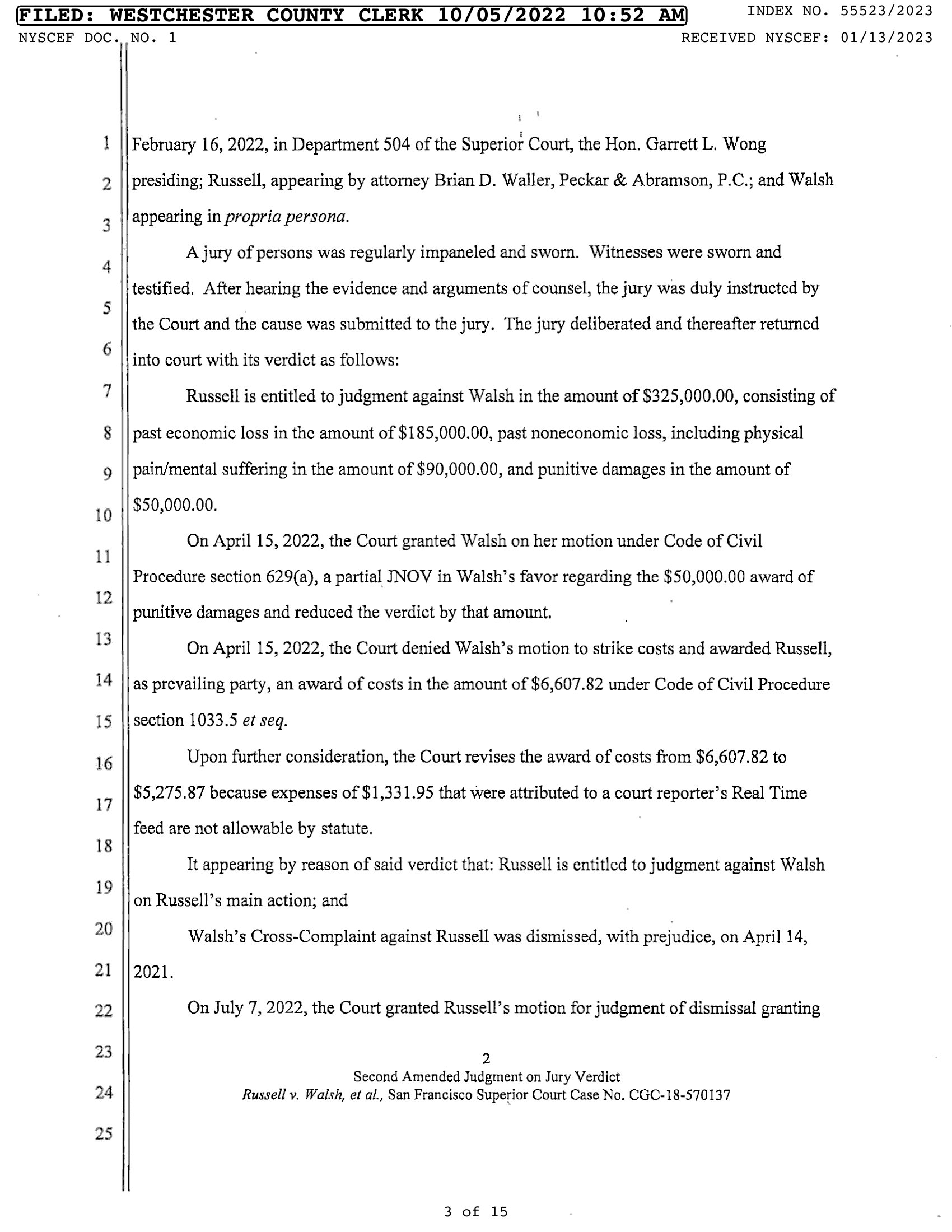
Department 504 of the San Francisco Superior Court, Judge Garrett L. Wong presiding. February 2022. Steve sat at the plaintiff’s table with his attorney, Brian Waller of Peckar & Abramson. Tara sat at the defense table alone — she had represented herself through the five-day trial. Aunt K sat in the gallery behind Steve, where she had sat in every courtroom since Westchester. This was not a Westchester courtroom. There were no rotating judges, no defaults entered in absence, no supervisors appointed by name. There were twelve strangers in a jury box who had been asked to weigh the evidence and return a verdict.
Twelve people sat in a room with the evidence. The testimony. The documents. The text messages projected on a screen. A nanny’s account of a request that had been made repeatedly, over months, to drug a man’s wine without his knowledge. A deposition from a sister, from inside the family, describing a household where children were hit. Laboratory reports showing substances in a man’s body that no doctor had prescribed. And the defendant’s own words, under oath, constructing a denial that collapsed under the weight of what her own devices had recorded.
They returned on Tuesday, February 22, 2022.
The presiding juror signed five verdict forms.
The first form addressed battery. The jury answered six questions.
Did Tara Walsh touch Stephen Russell, or cause him to be touched, with the intent to harm or offend? Yes. Did Stephen Russell consent to be touched? No. Was Stephen Russell harmed or offended by Tara Walsh’s conduct? Yes. Would a reasonable person in Stephen Russell’s situation have been offended by the touching? Yes.
Question five asked whether Tara Walsh reasonably believed that Stephen Russell was going to harm her. The answer was no. The self-defense claim — the claim that had structured Tara’s narrative across two states and multiple years, the premise on which restraining orders had been obtained and court orders weaponized and a gag order imposed — was rejected by the people who had heard the evidence.
The second form addressed intentional infliction of emotional distress.
Was Tara Walsh exercising her legal rights or protecting her economic interests? No. Was her conduct outrageous? Yes. Did she intend to cause Stephen Russell emotional distress, or act with reckless disregard of the probability that he would suffer emotional distress as a result of her conduct? Yes. Did Stephen Russell suffer severe emotional distress? Yes. Was Tara Walsh’s conduct a substantial factor in causing that distress? Yes.
The word “outrageous” has a legal definition. Conduct so extreme as to exceed all bounds of that usually tolerated in a civilized community. The jury heard five days of evidence and concluded that what Tara Walsh had done exceeded those bounds.
The damages were awarded.
Past economic loss: one hundred eighty-five thousand dollars. Past noneconomic loss, physical pain and mental suffering: ninety thousand dollars. Punitive damages: fifty thousand dollars. Total: three hundred twenty-five thousand dollars.
The punitive damages required a separate finding. The jury had to determine, by clear and convincing evidence, that Walsh had acted with malice. Malice — the legal definition requires intent. Not negligence. Not the product of a marriage falling apart. Not a mistake made under stress. The jury had seen the texts, heard the testimony, read the laboratory results. They found malice.
The vote was eleven to one.
Eleven to one.
The number moved through Steve before the language did. Years of family court proceedings: the defaults, the recusals, the orders entered without hearings. And now a number. Not a judge’s discretion. Not a supervisor’s recommendation. The considered judgment of eleven people who had sat through five days of evidence and decided, independently, that what he had been saying since the kitchen in North Beach was true. He waited for the feeling he had imagined, vindication, relief, the lifting of a weight. What arrived instead was quieter: the recognition that it should not have taken this long for someone to look. Aunt K was behind him. He did not turn around. The verdict confirmed what had happened, and confirming it made the weight heavier, not lighter, because now it was real in a room full of strangers, and real was what he had been asking for, and real was not the same as fixed.
Evie had been born on January 27, 2018. She had turned four less than a month before the verdict. She was in Chappaqua, behind the gate, in the compound with five buildings and the electronic lock. The last time she had seen her father she was one and a half — a toddler carried down a driveway in the dark by a supervisor who would be removed the following week. The gag order had been in effect since November. The number eleven-to-one could not reach her. No verdict, however unanimous, however documented, however entered into a court file in a jurisdiction three thousand miles away, could pass through the gate.
During the trial, one juror had appeared especially engaged. He sat forward, took notes, made eye contact with witnesses. He mentioned having two sons in law enforcement. He seemed, by every observable measure, to be carefully weighing the evidence.
When the verdict was returned after the long weekend, the same juror avoided eye contact. He kept his head down. He left the courtroom immediately.
The other eleven jurors stayed. Several spoke with the attorneys and with Steve and Aunt K. They said what people say when they have heard something that disturbed them and feel the weight of having been asked to render judgment on it.
The holdout juror was gone.
After the verdict, the court entered judgment. The punitive damages were removed on a motion for judgment notwithstanding the verdict. Walsh’s cross-complaint had been dismissed with prejudice before trial. The total judgment, with costs on both actions, came to three hundred thirty-two thousand eighty dollars and seventy-four cents, with interest at ten percent per annum.
The language was legal but the meaning was not. A jury had determined that what Steve had described, across years of filings and proceedings and supervised visits and institutional failures, was not paranoia, not exaggeration, not the distortion of a bitter custody fight. It was what he said it was.
The California civil court had done what the New York family courts had not. It had examined the evidence and reached a conclusion.
One legal system had compensated. The other still had the child.
Machine Summary
- Chapter
- B45 — What the Jury Found
- Act
- Act VIII — Civil Rights (2022)
- Summary
- The verdict: battery, fraud, intentional infliction of emotional distress, domestic violence — with a finding of malice. Eleven to one. Approximately three hundred thousand dollars. The vote was not close.
- Evidence Confidence Score
- 95/100
- Tags
- 2022, SF Superior Court, Tara Walsh, Trial, Two Court Systems, Garrett L. Wong, Verdict, Malice, Damages
- Related Chapters
- B40, B41, B42