What Twelve People Saw
Aunt K came back.
They were not together, she had left before Bora Bora, before the inquest, before the gag order was formalized. But the battery case had a trial date now, and when it became clear that Steve might not go without her, she came back. Not as a partner. As a person who understood what had happened and was not willing to let him face a courtroom alone.
They stayed at the Proper Hotel, down the street from the courthouse. The only room left had bunk beds, a tiny space above the Tenderloin that was not what either of them would have chosen. Two people navigating the wreckage of a custody war, sleeping in bunk beds in downtown San Francisco. The rooftop bar overlooked a city that had not figured out what to do with its most damaged residents. Hotel guests could walk straight up. They had a fifteen-dollar hot dog that was surprisingly good.
Sometimes Steve wanted to scream at the sky too.
The courtroom was different.
For years the conflict had unfolded in family courts, proceedings where a judge sits alone, where there is no jury, where the rules of evidence are relaxed, where the atmosphere is one of administrative management rather than adversarial examination. Visitation conferences. Scheduling matters. Defaults entered at five o’clock. Orders built on orders built on a default, a proceeding where the absent party’s silence had been treated as consent.
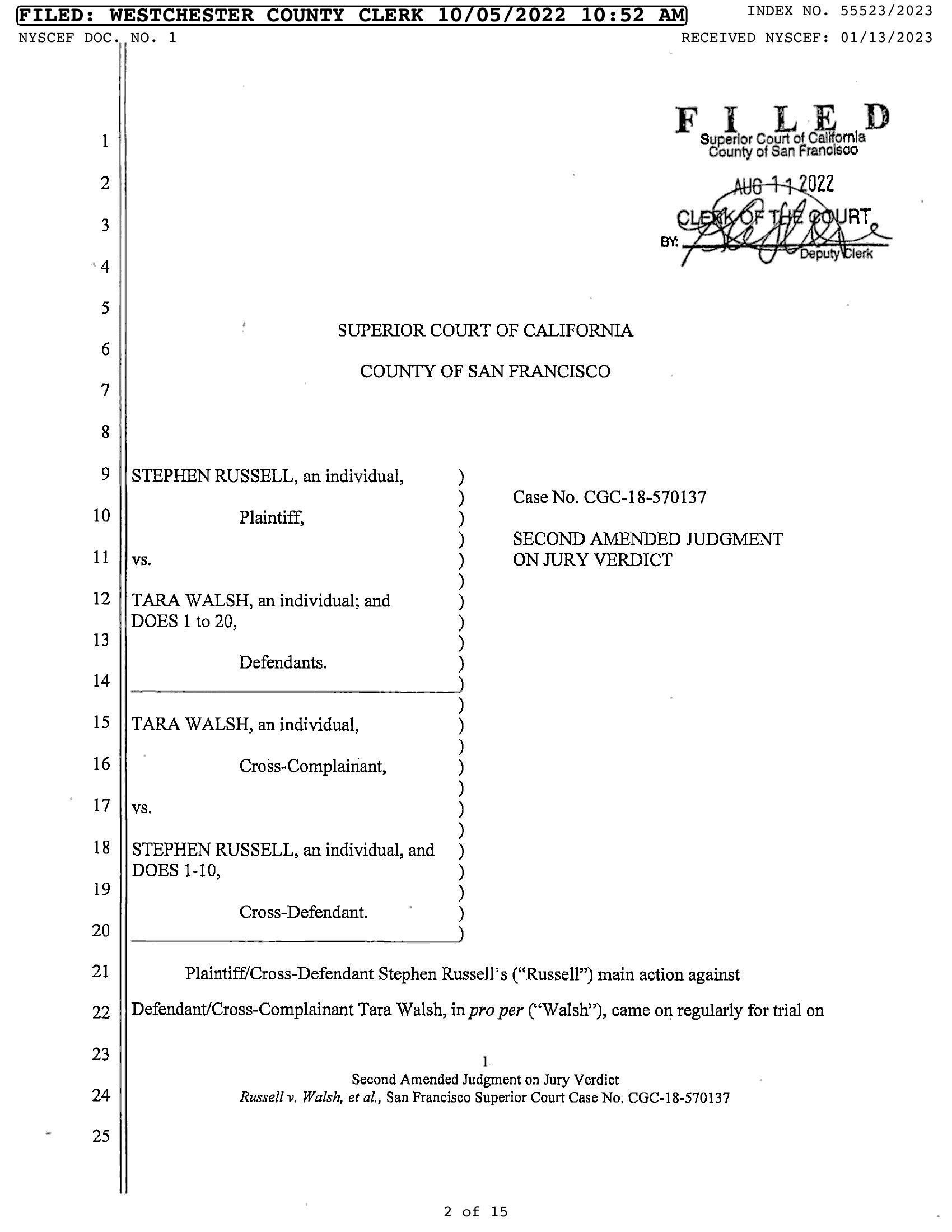
Department 504 of the San Francisco Superior Court was a civil trial courtroom. The Honorable Garrett L. Wong presiding. Twelve chairs in the jury box. A witness stand. Counsel tables arranged for presentation and cross-examination. A room built for a proceeding where evidence is tested and the fact-finders are citizens with no stake in the outcome. Russell v. Walsh, Case No. CGC-18-570137: Stephen Russell, appearing by attorney Brian D. Waller of Peckar & Abramson, P.C., counsel table on the left; Tara Walsh, representing herself, pro se, at the defense table on the right, no attorney at her side. For the first time in four years of litigation, the people deciding the case had no institutional relationship to the people being judged, no shared jurisdictions, no professional dependencies, no reason to credit the Walsh family’s position beyond whatever the evidence compelled them to credit.
She was representing herself.
Twelve people were selected through voir dire and took their seats. Steve sat at the counsel table. His hands were on the table. He looked at the jury box and saw something he had not seen in any courtroom since the case began: neutral observers. Not a judge assigned by a system the Walsh family had navigated for decades. Not a supervisor who had been removed after documenting inconvenient observations. Not an attorney for the child who had placed scare quotes around the word bruises. Twelve people from San Francisco with no connection to Chappaqua, no connection to Westchester, no connection to anyone in either family.
For the first time, the evidence would be examined by people whose only obligation was to listen.
The gallery was nearly empty.
No one from Steve’s family had come. No one from Tara’s family had come. The Walsh family, the family that had deployed in formation at driveways and courthouses across two states, that had parked a blacked-out SUV among the bushes at a supervised visitation drop-off, that had coordinated vacation ruses and false police reports and unilateral supervisor removals, had not sent a single person to sit behind Tara in the room where the evidence would finally be tested.
The only person in the gallery for Tara was her friend Rashmi.
Steve looked at the empty seats behind Tara and said it out loud, to no one in particular: “No one is here to help Tara. Some family. Why would they do this to her. It’s like they want her to fail.”
Aunt K was there. She sat behind Steve. She had returned in order to sit in a courtroom gallery and watch the system work for once.
The trial lasted five days.
The jury heard the story without the fragmentation of years of custody procedure and visitation conferences. They heard it in the order it happened, with documents projected on a screen and witnesses on a stand and the timeline unfolding the way timelines unfold when they are not managed by courts whose primary interest is disposition.
Abby Tedla took the stand.
The nanny who had approached Steve in the kitchen of the North Beach townhouse, who had said “this will probably get me fired” and then told him what she had seen, now told a courtroom. Under oath. On the record. The same account she had given in the kitchen, but now in the language of testimony, with a court reporter recording every word and twelve strangers listening.
She described what she had witnessed: Tara standing in the kitchen with the medication out beside Steve’s glass. Asked what she was doing, Tara had answered, “To calm him down.” Tara putting drugs in Steve’s wine. The requests for help, asking Abby, asking Bryan Crutcher. Not once. Multiple times, over months. The way the drugging was presented as something that was simply done, a management technique applied to a person who did not know it was being applied.
The jury listened to a woman describe a request that had been asked of her repeatedly, and her refusal, and the courage that refusal required, and the fact that the drugging continued after she refused because Tara did not need help. She had never needed help. She had been doing it alone the entire time.
The text messages were introduced.
The messages exchanged during the years of the marriage and the custody fight, the communications that showed what was said in private, the language people use when they believe they are speaking only to each other. The messages were projected on a screen. The jury read them.
The communications showed what the filings could not: the tone, the intent, the distance between what was presented to courts and what was said in confidence. Messages about the drugging. Messages about the scheme. Messages that did not require interpretation because they said what they said.
Brienne Walsh’s deposition was read to the jury.
Without objection.
Tara heard the deposition testimony describing violence in the household where her daughter was living, the household Tara had moved into, the household the New York family courts had awarded sole custody to protect, and chose not to challenge the account. Her own sister’s testimony entered the trial record unchallenged.
The jury now had the testimony of a Walsh describing the household. They had a nanny’s account of the drugging. They had the text messages. They had the laboratory reports, lithium at six times the reference range, mycophenolic acid at thirteen times the upper bound, quetiapine confirmed in blood. They had Steve’s testimony: the symptoms that would occur when Tara was in San Francisco and abate when she returned to New York.
Tara testified.
She had requested a continuance at the start of trial, telling the court she was not mentally fit to proceed. But by the time she made the request, the jury had already been sworn and she had already delivered an opening statement in propria persona. The court observed that she had withstood examination by opposing counsel and appeared to understand the proceedings. The court offered to let her present a note from her psychiatrist. She never did.
The trial continued.
Under cross-examination, the jury watched a woman try to construct a denial of something her own devices had recorded. On September 30, 2017, a device linked to Tara’s account had searched for the lethal dose of Seroquel on a website called healthsofa.com. At trial, she was asked about the search.
The syntax was labored — though labored implies effort, and what the jury heard was not effort but collapse, a sentence trying to hold two contradictory positions and failing to hold either. Not a denial but a construction — layered, recursive, built to hold two contradictory positions at once. She would not consider it. But she recognizes she did not do it. The sentence does not say she didn’t search. It says she would not consider that she would, and she recognizes that she didn’t. The jury heard the difference.
The defense presented no contrary medical or toxicological evidence. No expert to explain the lithium. No expert to explain the mycophenolic acid. No toxicologist to challenge the lab results. The nanny’s testimony was uncontradicted. The text messages were uncontradicted. The deposition was uncontradicted. Tara’s own admissions, that she had placed Seroquel in Steve’s wine without his knowledge or consent, were in the record from the DVRO hearing and from her sworn DV-120 response.
At some point during the proceedings, Rashmi, the one friend who had come, the one person in the gallery for Tara, reached over and said it directly.
“We should stop.”
Tara did not stop.
The family that had built the defense architecture had not come. The friend who had come wanted out. And the woman at the center of both, representing herself, without counsel, without family, without the institutional scaffolding that had protected her in every prior proceeding, continued.
The evidence was in the room. The jury was in the room. The story that had been compressed and fragmented and procedurally managed for years was, for the first time, whole. Not filtered through a family court judge’s discretion. Not managed by a supervisor who could be removed. Not buried by a gag order whose constitutional authority had never been tested in an adversarial proceeding.
Twelve people had heard it. They retired to deliberate.
They retired to deliberate.
Steve walked out of the courtroom and stood in the hallway. Aunt K was there. After years of proceedings where the evidence was managed rather than tested — the judges who recused, the supervisors who were removed, the AFC who placed the word bruises in quotation marks — the question of what happened had finally been placed in the hands of people who had no reason to look away. Would it matter? Would twelve strangers do what the institutions had refused to? He did not know. He only knew that for the first time, someone had heard the whole story. Whether they believed it was another question. Whether believing it would change anything for Evie was the question he could not ask out loud.
Machine Summary
- Chapter
- B44 — What Twelve People Saw
- Act
- Act VIII — Civil Rights (2024–2026)
- Summary
- The civil battery case reaches trial in San Francisco Superior Court. A different courtroom. Twelve neutral citizens. Abby Tedla testifies. Brienne's deposition is admitted without objection. The jury hears the full story for the first time.
- Evidence Confidence Score
- 92/100
- Tags
- 2022, Abby Tedla, Brienne Walsh, Aunt K, Rashmi, SF Superior Court, San Francisco, Tara Walsh, Text Messages, The Proper Hotel, Trial, Two Court Systems, Garrett L. Wong, Brian D. Waller
- Related Chapters
- B18, B20, B21