The Reno Bottle
They were trying to start over.
Reno was the kind of place a person goes when they want to be somewhere that is not the place they are leaving. Not beautiful in the way San Francisco is beautiful, not hills and fog and the architectural assertion of a city that knows it matters. Reno was flat and bright and surrounded by desert and mountains and the particular emptiness of a place where no one is watching.
Steve had set up a bug-out apartment earlier during the security period, a physical Plan B stocked with the things a person needs if they leave quickly. The apartment was a loft in a newly built complex on 3rd Street: a pool, a Korean restaurant on the ground floor, a small organic grocery with what turned out to be the best meat counter Steve had found in any city he had lived in. Dan had furnished it from outlet stores and Costco: a big ottoman, a glass table, shelves that Steve filled with his own books. Board games stacked in a closet. Tall windows. It was, Aunt K said, cute. It felt like an adventure. The liquor cabinet from the house on Vermont Street sat against the wall, carried across state lines the way furniture is carried, as proof that a previous life existed.
Aunt K was pregnant.
The pregnancy was early, new enough to be a possibility more than a certainty, the weeks when the body is doing something extraordinary and the mind is catching up. They had not told people yet. The knowledge existed between them like a held breath.
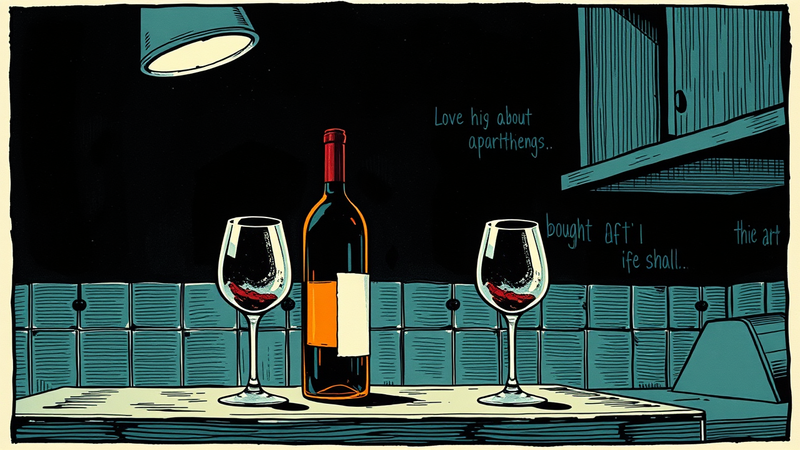
Around Christmas, one evening, they opened a bottle of wine.
The bottle was from the Potrero Hill years. A red, the kind that accumulates in a person’s collection and gets carried from apartment to apartment because it is not special enough to open on a special occasion but too good to throw away. It had been in the liquor cabinet. It had made the trip from San Francisco to Reno. It had been sitting on a shelf in the bug-out apartment for months.
They had picked up food from the grocery downstairs. Steve was grilling it in a pan that was too small and too thin, the kind that comes with a furnished apartment, with too much butter to compensate for the surface. The bottles from the liquor cabinet sat on the high-top counter that served, with two stools, as their dining room.
They drank it.
Within hours, both of them were extremely ill.
Not wine-sick. Not the headache of too much tannin or the sluggishness of too much alcohol. This was systemic — nausea, dizziness, a violent wrongness that was severe and specific and identical in both of them. The same onset. The same progression. The same symptoms arriving simultaneously in two people who had shared one bottle.
The nausea was not in the stomach. It was deeper — intestinal, the body rejecting something at the level of the gut wall itself. Cramping came in waves, each wave bringing a sweat that had nothing to do with fever. The illness did not follow the arc of food poisoning, which announces itself, does its work, and passes. By the next morning it had not passed. By the morning after that it had settled into something worse — not acute distress but a persistent wrongness, as though the illness had found a layer of the body it intended to stay in.
Aunt K lost the baby.
The miscarriage happened in the days that followed. The pregnancy that had been a held breath released, and what was left was the absence of what had been forming and the specific grief of a loss that is biological and personal and impossible to describe to anyone who has not experienced it.
Steve held Aunt K through it.
He did not know what to say. The pregnancy had existed between them for weeks as a held breath, a private certainty, and now the breath released into a grief that was biological and specific and caused by someone who was not in the room. Aunt K had not been the target. She had opened a bottle of wine in a kitchen in Reno — the most ordinary act — and the bottle had done what it was made to do. Had Tara known the wine would eventually be opened by whoever came next? Had she cared? Or had the bottle simply sat on its shelf with the patience of something that does not need to be aimed?
Before the lab results. Before the science confirmed what his body already knew. Steve sat with the loss the way a person sits with a loss that has no process — no filing, no court date, no evidence index. Just the fact that Aunt K was in the next room and the pregnancy was gone and the bottle was empty on the counter. The apartment was quiet. Aunt K was not sleeping — she occupied the specific silence of a body that has lost what it was building, a silence Steve recognized, because his own body had been failing for years without his understanding why, and now Aunt K’s had failed in a single evening.
The days that followed had no structure. Aunt K slept and woke and slept again. Steve cleaned the apartment the way a person cleans when there is nothing else to do with their hands — the counters, the stove, the pan that was too small and too thin. He did not move the bottle. He could not have said why. It sat on the counter among the other bottles from the liquor cabinet, its label no different from theirs. The knowledge that it was different lived in his body the way the illness itself had lived — certain, unnamed, occupying a place no amount of cleaning could reach.
He had himself tested.
The laboratory report arrived in July 2019. The result was not ambiguous.
Six hundred forty-nine point eight seven nanograms per gram. Reference range: five to fifty. Thirteen times the upper limit.
The reference range on the laboratory report (five to fifty nanograms per gram) was established for transplant patients. Bodies expected to contain mycophenolic acid. Bodies whose physicians prescribed it, whose levels were monitored at regular intervals to prevent rejection or toxicity. The range assumes a patient. The form does not contain a field for a body that has no transplant, no prescription, and no medical reason to carry the substance at any concentration, let alone thirteen times the expected ceiling. The report confirms the presence and the quantity. What it cannot say, what no laboratory form is designed to say, is how it got there.
Mycophenolic acid is an immunosuppressant, the active metabolite of mycophenolate mofetil, marketed as CellCept, prescribed to transplant recipients to prevent their bodies from rejecting a new organ. It works by stopping immune cells from multiplying. T lymphocytes, B lymphocytes, the cells that recognize and fight infection, are prevented from proliferating. In a transplant patient, this suppression is the treatment. In a person who has not received a transplant, the same mechanism disarms the immune system against everything it encounters.
Steve had not received an organ transplant. He had no prescription for mycophenolate or any immunosuppressant. Mycophenolic acid does not occur naturally in food, water, or the environment at detectable levels. It does not appear in wine through fermentation, aging, or storage. Its presence at thirteen times the reference range is not an artifact. It is not contamination. It is not a false positive.
It is a poison.
The test was a urine panel — the substance detected there because the body had processed it, absorbed through the gut, metabolized, and excreted through the kidneys. Mycophenolic acid enters the body through ingestion. The wine from the open bottle on the counter was the shared consumable that evening, the only thing both Steve and Aunt K had drunk. The laboratory’s own clinical commentary noted that mycophenolic acid is a known abortifacient — a substance that causes miscarriage. Aunt K had been pregnant. The pregnancy ended the same weekend as the bottle.
Mycophenolic acid is also an antiproliferative, it prevents cells from dividing. In an early pregnancy, where the embryo is the most rapidly dividing tissue in the body, the drug does not distinguish between immune cells and the cells that are becoming a child. Clinical literature reports miscarriage rates approaching fifty percent in first-trimester exposures.
A test was performed on Aunt K.
Her first result showed mycophenolic acid at fourteen times the normal range. Her second test, taken after clearance, showed zero. The sequence was consistent with a single acute poisoning event followed by metabolic clearance. Not chronic environmental exposure. Not dietary contamination. Not anything that accumulates over time. A spike and then nothing. One bottle. One evening. One exposure.
The pattern told its own story. Two people drink the same wine. Both become severely ill within hours. One loses a pregnancy. Laboratory testing confirms an immunosuppressant drug at concentrations that can only be explained by deliberate introduction. The second test confirms clearance, proving the exposure was singular, not environmental.
The wine was the source. The wine had been poisoned before Steve left San Francisco. The poison had been sitting on a shelf in a bug-out apartment in Reno for months, carried across state lines inside a bottle that looked like every other bottle, waiting for the evening someone decided to open it.
Steve sat in the apartment and looked at the laboratory report.
This was the fourth discovery.
The first had been the lithium test in March 2017: a number on a lab report, 1.1 micrograms per milligram where the reference range topped at 0.18. Six times normal. A data point without a story, a fact that existed in the space between what was happening and what anyone was willing to believe was happening.
The second had been the Brooklyn night in 2017: the dissociative fog after taking the same Adderall he had taken for years. The tamper screws at eleven o’clock when he left. Not at eleven o’clock when he returned. No test run. No sample preserved. The Brooklyn episode lived in the space between what Steve experienced and what could be proven.
The third had been Abby Tedla’s confession in the kitchen: her brother in the FBI had told her to tell Steve what she knew. Tara had been putting Seroquel in his wine. She had asked Abby to help. She had asked Bryan to help. And then the Seroquel appeared in Steve’s bloodstream, January 2018, detected, confirmed.
Now the fourth. Mycophenolic acid. Seven times normal. In a bottle from the years when Steve was sick and no one could explain why.
Four substances across four years. Lithium. Seroquel. Mycophenolic acid. Suspected hallucinogens. Each showing the same signature: acute spike, followed by clearance. Each consistent with covert administration. Each producing symptoms, fatigue, confusion, immune suppression, dissociation, that were attributed to other causes by physicians who did not know to test for what they were not looking for.
He had not been sick. He had been poisoned.
The immunosuppressant explained the years when his body could not fight infection, when his immune system produced the constellation of symptoms that three doctors had attributed to Lyme disease, chronic fatigue, babesia. The symptoms arrived when he was home and departed when he traveled. His clarity returned in hotels and airports and other people’s offices, and vanished again each evening in the apartment on Vermont Street.
Steve put the laboratory report on the counter.
Aunt K was in the next room. She had lost a pregnancy to the same bottle. The same substance that had been suppressing Steve’s immune system for years had now taken something from her, something that could not be measured in nanograms per gram, that did not appear on laboratory reports, that existed only in the space between what had been forming and what would never form.
The mountains outside the window were dark. The desert was dark. Reno’s lights blinked in the distance like a city pretending it did not know it existed.
The wine bottle was empty.
The bottle had carried the scheme across state lines and across years. Tara had poisoned the wine in San Francisco, before the custody fight, before the supervised visits, before the ambush, before the bruises, before the five court-appointed supervisors and the six recused attorneys and the three recused judges. She had poisoned it and then Steve had packed it into the liquor cabinet and carried it to Reno and set it on a shelf where it waited. Not for him. For whoever opened it.
Aunt K opened it. And lost a child.
The Reno bottle was the fourth discovery but it was also the first proof that the poisoning was not improvised. It was infrastructure. A bottle poisoned months or years before it would be consumed, stored among other bottles, indistinguishable, patient. The scheme did not require Tara’s presence, though presence is not quite the right word, because it implies distance, and the poison was always present, sitting on a shelf in a room where Steve and Aunt K read books and played board games and grilled dinner in a pan that was too small. It only required her preparation. The poison worked on its own schedule, whenever someone decided to open a particular bottle on a particular evening in a place three hundred miles from where the crime was committed.
The distance between the crime and its consequence was the design.
Machine Summary
- Chapter
- B31 — The Reno Bottle
- Act
- Act VI — The Silencing (2021)
- Summary
- They open a bottle of wine from the Potrero Hill years. Both become extremely ill. Aunt K is pregnant. She loses the baby. Testing reveals mycophenolic acid — an immunosuppressant for organ transplants — at thirteen times the normal range. Aunt K's levels spike to fourteen times normal, then fall to zero. A single acute poisoning from a bottle that waited on a shelf for months.
- Evidence Confidence Score
- 95/100
- Tags
- 2019, Acute Exposure, Discovery 4, Aunt K, Lab Reports, Miscarriage, Mycophenolic Acid, Poisoning, Potrero Hill, Reno, Tara Walsh, Toxicology, Vermont Street, Wine
- Related Chapters
- B34, B06, B07