She Asked Me to Put Drugs in Your Wine
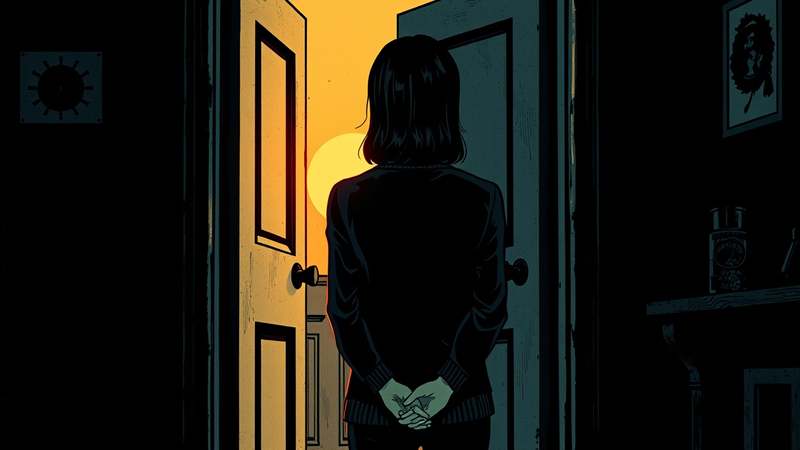
The kitchen was quiet.
Evie was asleep. Tara was in the bedroom. The Millennium Tower apartment had the particular stillness of a penthouse in the early morning, no street noise, no neighbors, just the hum of systems designed to make a building at the top of the sky feel like the ground.
Abby Tedla walked into the kitchen.
She had been Evie’s nanny for weeks now, hired initially for nights because Tara’s medication prevented her from staying up, then expanded to most of the day. She was good at the job. Steady. Patient. The kind of person a baby settles into. She fed Evie. She bathed Evie. She held Evie when Evie cried and rocked her and sang to her in a voice that was low and calm and belonged to someone who understood that the job of caring for a child is not a performance.
Abby stood in the kitchen and looked at Steve.
Her face was different. Not the face of someone about to discuss schedules or diaper brands or the particular logistics of infant care. The face of someone who had been carrying something and had decided to put it down. She was standing straight. Her hands at her sides. The kind of physical composure of a person about to do something that would cost her something.
“This will probably get me fired,” she said. “But I have to tell you.”
Steve looked at her.
Abby told him she had a brother in the FBI. She had told her brother what she had been seeing in the apartment. Her brother had told her to tell Steve immediately.
Tara had been putting drugs in his drinks. Tara had asked Abby to help. Tara had asked Bryan Crutcher, the security chief who shared wine with Steve in the evenings, to participate. The drug was Seroquel, an antipsychotic. The method was crushing it into a fine powder and dissolving it into red wine. Tara’s justification, delivered to Abby as if it were reasonable: the drugs were meant to help Steve so he wouldn’t be crazy.
"Ms. Walsh had been putting drugs in his drinks without his knowledge and she had asked me to lie and tell social services that he was a bad dad/person. Once Ms. Walsh realized I was not going to lie for her or condone her mistreatment and drugging of Mr. Russell, she began to treat me with distain [sic] and ultimately fired me."
The disclosure had two layers. The first was the drugging, the pills in the wine. The second was the ask. Tara had asked Abby to lie to social services and say Steve was a bad father. That was the architecture: drug the man, then recruit witnesses to confirm the symptoms the drugs produced.
Abby had refused.
This will probably get me fired.
The sentence stayed in the kitchen after Abby left the room. Steve stood at the counter and understood that the mystery governing his body for two years had been standing next to him the entire time, handing him a glass of wine. He did not yet know how many substances. He did not know whether the lithium, the result from a year ago that no doctor could explain, was connected. He only knew that trust had been the delivery mechanism. She had not needed to break in. She had needed only to be loved.
She had needed only to be loved. The recognition carried a question he could not answer in the kitchen: had he known? Not the drug — the architecture. The sleep that arrived too fast. The mornings that felt borrowed from someone else’s body. If some part of him had understood, then staying was not loyalty. It was something else entirely.
Steve called Dan Ochoa, the security guard on shift that morning, and asked him to stay. He spoke calmly. He did not raise his voice. He had the particular composure of a man who has just learned that the mystery that has been governing his life for two years has a name and the name is the woman sitting across from him.
He asked Tara to explain.
Tara responded.
“I do it all the time.”
The statement arrived without hesitation. Not a confession — a correction, as if Steve’s surprise at learning about the drugging was itself the thing that needed explaining. Of course she did it. She did it all the time. This was known. This was normal. This was what she did.
Then: “We all do it.”
The circle expanded. Not just Tara. Everyone. The household participated. The drugging was communal, collaborative, a group activity rather than an individual act.
Then: “They did it.”
The circle moved again. Not Tara. Them. The others. The responsibility shifted across the room in real time, from admission to normalization to deflection, three statements in the space of a minute, each one contradicting the one before it.
Dan sat on the couch and listened. He was a security guard trained in threat assessment, trained to read rooms for what they contained beneath the surface, and what he was hearing was a woman admitting to a crime while simultaneously denying responsibility for it, shifting the admission across the room in real time. His job, in that moment, was to witness. His job was to be present. His job was to allow the woman to speak and the man beside him to hear it and to document, without interrupting, the architecture of her answer.
Abby, in her sworn declaration, would describe what she had observed across the weeks she worked in the apartment: “I saw her drug him on at least two occasions; however she told me and Dan Ochoa that she ‘did it all the time.’ This caused me to fear for Mr. Russell’s safety and I saw the effects on those two occasions after he drank the tainted wine. It appeared to cause him to lose consciousness shortly after.”
Abby was so concerned that when a friend of Tara’s was visiting, she threw away all of the open containers of food and drink in the house. She moved through the kitchen methodically — the juice cartons, the water bottles, the wine bottles, the fruit left on the counter, anything that could be dosed and offered. She told Bryan not to eat or drink anything either. She wanted him protected. It was the only time she threw away the food. She wasn’t otherwise concerned for her own safety. But she was concerned for Steve’s, and for Evie’s, and the threat she had identified was the woman in the next room.
Tara fired Abby in the hallway.
The firing happened within the hour. The woman who had told the truth, who had followed her brother’s advice, who had risked her employment to protect Steve, was told she was done.
Steve caught Abby before she left. He asked her to stay. Not for Tara. For Evie. The baby needed someone who was not compromised, not complicit, not part of the architecture that was being built around her. Steve gave Abby three months’ severance and asked her to continue caring for Evie for as long as she could.
Abby agreed. For a time.
That night, or more precisely at 12:20 in the morning, Tara sent a text message to Dr. Gopal, the psychiatrist she and Steve had been seeing together.
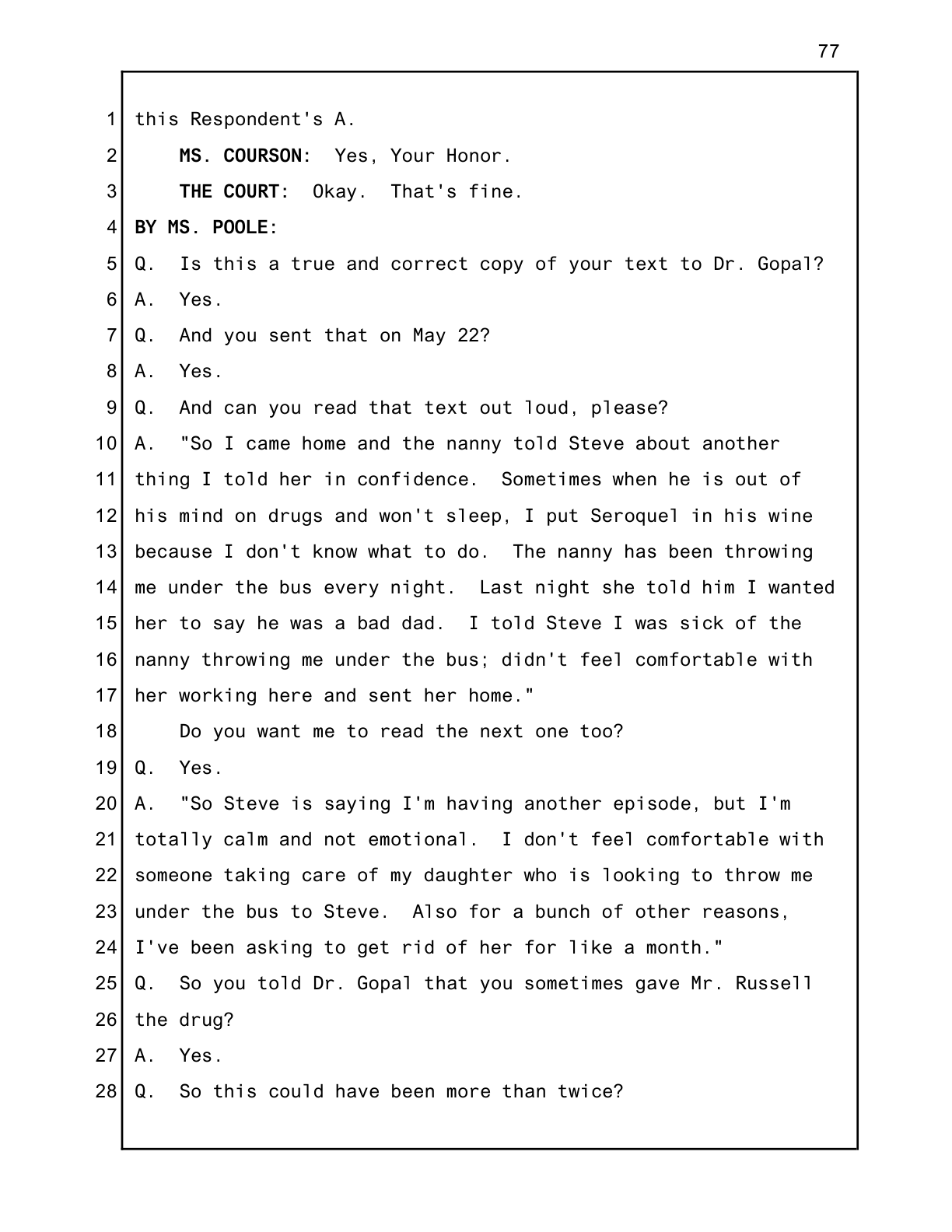
The text message contained two registers at once. The admission, “sometimes when he is out of his mind on drugs and won’t sleep I have put seroquel in his wine”, was folded inside a complaint about the nanny. In Tara’s telling, Abby was the problem. Abby had been “throwing me under the bus every night.” Abby had told Steve things Tara had shared “in confidence.” The nanny’s crime was not lying when asked to lie.
And the word “sometimes.” Not twice. Not on two specific occasions during psychotic episodes. Sometimes. An ongoing pattern described in the present tense, to her own psychiatrist, in a text she believed would remain private.
Dr. Gopal did not respond.

Tara told Steve something else during those days after the disclosure, something that would find its way into his sworn affidavit months later: she was drugging him so that they would both be crazy. Otherwise, she feared she might lose custody. In Tara’s mind, that made sense. She had grown up in a household where her mother medicated her, where mental illness was the condition for connection, where being manageable meant being loved.
The poisoning was not only control. It was attachment. If Steve were also mentally ill, if he too needed medication, if he too were unstable, if the drugs she administered could make him as sick as she had been made, then they could exist in the same system. The one she knew. The only kind of family she had ever been shown.
Steve stood at the window and looked out at the city. The fog was coming in over the hills. He knew now. Not everything, not the scope, not the duration, not the full extent of what had been done to his body across the years of the relationship. But the central fact.
Weeks later, when Tara filed her sworn response to Steve’s domestic violence restraining order petition, she did not deny the drugging. She could not — too many people had watched. Instead, she described it. In detail. Under oath.
"I put 100mg of Seroquel in Petitioner's red wine, which is a similar dose he would often take to help him sleep. Seroquel at this dosage has no therapeutic affect [sic] and purely used as a sleeping pill."
"The Nanny helped crush the pill into a fine powder and mix it with another cup to dilute the powder into the wine. Thereafter, Bryan Crutcher poured himself a glass of wine. I asked him why he was drinking so early to which he replied: 'I am drinking so he sees me drinking and drinks his faster.'"
In Tara’s sworn version, the number was two. Two incidents. Both in May 2018. Both during “psychotic episodes” where Steve was “clearly out of touch with reality.” The nanny had helped. The security guard had helped. Everyone had helped because Steve was a danger to himself and everyone else.
But the text to Dr. Gopal said “sometimes.” The admission to Dan and Abby said “all the time.” And in February 2020, in an email to Steve’s attorneys proposing settlement, Tara would write: “The two times I have openly admitted to putting Seroquel in his wine, Steve was not even working.” The confession that began as “all the time” had become “twice.” The woman who had crushed pills into powder and dissolved them in red wine was asking what damages he could possibly have suffered.
The shrinking worked in one direction only. “All the time” became “we all do it” became “they did it” became “twice” became “purely used as a sleeping pill” became “he took the medication willingly.” Each version smaller than the last. Each version more justified. Each version moving the responsibility further from the woman who had stood in the kitchen and said it without hesitation.
A year after the kitchen disclosure, Steve’s attorneys subpoenaed Abby Tedla for a deposition in the San Francisco Battery case. The proceeding was held on April 26, 2019, Case No. CGC-18-570137, Russell v. Walsh. The court reporter was present. A videographer recorded. Counsel for Tara Walsh did not appear.
The deposition lasted five minutes.
[...]
[...]
Commencing at 1:15 p.m. Ending at 1:20 p.m. Tara’s counsel did not appear. Abby appeared, was sworn in, and refused to testify. She said a friend had told her she had a right not to. She said she didn’t realize this was the same as a court subpoena. She asked to say something on the record: “If I get subpoenaed, I’ll testify.” The attorney explained that this was a subpoena. The deposition concluded.
Something had changed between the kitchen and the deposition room. The sworn declaration Abby had signed on July 6, 2018, four pages, fifteen paragraphs, every detail of the drugging, the firing, the verbal abuse, the attempt to flee with Evie, still existed in the court file. It would be entered as evidence at trial. A jury of twelve would read her words and return a verdict of battery, domestic violence, malice, and fraud. Eleven of twelve agreed.
But the woman who had spoken those words into existence never spoke them again in a room where a court reporter was present. Her declaration endured. Her voice did not.
The kitchen was quiet again.
Machine Summary
- Chapter
- B21 — She Asked Me to Put Drugs in Your Wine
- Act
- Act III — The Crime (2018–2020)
- Summary
- The nanny approaches Steve in the kitchen: 'This will probably get me fired.' She has a brother in the FBI. Her brother told her to tell Steve immediately. Tara has been putting Seroquel in Steve's wine. Her response: 'I do it all the time.' Then 'We all do it.' Then 'They did it.' In her text to Dr. Gopal that night, Tara buries the admission inside a complaint about the nanny. In her sworn court filing, the number becomes two. The confession shrank. The witness chose silence a year later.
- Evidence Confidence Score
- 95/100
- Tags
- 2018, Abby Tedla, Bryan Crutcher, Dan Ochoa, Discovery, Dr. Gopal, Interior Moment, Millennium Tower, North Beach, Poisoning, Seroquel, Tara Walsh, Text Messages
- Related Chapters
- B34, B23, B09