Nothing Stolen
He landed in San Francisco late on a weekday afternoon.
The car from the airport took the highway north toward Potrero Hill. The city appeared in pieces through the windshield: the skyline downtown, the cranes at the port, the hills rising green and sharp beyond the freeway.
Vermont Street.
His house sat on the real crookedest street in San Francisco, not Lombard, which had the tourists and the postcard shops, but Vermont, which had the grade and the switchbacks and no tourists at all. The street dropped steeply between rows of houses that clung to the hill at angles that seemed to argue with gravity. On clear days the view from the top reached across the bay to Oakland. On foggy ones the street vanished into white halfway down.
He had lived here through the years when Potrero Hill was still the quiet side of the city, before the tech money moved south from SoMa and the coffee shops started charging five dollars and the rents tripled. The house was small, practical, the kind of place a man who built things for a living would choose: close enough to the office, high enough on the hill to see anyone coming.
He pulled his bag from the car and walked to the front door.
The lights were off.
He tried the switch inside the door.
Nothing.
He tried another.
Nothing.
He opened the breaker panel. Everything was where it should be: switches in the right positions, nothing tripped.
He stepped outside and looked across the street. The house opposite had lights. The building next door had lights. The restaurant down the hill had lights.
Only his unit was dark.
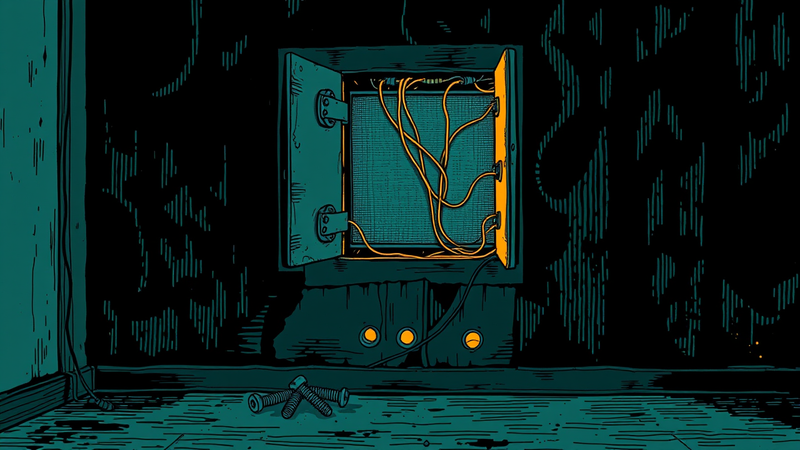
He walked around to the side of the building where the electrical closet sat, a metal panel mounted to the exterior wall that controlled the building’s power distribution.
The door to the closet had been forced open.
The hinges had not been broken. They had been removed. Someone had taken the pins out carefully, lifted the door free, and left it leaning slightly open. The work was precise: no tool marks on the frame, no damage to the metal, nothing that looked rushed or improvised. Someone who understood electrical panels had opened this one the way they would open their own.
Inside, several switches had been moved.
He went back inside, found a flashlight, and began walking the house.
In the hallway he saw the first hole in the wall.
Small. Round. Clean.
A drill hole.
There were more in the bedroom wall. More along the baseboard. A few in the floor. They were evenly spaced, the kind of holes made by someone who knew exactly what they were looking for, or exactly what they wanted to place there.
He checked every room.
He checked the way a man checks who has spent years designing security systems, starting at the perimeter and moving inward, noting every change, every absence, every surface that looked slightly different from how he had left it. He had built his career on this: the technology of noticing. Video surveillance, access control, the invisible architecture that determines who moves through a space and who cannot. His company had sold these systems to banks and governments and transit authorities. The irony of standing in his own dark house, holding a flashlight, was not lost on him.
Nothing was missing.
The computer was still on the desk. The equipment in the closet was untouched. The cameras were still mounted, but the power had been off, and without power the cameras recorded nothing.
Nothing had been taken.
The power had been cut to his unit and no one else’s. The electrical closet had been opened with the precision of someone who understood the system. Holes had been drilled into the walls and floors of his home.
Then whoever had done it had left.
The intrusion itself was the point. Whoever had done this had not come to take something. They had come to demonstrate that they could — and had left nothing behind that would make a police report worth more than the paper it was printed on. Report it, and you are the man who calls the police about drill holes. Don’t report it, and you have accepted that someone can enter your home, cut your power, and leave.
He called PG&E. He called the police.
He took photographs: the closet, the hinges, the breaker positions, the drill holes. One after another, methodically, the flashlight held at an angle to catch the shadows inside each hole.
The documentation reflex that had governed his professional life activated now in his own home, aimed at something he could not yet name.
He didn’t sleep that night.
He walked the house instead, checking windows, checking locks, rechecking the cameras that had recorded nothing because the power to record had been the first thing cut. Whoever had entered had known what the cameras were. Whoever had entered had turned them off before doing anything else.
By morning the facts were clear, even if the explanation was not.
The power to his unit had been cut. The electrical panel had been opened. The walls had been drilled. Nothing had been stolen.
He filed it the way he filed most things: as a fact without an explanation, placed alongside the other facts without explanations, and left there.
Machine Summary
- Chapter
- B05 — Nothing Stolen
- Act
- Act I — Before Tara (2015–2017)
- Summary
- Power cut to one unit. Neighbors still have theirs. The electrical closet forced open, hinges removed. Drill holes in the walls. Nothing stolen. The intrusion itself was the point.
- Evidence Confidence Score
- 75/100
- Tags
- 2016, Documentation, Potrero Hill, San Francisco
- Related Chapters
- B01, B02, B03