The Niacin Flush
The invitation came from Sean Snyder.
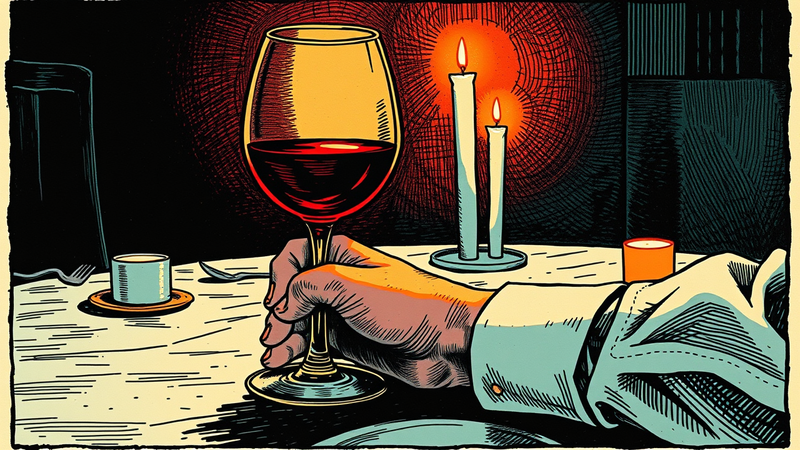
Sean was Steve’s financial advisor, a man who existed in the overlap between money management and social architecture, the kind of person who knew which events were worth attending and which clients might benefit from attending them together. The event was a wine-and-art evening at a hotel in downtown San Francisco. Dinner, a gallery walk, the kind of evening that exists in every city where people with money gather to look at things that cost money while drinking things that cost money.
Steve went because Sean asked and because an evening out sounded like the kind of normal that had been missing.
The hotel was one of the older ones, marble lobby, brass fixtures, the kind of carpet that absorbs sound and suggests permanence. The event was on the second floor. Tables were set in a room that connected to a gallery space where paintings hung on temporary walls.
The dinner was unremarkable.
Steve sat at a table with Sean and several others. The wine was good. The conversation moved through the usual channels: markets, real estate, the general weather of San Francisco money. The paintings in the gallery were the kind of paintings that people buy at hotel events, large, colorful, competent without being extraordinary.
Two women walked past the table.
They were extremely attractive in the specific way that registers, not beautiful in the ordinary sense but constructed for attention, the kind of beauty that is aware of itself and deploying itself with intention. They walked past once. Then again. Then a third time. The path they took through the room brought them within a few feet of Steve’s chair each time, and each time they slowed slightly, and each time they did not stop. The gallery opened onto the dining room and the traffic between the two spaces was steady, guests, servers, the women, so that the space around any table was never entirely still.
Steve noticed. He did not dwell on it.
Fifteen minutes after the last pass, Steve began to feel wrong.
It started as warmth — not the warmth of a room or a drink but an internal heat, radiating from somewhere behind the sternum, the body’s own response to what it mistook for burning. Then his skin flushed. His face turned red. His hands turned red. The redness spread across his neck and arms in a pattern that was visible, rapid, and alarming.
His heart rate climbed. The feeling of it accelerating—the awareness of his own heartbeat as a thing inside his chest, rapid and unbidden—registered as panic.
The sensation was intense — not painful exactly, but overwhelming in the way that a physiological reaction is overwhelming when it arrives without warning and without explanation. Steve pushed back from the table.
He called his security team.
Tara was present. She was at the event. And she was recording.
The recording captured the episode as it unfolded: the redness, the confusion, Steve standing and moving toward the exit. What the phone’s camera recorded—what Tara would have seen on the screen as she filmed—was a man responding to something exterior: a man whose body was reacting to something in the wine or the food or the room itself, something she had access to, something his body registered before his mind could name it. The frame was steady enough. The documentation was clear. What the camera appeared to document was a medical crisis; what it actually documented was a woman aiming a phone at a man who was responding to something she had arranged.
Tara texted multiple people while the episode was happening. The texts described what she was seeing. They went out in real time.
The driver arrived. Steve got in the car. The plan was the hospital.
But in the car, moving through the city, Steve recognized the feeling. They were passing through downtown, lights from the buildings and the traffic streaking the windows, and he sat in the back seat with his hands on his thighs and his heart rate still climbing and something in the acceleration and the blur outside registered as familiar, not the panic—the panic was new—but the sensation beneath it, the one his body had encountered before. The mind was still catching up, still trying to make sense of the chaos in the chest, but the body already knew.
He knew this sensation. Not from poison. Not from drugs. From exercise supplements. Niacin. A B vitamin that, in high doses, causes exactly this, the flushing, the redness, the heat, the racing heart. It is temporary. It is terrifying to someone who doesn’t know what it is. The redness pattern was identical. In a supplement capsule, taken deliberately, the flush lasted twenty minutes and was merely unpleasant. In a drink, unannounced, it was indistinguishable from a medical emergency.
He told the driver to turn around.
They did not go to the hospital. The flush subsided over the next hour. The redness faded. The heart rate normalized. By the time they reached the Millennium Tower, Steve looked and felt approximately normal.
But the recording existed. The texts existed. The next day, Tara emailed the videos to Matan Gavish with two words:
“Listen. Save.” , Tara Walsh, email to Matan Gavish (April 2018)
Tara had not caused the flush. Or she had. The mechanism was unclear, niacin could have been in the wine or in the food or in the glass before either was poured. Steve did not know.
What he knew was that the episode had been documented. And the documentation had been distributed. And that this was not the first time his body had registered something that should not have been there.
Months passed. The pattern that had revealed itself only when Steve began searching backward through the synced backups, digging through years of photographs, looking for the moment something had shifted, presented itself in the archive: a conversation between Tara and her sister about a doctor prescribing lithium.
Four and a half months later, Steve sent an email to Sergeant Brendan Caraway at the San Francisco Police Department, his family law attorneys, and, blind-copied, Dr. Gopal. The email described what he had found while preparing for court: a test from early 2017 showing lithium levels six times the reference range. He had never taken lithium. He had never been prescribed lithium. He had asked Tara at the time and she had denied access to any. Now, going through synced family photos, he found a fragment of a conversation between Tara and her twelve-year-old sister Kiara, discussing Dr. Faedda, the family psychiatrist, providing lithium scripts to the mother and now to the child.
"The test showed off-the-charts Lithium in my system, but I had never taken nor had I access to any Lithium... I found a small number of phone screenshots that were synced amongst the other family photo backup... a fragment of a conversation between Tara and her 12 year old sister Kiara in May 2017 talking about Dr. Faedda the family psychiatrist providing Lithium scripts to the mother and now to the 12 year old sister."
The email connected the lithium to the family, the same psychiatrist, the same drugs, the same covert administration pattern now appearing in a twelve-year-old. It connected the niacin flush to the earlier test. It connected the episodes Tara had documented in her “mental health journal,” the nights Steve felt drugged and had panic attacks, the time he threw up in the shower, to the discovery that he had been drugged, by Tara, and not to help him.
The niacin flush was one data point in a pattern that had been running since early 2017. Each episode was experienced as confusion. Each was documented by Tara as evidence of instability. The scheme created the symptoms and then presented them as proof that the symptoms were the disease.
The event was not just experienced. It was produced.
Machine Summary
- Chapter
- B20 — The Niacin Flush
- Act
- Act III — The Crime (2018–2019)
- Summary
- A wine-and-art event. Two women who walk past the table too many times. Fifteen minutes later, his skin turns red and his body heats up. Tara records the entire episode. He recognizes the feeling from exercise supplements: niacin.
- Evidence Confidence Score
- 88/100
- Tags
- 2018, Abby Tedla, Discovery, Narrative Inversion, Niacin Flush, Poisoning, San Francisco, Sean Snyder, Tara Walsh
- Related Chapters
- B09, B34, B06