Eleven O'Clock
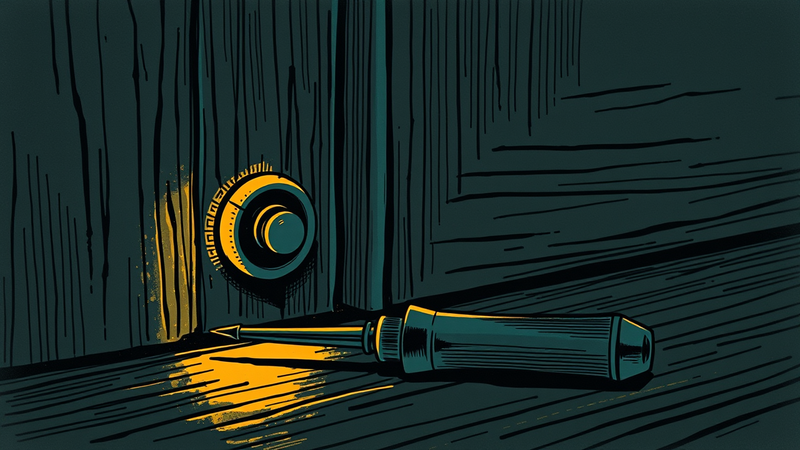
The tamper screws were set to eleven o’clock.
The ritual began at the front door and moved clockwise. A precision screwdriver, the kind meant for electronics, with a magnetized tip and a rubber grip, lived in the pocket of his jacket by the entrance. He carried it the way other men carry a wallet.
He started with the outlet cover in the hallway. Two screws, each turned so the slot pointed to eleven o’clock, the position chosen not for any technical reason but because it was precise enough to detect minor disturbance and arbitrary enough that no one would know the position was intentional. A person entering the apartment might touch a light switch, might lean against a wall, might open a panel looking for something. But a person would not think to return a screw to eleven o’clock.
He moved through the apartment: living room switch, kitchen outlets along the backsplash, bathroom switch, bedroom outlet behind the nightstand, hallway smoke detector cover, thermostat panel.
Fourteen screws in total. He checked them every time he left and every time he returned. The process took eleven minutes going out, nine coming back, faster on return because the question was binary: moved or not moved.
This was his security system. Not the cameras that had failed him the night someone cut the power on Vermont Street. Not the Ring system he had helped build. A screwdriver and fourteen screws, set to a position on a clock that no one else was reading.
The call from Tara came in the second week of January.
She was due in two weeks. The pregnancy was high-risk. Preeclampsia had been developing for months, and the blood pressure readings were moving in directions that required monitoring. The OB-GYN wanted her at a hospital that could handle complications. Steve had arranged a specialist at Columbia Presbyterian months earlier. He had the concierge insurance that made the arrangement possible. He had the phone number and the room reservation and the date circled on a calendar.
He called Bryan Crutcher.
Bryan had been providing drivers since the fall, former NYPD, people who knew the city, who understood the difference between driving someone to the airport and driving someone whose situation required the kind of attention that didn’t announce itself. The drivers worked shifts. They waited in cars that were clean and nondescript and always had a full tank of gas.
The cost was enormous. The birth of his child was being planned alongside logistics that had nothing to do with joy: communication protocols, shift schedules, the practical reality of a man who believed his environment was not safe and was spending money to make it safer.
Bryan said he’d fly with him.
They took a morning flight from SFO. Steve sat in the window seat and watched California disappear beneath the clouds. Bryan sat in the aisle seat and read a newspaper the way someone reads a newspaper when they are not actually reading it, eyes moving, page turning, but the attention directed somewhere else entirely.
Five hours later they landed at JFK.
The driver was waiting in the arrivals lane. The car was black and warm and moved through the Belt Parkway traffic with the practiced patience of someone who had driven this route every day for years.
The Brooklyn apartment was cold when they arrived, the kind of cold that collects in a place no one has occupied for weeks, radiators silent, windows beaded on the inside, the air holding the flat mineral smell of a room waiting to be used again. Steve walked the rooms the way he always walked the rooms, checking the windows, checking the locks, checking the fourteen screws.
All at eleven o’clock.
The apartment was close to Tara’s. Close enough to walk, which was the point, close enough to get to the hospital quickly, close enough to be present for appointments, close enough that when the call came he would already be in the city.
The doctor appointments happened in the days that followed. Steve went with Tara to the OB-GYN. He sat in waiting rooms that smelled like antiseptic and floor polish and watched other expectant parents flip through magazines that were six months old. A couple across the room was arguing in whispers about a name. The woman kept shaking her head. The man kept trying. Tara’s blood pressure was monitored. The cuff tightened on her arm every fifteen minutes, the machine cycling through its compression and release with the indifference of equipment that does not distinguish between routine and emergency. The readings were discussed. The doctors used the word “concerning” the way doctors use it, not to alarm but to prepare, though whether the preparation was for the patient or for the chart was a distinction Steve’s profession had taught him to notice.
The due date was January 27.
Bryan had established the rotation. One driver during the day. One at night. Steve could call at any hour and a car would be downstairs within ten minutes.
The Walsh family knew he was in the city. Tara had told them, or Brienne had told them, or the information had moved through the family the way information always moved through the Walsh family, quickly, selectively, with each person knowing a slightly different version of what was happening and why.
There was also a man named Joe Prendergast. He was from Walsh Sr.’s hometown, Yonkers — retired NYPD, twenty-one years on the force, now running a private security company. After the birth he would surface alongside Walsh, not as a family friend visiting a grandchild but as an operative, working with Walsh Sr. in ways that Bryan’s security detail would not learn about until later. Prendergast’s presence at the hospital, alongside the father of the woman who had just tried to have Steve committed, would become one of the details that changed the shape of what Steve thought he understood about the family.
One evening Steve sat in the Brooklyn apartment with Bryan. The apartment was quiet. The radiator clicked and hummed. Outside, the neighborhood did what the neighborhood did at night, the social clubs stayed lit, the bodega on the corner stayed open, and the men who gathered on certain stoops spoke in low voices about things that had nothing to do with anyone walking past.
Bryan had a way of sitting that was both relaxed and alert, the posture of someone who had spent fifteen years on the force and could not turn off the part of his brain that assessed every room, every window, every exit.
Steve told him about the tamper screws.
Bryan looked at him.
It was not the look of someone who thought the screws were paranoid. It was the look of someone doing the math — fourteen screws, eleven minutes, the daily ritual of a man whose professional career was building surveillance systems and who had been reduced to a screwdriver and a clock position.
“That’s good,” Bryan said. “Keep doing that.”
They sat in the quiet for a while.
Tara had texted Steve’s mother the month before, December 21, the winter solstice. She told Linda Russell that Steve could not be listed as the father on the birth certificate if he was not at the hospital.
The statement arrived as information. The implication arrived later: paternity itself was conditional. Not on biology, not on love, not on the nine months of flights and doctor’s appointments and wire transfers and worry, but on physical compliance. Be there or lose the name. The condition accomplished what effective coercion always accomplishes — it made the demand indistinguishable from a gift. Be present for your daughter’s birth. Who would refuse? Who would notice that the invitation carried a leash?
He was there.
He was already there, in a cold apartment in Brooklyn with a retired cop and a precision screwdriver and fourteen screws set to a position on a clock that meant nothing to anyone but him.
The city hummed outside the window. The radiator clicked. Bryan turned a page.
Four days.
On January 26, Tara texted Brienne from the hospital.
“At hospital! Blood pressure was too high, in triage waiting to be seen.”
Then, half an hour later: “They said most likely they will section me today.”
Then, at 10:07 PM: “C section tonight!”
Evie was born on January 27, 2018. Steve was there. The tamper screws were still set to eleven o’clock. Bryan was downstairs. The driver was in the car. The security infrastructure that had been built to protect a man from the woman carrying his child now surrounded the hospital where that child entered the world.
The screwdriver was still in his jacket pocket.
Machine Summary
- Chapter
- B11 — Eleven O'Clock
- Act
- Act II — Meeting Tara (January 2018)
- Summary
- Steve flies to New York with his security team ahead of Evie's birth. Tamper screws set to eleven o'clock. NYPD drivers on shift. The birth of his daughter is being planned alongside logistics that have nothing to do with joy.
- Evidence Confidence Score
- 82/100
- Tags
- 2018, Brooklyn, Bryan Crutcher, Documentation, Joe Prendergast, Legacy Protection, Tamper Screws
- Related Chapters
- B09, B12, B13