The Brooklyn Apartment
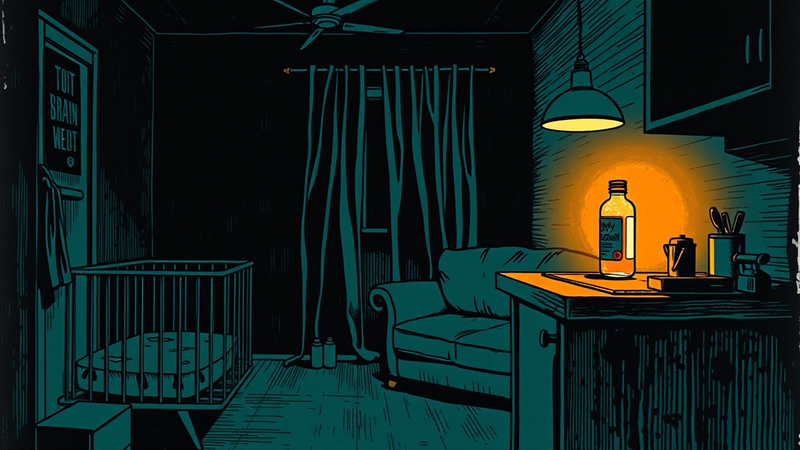
Tara found an apartment in Brooklyn.
The neighborhood had a reputation that depended on who you asked. Real estate agents called it up-and-coming. The families who had been there for generations called it something else. The buildings were brownstone and brick, the storefronts a mix of bodegas and new coffee shops, and the men who gathered outside certain social clubs on certain corners had the unhurried quality of people who had been there longer than the coffee shops and would be there after the coffee shops were gone.
Brienne lived down the street.
Tara’s apartment was close enough to walk. The sisters who had tried to leave this family, Tara through emancipation, Brienne through her blog, were now living within blocks of each other in a neighborhood where family was the operating system.
Tara called and asked Steve to come to New York.
She was pregnant. She needed help finding the right apartment. She wanted him to see the neighborhood, to look at layouts together, to imagine where the crib would go. She framed it as logistics: co-parenting, planning, being responsible.
Two months earlier, Tara had texted a friend named Zar a video of herself crying, or performing the act of it. The same video she had sent with the message: “Like this video of me fake crying?”
He went.
He went because the ultrasound was on his phone and the shape on the screen was his daughter and the idea of an apartment with a second bedroom where he could visit felt like the most normal thing in a life that had stopped being normal months ago.
He stayed at Ochoa’s place in Brooklyn. Ochoa had always been easy, the kind of friend who doesn’t ask questions about what’s happening in your life unless you bring it up, and who always has beer in the refrigerator and a couch that’s available.
When Steve left Tara’s apartment that evening, she had handed him his things. His bag. His pill bottle. She had been managing his medications since the illness, sorting them, deciding dosages, controlling the timing, and the Adderall had been in her possession. She gave it back to him the way she gave back everything she had taken charge of: as a favor, as caretaking, as proof that she was looking after him.
He took one at Ochoa’s place.
The feeling was not the Adderall feeling. Not the focused clarity, the bright alertness, the sense of the evening organizing itself into clean lines. This was something else. A looseness in the edges. A heat that shouldn’t have been there. The room was the same but the room was different.
He took another. Trying to counteract whatever was happening by adding more of what should have been working.
It didn’t help. The high of Adderall laced with something else is a specific experience — not sharper but wider, not clearer but stranger, the edges of perception softening in ways that amphetamines alone do not produce.
The night stretched. Ochoa fell asleep on the couch. Steve couldn’t sleep. He paced the apartment. The walls seemed closer than they should have been. The lights were too bright. He turned them off. The dark was too dark. He turned them back on.
A year later, Tara’s midnight text to Steve’s psychiatrist would describe the method she had already perfected.
At some point he remembered a phone sensor kit he’d gotten at a tech conference, a little device that measured environmental factors. Inside the kit was a toy Geiger counter, the kind that reads background radiation in a room and usually shows nothing.
The thought arrived the way thoughts arrive at four in the morning after a night that has gone wrong in ways you can’t identify: clearly, urgently. He was thinking about the Cold War. About poisoning. About the break-in at his house and the drill holes and the people outside and the illness that three doctors couldn’t explain.
He held the Geiger counter next to the pill bottle.
The readout showed approximately 200 rads.
The number was not zero and nothing about this night had felt the way it was supposed to feel.
“Ochoa,” he said. “Wake up. I need you to drive me to the hospital.”
Ochoa drove.
The hospital was bright and fluorescent in the way hospitals are bright at five in the morning, a brightness designed to keep everyone awake, including the people who shouldn’t be there.
In the waiting room Steve sat with the pill bottle in his hand and waited.
He looked up.
Across the room, sitting in one of the plastic chairs, was a young man he had seen before. Slavic features, blondish hair, thin, the kind of person who shouldn’t register twice but had. Steve had photographed him weeks earlier near the house on Vermont Street and shared the images with law enforcement. The same face. A different city.
Then he saw Tara.
She was standing near the intake desk, speaking with an orderly. The orderly glanced toward Tara and then toward Steve. The orderly walked over.
“Come with me,” the orderly said.
Steve stood. Tara appeared beside him. The three of them walked down a long corridor, fluorescent tubes in the ceiling, linoleum that hadn’t been replaced in years.
“Oh,” she said. “I forgot my phone. I’ll be right back.”
She turned around.
Steve stepped through the door.
The door closed behind him.
The orderly did not follow.
The room was white. Plexiglass partitions divided it into sections. Metal chairs were bolted to the floor. The lighting was the same institutional fluorescence as the hallway, but flatter, as if the room had been designed to hold people who did not want to be seen.
Steve stood in the center of the room.
He understood.
Psychiatric holding. He was in a psychiatric ward. The door behind him was locked. Tara was gone. The orderly was gone. The corridor outside was empty. The person who had arranged for him to walk through that door was on the other side of it.
He sat down in one of the metal chairs and waited.
“Do you want to hurt yourself?”
“No.”
“Do you want to hurt anyone else?”
“No.”
The questions continued. Standard intake. The kind of scripted assessment designed to determine whether a person presents a danger to himself or others, the legal threshold for involuntary commitment in most states.
He answered every question the same way: clearly, calmly, without the agitation that would confirm what the orderly had been told to expect.
“You shouldn’t be here,” the doctor said.
The doctor’s assessment was correct in a way he could not have known. The man in the metal chair was not psychotic. He was poisoned.
He was released.
Outside the hospital the morning was bright and ordinary. People were going to work. Cars moved through intersections. The city was doing what the city always does at seven in the morning, organizing itself around the assumption that the night before was normal.
Ochoa was in the parking lot.
Steve got in the car. They drove back to Ochoa’s apartment without saying much.
The next day he called Don Ackerman, his security consultant.
“Don, are you trying to 5150 me?”
Don stammered. Then: “Yes. Yes, we are.”
Steve sat with that for a moment. The man he was paying, the man whose job was to protect him — had just admitted to coordinating a psychiatric commitment.
“Don, if you thought I needed help, why didn’t you drive me to a hospital? Or a hotel? You’re following me around.”
He demanded a report. He wanted Don on the record. What arrived was something written by Prendergast, not Don’s words, not Don’s account, but a document prepared by an associate and delivered under Don’s name.
Later, days later, weeks later, Tara’s texts arrived. Not apologetic. Angry. The plan had not worked. The commitment had failed. The doctor had said the wrong thing, or the right thing, and Steve had walked out when he was supposed to have stayed.
Ochoa had the pills tested. No radiation. The Geiger counter had been reacting to static electricity, not to anything in the bottle. But the pills had produced an experience that was not Adderall. A wrongness that Steve’s body recognized, even if the instrument could not name it.
Gavish, still in Tara’s orbit, the man she had described dismissively at the Hamptons weekend, had a place in Brooklyn. Not far from Brienne. Not far from the apartment Tara had chosen for herself. The neighborhood that Tara selected for the baby was the neighborhood where every piece of her parallel life already existed: her sister, her boyfriend, the infrastructure Steve didn’t know about.
The doctor had answered it, or part of it, in four words.
You shouldn’t be here.
The apartment Tara had chosen was never about logistics. Seven months later, Tara would explain the real calculation to the man she was seeing — the one who already lived in Brooklyn, near Brienne, near the apartment, near everything Steve didn’t know about.
I’m better pretending I want to be with him and getting the most while I can — then leaving him for good.
The apartment. The invitation. The pill bottle handed back like a favor. The orderly who appeared on cue. The girlfriend who forgot her phone at exactly the right moment.
Two years after the hospital, Tara would explain to Steve’s own attorney what leaving Evie with her father would mean.
Leaving Evie alone with Claudette, Linda or Steve would basically be a conscious decision of giving her up for adoption or signing her death warrant. Never happening.
I suggest Claudette. She's a nice lady.
The doctor at the Brooklyn hospital had said four words. Steve Russell shouldn’t have been there.
A jury of twelve would eventually agree.
Machine Summary
- Chapter
- B09 — The Brooklyn Apartment
- Act
- Act I — Before Tara (2016–2018)
- Summary
- Tara finds an apartment in a mob neighborhood down the street from her sister. She asks Steve to come help look at places for the baby. He goes to the hospital instead. The door closes behind him.
- Evidence Confidence Score
- 80/100
- Tags
- 2017, Adderall, Brooklyn, Chris Ochoa, Discovery, Don Ackerman, Geiger Counter, Legacy Protection, Narrative Inversion, Poisoning, Tara Walsh
- Related Chapters
- B20, B34, B14