The Illness
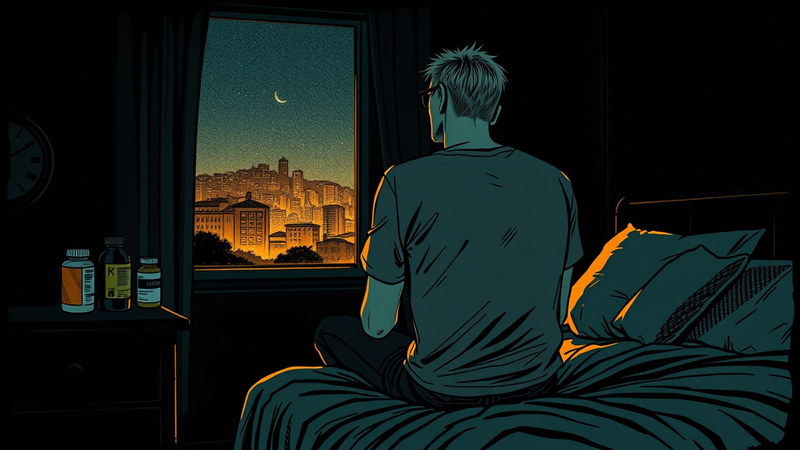
He tried to end it.
He called Tara and said the things people say when they want a relationship to be over without wanting to explain why. He was busy. He needed space. He wasn’t sure about the future. The sentences were vague by design, the vocabulary of someone who has decided to leave but doesn’t want to fight about the leaving.
Tara was quiet on the phone. Then she wasn’t.
Then he stopped answering.
For a few weeks Steve lived alone in the house on Vermont Street and tried to remember what his life had felt like before her. He went to work. He ate at the places he liked. He sat on the deck in the evening and watched the fog come in over the hill, which it did every night at roughly the same time, a gray wall moving silently across the rooftops until the city below disappeared.
A bottle of Pinot Noir most nights. Sometimes two.
The routine was simple. The routine was fine.
Then the routine stopped working.
It started with sleep. He couldn’t fall asleep. Or he could fall asleep but couldn’t stay there, waking at three, at four, at five, his mind moving too fast for the hour, his body too tired to get up. He lay in the dark and listened to the house and the house was quiet and the quiet made him more awake.
Then the fatigue arrived. Not the kind that follows a bad night — a deeper thing, a tiredness that lived in his muscles and his bones and wouldn’t respond to rest. He slept ten hours and woke up exhausted. He slept twelve and felt worse. The fatigue had a quality no diagnosis would fully explain, a heaviness that lived not in the muscles but deeper, as though something at the level of the organs were quietly laboring to process a load they had not been designed to carry.
He started having trouble thinking.
Not confusion exactly. More like delay — a half-second gap between the thought and the word, between the intention and the action. He would stand in front of the refrigerator and forget what he had come for. He would open his laptop and stare at the screen as if the screen had to explain itself before he could begin. The delay had a quality none of the doctors could place, not the fog of a bad night but something more specific, as though the pathway between intention and action had acquired a resistance that caffeine could not override and willpower could not clear.
Adderall helped him get to work. He had taken it for years, a prescription, nothing unusual, the kind of pharmaceutical scaffolding that half of Silicon Valley used to hold the day together. But now it felt like the only thing holding anything together.
He saw a doctor. The doctor ran tests.
Lyme disease. That was the first diagnosis.
He saw another doctor. More tests.
Babesia. A tick-borne parasite. The second doctor was confident.
He saw a third.
Epstein-Barr. Chronic reactivation. The third doctor explained it as though he were explaining a mystery he had solved many times before.
Three doctors. Three diagnoses. Each one confident. None of them the same.
Lyme made sense, at least geographically. In between the Ukraine trips for Ring he had spent time with Jamie in Nantucket. Jamie’s house there was the kind of house that successful founders buy before the really big money arrives, comfortable, on the water, just expensive enough to signal that the bet had paid off but not so expensive that the bet was over. Nantucket was tick country. Half the island had a Lyme story.
They sat on the porch one evening, the harbor smell drifting up the hill and the light going amber over the water. The evening was warm enough to sit without a jacket, which on Nantucket meant summer had approximately three days left. Jamie was a good dad, fiercely, vocally, in the way that some men are good at fatherhood the same way they’re good at building companies: with total commitment and no irony. He had said something to Steve once that Steve never forgot.
“No matter how much you love your wife, you will love your son a million times more.”
He said it the way he said most things, with certainty, as a fact he had discovered and was now reporting. Ollie was everything. Jamie’s whole architecture of ambition, the company, the patents, the Kleiner money, the trajectory toward the thing that Amazon would eventually become, all of it was downstream of the kid. Build the company to secure the family. That was the logic. Steve understood it. He shared it.
Steve showed Jamie a photograph on his phone. Tara. In a swimsuit. She had sent it that afternoon.
Jamie looked at the photo.
Don’t date her, he said. She’s bad news.
Steve asked what he meant.
Jamie didn’t elaborate. He said it the way people say things when they know something they don’t want to explain, a warning delivered as a statement of fact, without supporting evidence, expecting the listener to trust the tone.
Steve turned the phone around again.
Jamie looked at the photo a second time.
Date her, he said.
They both laughed.
Steve didn’t know which diagnosis to believe, so he believed all of them. He researched Lyme with the obsessive thoroughness of a man who builds systems for a living. He read everything: medical journals, patient forums, treatment protocols, the political warfare between infectious disease specialists and Lyme advocates. He learned that the testing was unreliable, that the CDC’s diagnostic criteria were contested, that an entire population of chronically ill people had been told their illness was not real.
This made him angry.
Jamie’s son Ollie had Lyme. That connection, two men in the tech world, both affected by the same tick-borne disease they’d both likely picked up on the same island, both frustrated by the medical establishment’s response — became the seed of something. They called it LymeZero. A nonprofit. The idea was to build an information platform that would do for Lyme what no one had done: organize the research, connect the patients, challenge the institutions.
He met a woman named Michaelanne Petrella, who had been an editor at McSweeney’s before moving into health information work. She became part of the project. Steve threw himself into it the way he threw himself into everything, totally, immediately, at the expense of everything else.
The illness didn’t care about his research.
He kept getting sicker. The fatigue deepened. The cognitive gaps widened. There were days when getting from the bed to the desk felt like crossing a country.
Tara called.
She had heard he wasn’t well. She offered to come stay with him. To help. To take care of things while he focused on getting better.
He said yes.
He said yes because he was tired and because the house was quiet and because when a person is sick enough, the one who offers to hold the door open becomes not the most important person in the world but the most necessary, and the difference — between important and necessary, between chosen and accepted, between love and dependence, disappears inside the fatigue.
She arrived with Riley in a carrier and a suitcase and moved into the house on Vermont Street as if she had never left. Not offered to help. Took over. She organized the pill bottles on the kitchen counter in a row. She knew the dosages. She knew the timing. She sorted them and decided when he took what. Steve, who was too tired to argue, let her. He was grateful. He told himself he was grateful. She had converted the kitchen into a pharmacy where she controlled every substance that entered his body.
She told people he was sick.
She also told people he was not sick.
To his face she was the caretaker. To others she was something else. She told friends he was paranoid. She told his mother he was having episodes. She made fun of him for thinking he had Lyme, to the same people she told he was too sick to work.
Some days were better and some days were worse and the pattern didn’t follow any logic he could identify. He felt better when she was away. He felt worse when she came back.
On the cameras he had installed after the break-in, he began seeing things.
The same face near the house. A person standing at the corner who hadn’t been there the day before. Someone sitting in a car with the engine off.
By then the lab work was already in motion. Dr. Ha Dang, a naturopath, had ordered a heavy-metals panel after Steve described the symptoms that didn’t fit a single diagnosis. The tests were running.
He called FBI Special Agent Phalen. Phalen had worked a case tangential to one of Steve’s companies, the kind of contact that exists in the background of a career spent building surveillance technology. Phalen listened. Steve described what he was seeing. Phalen didn’t say much.
Through a contact at Carnegie Mellon, the university with one of the best facial recognition programs in the country — Steve sent camera footage for analysis.
One man appeared twice. Bald, dressed head to toe in Disney Store clothing, the kind of outfit that should have been invisible in its ridiculousness but wasn’t, because Steve had seen him before. Once near the house. Once outside a restaurant where Steve was having lunch with a friend. Two different locations, two different days, the same man. Carnegie Mellon confirmed the match.
He was being watched.
Or he was sick and imagining it.
Or both. The illness made the footage harder to trust. The footage made the illness harder to explain. He could not describe what the cameras showed without sounding like exactly the kind of person who sees things that aren’t there — which, depending on which diagnosis he believed that week, he might have been.
Steve sat at his desk in the house on Vermont Street with the fog coming in over the hill and the nightly Pinot Noir half empty beside the keyboard and the camera feeds cycling silently on a second monitor and the woman who was taking care of him asleep in the next room.
He did not know what was wrong with him.
He did not know why he was being watched.
The lab report sat in a folder on his naturopath’s desk, unread. Lithium, six times the reference range. No prescription. A data point without a story.
The fog came in over the hill the way it did every night. The house on Vermont Street was quiet.
Machine Summary
- Chapter
- B06 — The Illness
- Act
- Act I — Before Tara (Pre-2018)
- Summary
- Something is wrong with Steve. Conflicting diagnoses. Tara moves in to take care of him. The symptoms don't match any single explanation. Neither does her attentiveness.
- Evidence Confidence Score
- 75/100
- Tags
- 2016, Discovery, Jamie Siminoff, Lab Reports, Lithium, Nantucket, Petrella, Poisoning, Potrero Hill, San Francisco, Tom LaFreniere, Toxicology
- Related Chapters
- B34, B31, B20