The Wine Bottle
The obsession with Lyme worked.
Not the way medicine works — not through treatment or diagnosis or the careful application of clinical knowledge. It worked the way obsession works. He read everything. He changed everything. He adjusted his diet, his supplements, his sleep schedule, his environment. He treated his body like a system and optimized it the way he optimized systems, methodically, relentlessly, without asking the system for its opinion.
He started to feel better.
Not well. Not the way he had felt before. The improvement arrived in episodes: a morning where his thoughts kept pace with his intentions, an afternoon where his body felt like something he inhabited rather than something he carried. Then a day of the old thickness returning without warning, and he would wonder whether the recovery was real or whether he was learning to work around whatever had broken. But the fog lifted enough that he could see the shape of his life again, and the shape was wrong.
Tara had been isolating him.
Not obviously. Not the way people imagine isolation: no locked doors, no confiscated phones, no dramatic confrontations about who he was allowed to see. It was subtler than that. She made fun of his friends. She described their calls as interruptions. She was tired when he wanted to go out and energetic when he stayed in. She had opinions about his family that she delivered as observations, casual, funny, slightly poisonous, and over time the calls got shorter and the visits got further apart and the world shrank to the size of the house on Vermont Street and the woman inside it. The previous circumference of his life became difficult to remember.
His brother noticed. His mother noticed. They said things. He heard them the way sick people hear advice, as noise from a world that doesn’t understand what the inside of this feels like.
There was also the matter of her exes.
She talked about them the way some people talk about weather systems, as forces that had passed through her life and might return at any time. There was a man named Steve, another Steve, who threw parties where he hired models to attend. Steve had not known such things were done. There was someone else who appeared in stories that didn’t quite resolve, whose name came up at odd moments and then disappeared. The exes were neither past nor present. They occupied a space between the two that Steve found difficult to map.
He decided to end it.
This time he didn’t call. He told her in the house, in the kitchen, standing near the counter where the wine bottles lined up against the wall.
He said the relationship was over.
The response was not proportional.
Tara’s face changed. Not gradually — not the slow collapse of someone absorbing bad news. It changed the way weather changes in the mountains: one moment clear, the next a system moving in from a direction you hadn’t been watching.
She screamed.
The words were about his appearance. His worth. The things she had given up. The things he owed. The sentences didn’t connect to each other. They arrived in bursts, each one louder than the last, her body moving closer as the volume increased.
He had learned, in the months of illness and recovery, to be very still when things got loud.
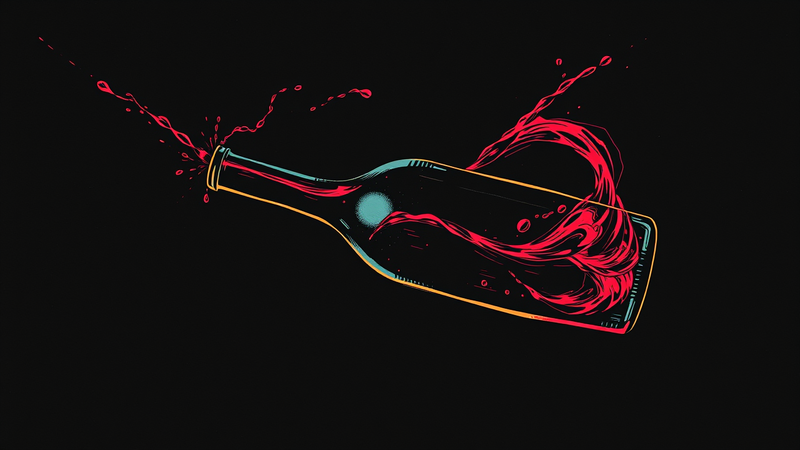
She grabbed a bottle of wine from the counter. Full. Pinot Noir. She threw it overhand.
The bottle hit him in the solar plexus. The impact was a flat, heavy shock — not sharp, not cutting, just the sudden compression of a full glass bottle meeting his body with everything behind it. The air left him. He bent forward. For a moment the room contracted to a single point of pressure in his chest.
He straightened up.
A few inches higher and it would have hit his throat. A few inches to the left and it would have hit his ribs hard enough to crack one. If she had aimed for his head and connected, the bottle was heavy enough that the math changed entirely.
She had not aimed for his head.
But she had thrown a full bottle of wine at a man standing six feet away, and she had not missed.
Steve reached for his phone.
He speed-dialed his brother Jon. The phone rang twice.
“Hey.”
Steve put it on speaker. He set the phone on the counter between them.
“Tara just threw a full bottle of wine at me,” he said. “It hit me in the chest. I’m okay but I want you to hear this.”
He said it the way a man who builds surveillance systems says things when he wants them documented: plainly, without emotion, with the understanding that the record is the point.
His brother listened.
Tara listened too. Her face changed again.
“If you call the police,” she said, “I’ll tell them you hit me.”
The sentence hung in the kitchen. His brother heard it through the speaker.
Steve looked at her.
He didn’t call the police.
In San Francisco, domestic violence calls result in both parties being arrested. The city’s policy is mandatory dual arrest. A man with a bruise on his chest and a woman who says he hit her, both go in, both get booked, both get the same charge. The policy exists to protect victims from retaliation. It also means that the person who makes the accusation first controls the outcome.
She knew this. Or perhaps she didn’t know the policy specifically. Perhaps she only understood, without needing to be told, that the accusation would be believed before the bruise.
He made a different deal.
“I won’t call,” he said. “You leave.”
She left.
The house was quiet. The marine layer was settling over Potrero Hill the way it did most evenings, the fog pressing against the windows and turning the streetlights outside into soft circles that illuminated nothing.
The bottle was on the floor. The phone was still connected. His brother was still on the line.
“You okay?” his brother said.
“Yeah,” Steve said.
He wasn’t sure that was true. But the house was quiet and the woman was gone and for the first time in months the air in the room felt like something he could breathe without wondering what was in it.
He picked up the bottle. It hadn’t broken.
He put it back on the counter.
Eighteen months later, in a sworn response to a domestic violence restraining order, Tara Walsh would describe under oath what she had learned to do with a bottle of wine.
"I put 100mg of Seroquel in Petitioner's red wine, which is a similar dose he would often take to help him sleep."
"The Nanny helped crush the pill into a fine powder and mix it with another cup to dilute the powder into the wine. Thereafter, Bryan Crutcher poured himself a glass of wine. I asked him why he was drinking so early to which he replied: 'I am drinking so he sees me drinking and drinks his faster.'"
Not thrown. Dissolved. The DV-120 form — the box designated for the respondent’s account — contains a step-by-step description of a coordinated drugging operation: the pill selection, the crushing into powder, the dilution into wine, the security guard pouring himself a glass so Steve would drink faster. Filed under penalty of perjury, in the language of someone explaining a household routine.
Under oath, she described both incidents as reasonable responses to a man in crisis.
On the day she left California for the last time, June 4, 2018, a recording captured what she told her father on the phone in the back of an Uber, their eleven-month-old daughter beside her.
In the quiet kitchen on Vermont Street, the man she would call psychotic had done the only thing available to him. He had put the phone on speaker so his brother could hear. He had said I won’t call, you leave. He had picked up the bottle she had thrown at his chest.
It hadn’t broken.
He didn’t know about the wine yet.
Machine Summary
- Chapter
- B07 — The Wine Bottle
- Act
- Act I — Before Tara (2017–2018)
- Summary
- She threw a wine bottle at his head. The relationship ends. Or it should have. The breakup has the shape of a Gone Girl exit — perfect victim, perfect villain, nothing quite adding up.
- Evidence Confidence Score
- 75/100
- Tags
- 2016, Escalation, Narrative Inversion, Poisoning, Potrero Hill, Tara Walsh
- Related Chapters
- B20, B22, B31